

Teachers’ Day usually makes us think of the people who taught us in classrooms, lecture halls, laboratories, and examination rooms. But somewhere between the resuscitation bay, the crowded triage area, the nursing station and the next patient waiting to be seen, I often wonder:
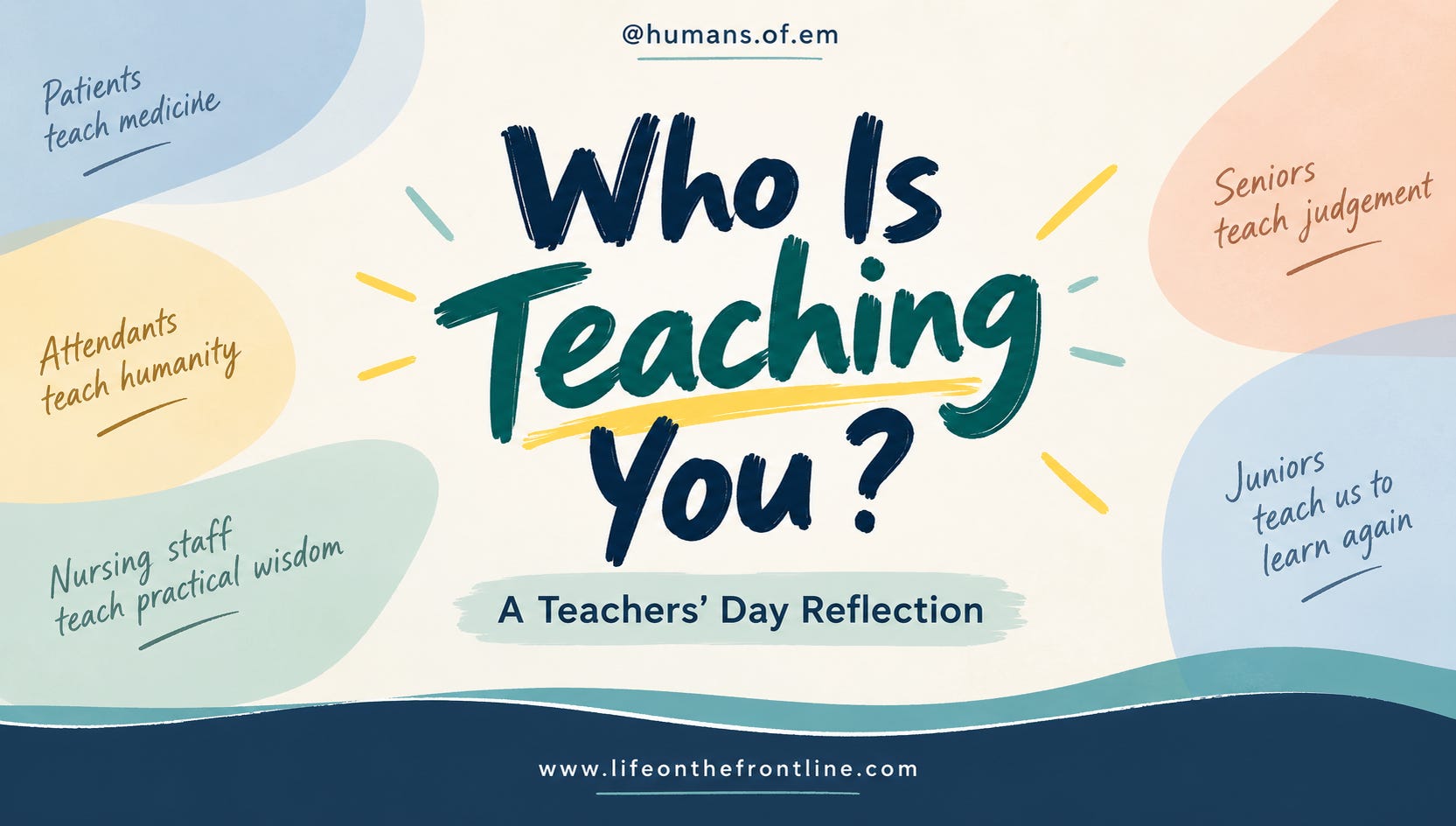
Who are our teachers ?
The answer is rarely just our seniors. In fact, if we pay enough attention, the Emergency Department may be one of the largest classrooms we will ever enter.
And almost everyone in it is teaching us something.
The Patient
The patient is often our first teacher. Not every patient presents like a textbook.
Sometimes the history is incomplete. Sometimes the examination finding is subtle. Sometimes the diagnosis we initially considered doesn’t quite fit. And sometimes, the patient teaches us simply by reminding us that the person in front of us is more complicated than the label we are trying to assign. Every patient adds another piece to our clinical experience. The more patients we see, the more patterns we recognise.
But importantly, the more we should also realise that not every patient follows the pattern. That is where learning happens.
The Attendant
Then there is the patient’s attendant. They may arrive frightened, angry, confused, impatient or overwhelmed. They may ask the same question repeatedly.
“Is he going to be okay?”
“Why is this taking so long?”
“Can you please tell me what is happening?”
These interactions teach something that no clinical guideline can fully teach:
Communication under pressure.
Emergency medicine is not only about identifying illness and treating it. It is also about explaining uncertainty. About setting expectations. About listening when you are busy. About remembering that for the family sitting across from you, this may be one of the most frightening days of their lives.
Sometimes, the attendant teaches us to be better doctors by forcing us to become better humans.
The Nursing Team
There are lessons that are difficult to learn from books. How to recognise that something is changing before the numbers become alarming. How to prioritise when three things happen simultaneously. How to prepare for the next deterioration while managing the current one. How a small practical adjustment can make a major difference during a resuscitation.
Our nursing colleagues accumulate an enormous amount of practical wisdom through experience. If we are willing to listen, they teach us every day.
Clinical expertise in the ED is a team sport. And good teams learn from each other.
The Seniors
Our seniors teach us in obvious and less obvious ways. They teach us how to approach uncertainty. How to make decisions with incomplete information. How to remain calm when everyone around us is becoming anxious. Sometimes they teach us through a carefully chosen question. Sometimes through a difficult case discussion.
Sometimes simply through watching how they behave when things don’t go according to plan. And occasionally, the most valuable teaching moment comes from hearing:
“Why did you choose this?”
Not because the answer is necessarily wrong. But because being asked to explain our reasoning forces us to examine it.
And Then Come the Juniors
Perhaps the most unexpected teachers in the Emergency Department are the people we are supposed to be teaching.
Our juniors.
Their questions can be remarkably powerful.
“Why are we doing it this way?”
“Could this be something else?”
“What happens if we don’t do this?”
“Is that really the best evidence?”
And occasionally:
“But why?”
That last question can be dangerous. Because sometimes we realise we don’t actually remember. Not because we are incompetent. Not because we have forgotten medicine. But because medicine is vast, and clinical practice is busy. Knowledge that was once clear can become rusty.
A junior’s question can expose that gap. And suddenly, the teacher becomes the student again. You go back to the textbook. You search the literature. You revisit the guideline.
You reconsider something you have been doing almost automatically.
And you learn. Perhaps this is one of the greatest gifts juniors give their seniors. They make us uncomfortable enough to keep learning.
A Classroom
Maybe we have misunderstood what teaching looks like. Teaching isn’t always a lecture. It isn’t always a PowerPoint. It isn’t always a journal club or a grand-round presentation.
Sometimes teaching is:
A patient’s unusual presentation.
An attendant’s difficult question.
A nurse’s practical suggestion.
A senior’s challenging question.
A junior’s seemingly simple doubt.
And sometimes, teaching is the mistake we almost made—but caught because someone asked the right question at the right time.
For me, The Emergency Department is constantly generating these moments. We just have to notice them.
A Pulse Check for Teachers’ Day
So, on this Teachers’ Day, perhaps the question isn’t:
“Who was your favourite teacher?”
Perhaps the more useful question for those of us working in Emergency Medicine is:
“Who taught you something today?”
And an even harder one:
“When was the last time a junior taught you something?”
If you can’t remember, perhaps that’s worth reflecting on. Because being senior does not mean we have finished learning. And being a teacher does not mean we stop being students. In Emergency Medicine, the roles constantly change.
Today I teach.
Tomorrow I learn.
Sometimes, I do both in the same resuscitation bay.
That may be one of the most beautiful things about our specialty.
This Teachers’ Day
To the patients who challenged our clinical thinking.
To the attendants who taught us empathy.
To the nursing teams who taught us the practical art of emergency care.
To the seniors who shaped our judgement.
And to the juniors whose questions make us open the books again—
Thank you.
You may not always realise that you are teaching us. But you are. And perhaps the best teachers are not the ones who give us all the answers. They are the ones who make us ask better questions.
Pulse Check
Who has been your unexpected teacher in the Emergency Department?
A patient?
A nurse?
A senior?
A junior?
Tell me about one lesson you learned from someone you weren’t expecting to learn from.
Life on the Frontline is a space for reflections on Emergency Medicine, medical education, clinical practice and the people behind the work.
Happy Teachers’ Day.