

By-
Dr Arihant Jain, MD | lifeonthefrontline.com
Instagram: @humans.of.em
X | Linkedin | ORCID
————————————————————————
We have become very good at giving antibiotics early. Perhaps less good at knowing exactly why we are giving them. That is not necessarily a failure of clinical practice. It is, in many ways, an unavoidable consequence of emergency medicine.

The patient arrives hypotensive, tachypneic, febrile, confused, or simply “looks septic.” Microbiology is unavailable. Definitive imaging may still be pending. The emergency department is designed around action under uncertainty.
So we do what we are taught to do:
Recognize sepsis.
Resuscitate.
Give antibiotics early.
But there is a paradox embedded within this approach.
The moment when we need to make the antibiotic decision fastest is often the moment when we know the least about the diagnosis.
Diagnostic uncertainty can drive broad-spectrum empiricism, while antibiotics started during the initial resuscitation phase may continue even when subsequent information reduces the likelihood of bacterial infection (Tamma et al., 2011; Schoffelen et al., 2024).
This raises a different question about antimicrobial stewardship in the emergency department:
What if the problem isn’t simply how quickly we give antibiotics—but how quickly we can improve the certainty behind that decision?
And what if one of the tools for doing that is already in our hands?
POCUS.

The POCUS we use today is not necessarily the POCUS we need tomorrow
Point-of-care ultrasound has become deeply embedded in emergency medicine.
We use it to assess shock.
To evaluate dyspnea.
To identify pneumothorax.
To assess cardiac function.
To guide procedures.
But most of these applications are framed around diagnosis, resuscitation, or procedural safety.
Antimicrobial stewardship is rarely the stated endpoint.
Yet multiorgan POCUS can potentially do something highly relevant to stewardship:
It can change the information available at the moment the antibiotic decision is being made.
The literature increasingly suggests that bedside ultrasound can identify infectious sources, recognize non-infectious mimics of sepsis, and facilitate source-control procedures (Perera et al., 2010; Cortellaro et al., 2017; Verras et al., 2023).
That led me to a simple question:
Could POCUS itself become part of an antimicrobial stewardship pathway in the first hour of emergency care?
Not as an antibiotic “rule-out” test. Not as a replacement for microbiology. Not as another acronym to memorize. But as a structured diagnostic intervention that changes the pathway from uncertainty toward specificity.
From “Does this patient have sepsis?” to “Where is the problem?”
One of the biggest problems with the early sepsis phenotype is that it is nonspecific.
Hypotension.
Tachycardia.
Tachypnea.
Altered mentation.
Elevated lactate.
These findings tell us that something is wrong.
They do not necessarily tell us what is wrong.
This is where POCUS can contribute to what we might call diagnostic stewardship.
Instead of stopping at:
“Possible sepsis.”
we can begin asking:
“Is there a probable anatomical source?”
That is a fundamentally different question.
And it can be surprisingly actionable.
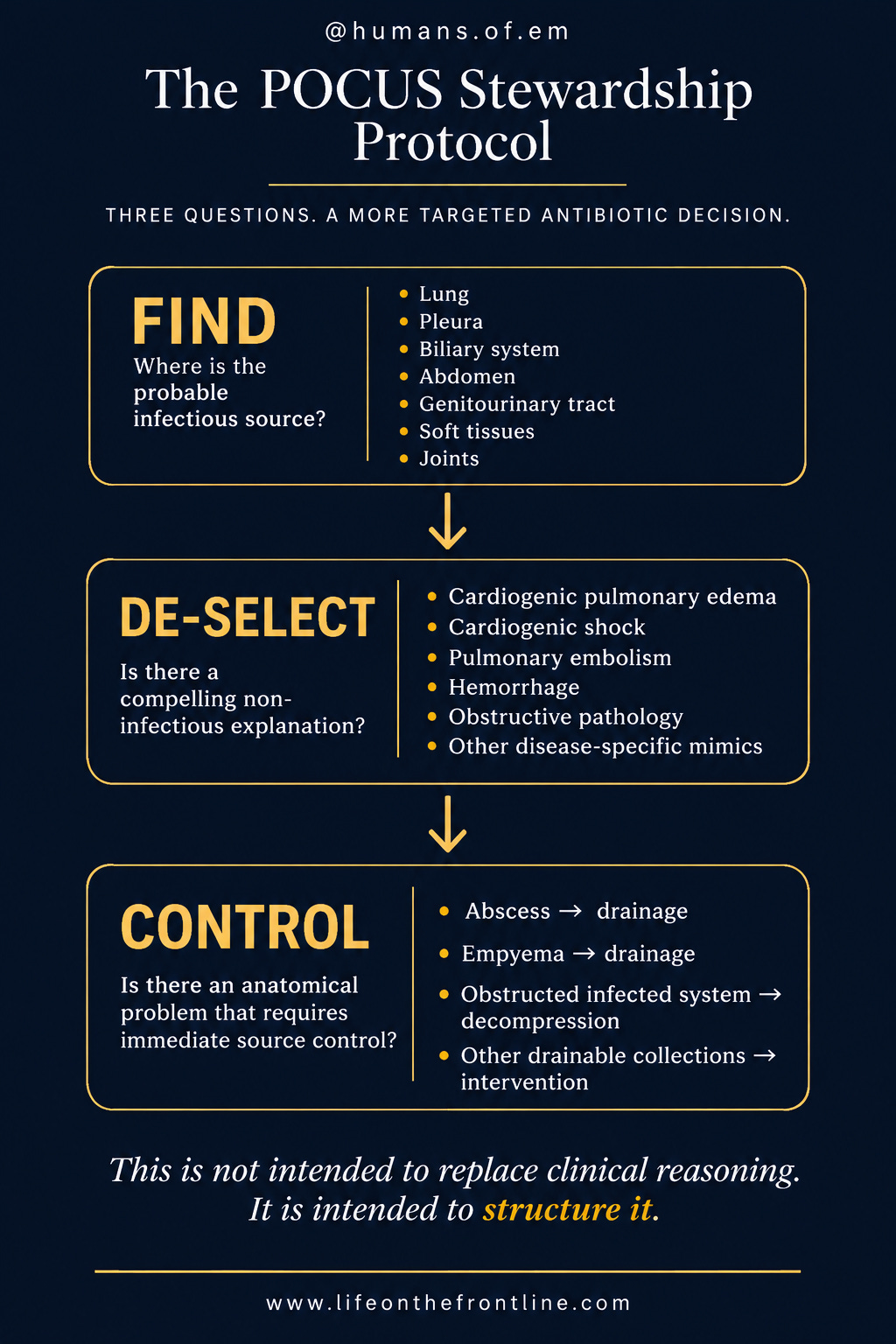
FIND
Find the infection.
Consider three common scenarios.
The lung
Consolidation with dynamic air bronchograms can support a diagnosis of pneumonia.
Lung ultrasound has demonstrated high diagnostic accuracy for pneumonia, with a systematic review cited in our review reporting pooled sensitivity of approximately 92% and specificity of 94% (Desai et al., 2024).
The gallbladder
Gallstones, gallbladder wall thickening and pericholecystic fluid can shift the diagnostic pathway toward a biliary source.
Emergency physician-performed ultrasound has demonstrated approximately 87% sensitivity and 82% specificity for acute cholecystitis in the cited literature (Summers et al., 2010).
The soft tissues
A patient labelled as having “cellulitis” may actually have a drainable abscess.
POCUS can identify the collection and peripheral vascularity that distinguish an abscess from simple cellulitis—and that distinction immediately changes management (Tayal et al., 2006; Guillén-Astete & Naredo, 2025).
The broader principle is more important than any individual ultrasound sign:
POCUS can move us from a syndrome-based diagnosis toward a source-specific diagnosis.
And source-specific diagnosis is inherently more compatible with targeted antimicrobial therapy than indefinite broad-spectrum empiricism.
But stewardship isn’t only about finding infection
This is where the concept becomes more interesting. If antimicrobial stewardship is only about finding infection, we are missing half of the problem. Sometimes the most important finding is:
There is no infection.
Consider a patient with:
Hypoxia + tachypnea + bilateral B-lines.
The reflex interpretation may be pneumonia. Perhaps ARDS. But bilateral B-lines are not synonymous with infection.
Add focused cardiac ultrasound.
Now suppose we find significant cardiac dysfunction alongside the diffuse interstitial pattern. The diagnostic probability changes.
The patient may have cardiogenic pulmonary edema.
And that can change the antibiotic decision.
Lung and cardiac POCUS can therefore be used together to interrogate an important diagnostic overlap. A systematic review and meta-analysis reported lung ultrasound sensitivity of approximately 88% and specificity of 90% for acute decompensated heart failure (Maw et al., 2019).
But there is an important caveat.
A patient can have both infection and cardiac dysfunction.
POCUS should therefore never become:
“B-lines = no antibiotics.”
That would simply replace one form of diagnostic error with another. Instead, POCUS should be understood as a tool for updating diagnostic probability.
That distinction matters.
DE-SELECT
Find the mimic.
A structured multiorgan examination can reveal diagnoses that look remarkably similar to sepsis.
Cardiogenic shock.
Pulmonary embolism.
Hemorrhagic shock.
Obstructive pathology.
Severe dengue.
Renal obstruction.
These conditions can generate physiological patterns that trigger reflexive antibacterial treatment (Volpicelli et al., 2013; Polyzogopoulou et al., 2023; Dewan et al., 2021).
This is where POCUS potentially becomes therapeutic stewardship. The objective is not to prove that the patient does not have infection. It is to acquire enough additional information to ask:
“Does the current probability of bacterial infection justify continuing this antimicrobial strategy?”
That is a much more sophisticated stewardship question.
And then comes the part we often forget:
CONTROL
Suppose POCUS identifies an abscess. Finding it is only the beginning. The clinically meaningful next step is:
Drain it.
A complex pleural effusion?
Drain it.
An infected obstructed collecting system?
Decompress it.
This leads to what I think is one of the most important ideas in this framework:
Source control is antimicrobial stewardship.
An undrained abscess is not merely a diagnostic problem. It is a persistent bacterial reservoir.
When source control is delayed, persistent infection can be interpreted as antimicrobial failure, potentially prompting broader or prolonged antibiotic therapy even when the original regimen may have been appropriate (Santos et al., 2026).
POCUS can accelerate recognition of drainable collections and facilitate bedside interventions, including drainage of abscesses and pleural infection and decompression of obstructed systems (Tayal et al., 2006; Santos et al., 2026).
And there is an interesting quantitative signal here. In the liver-abscess literature cited in the review, percutaneous catheter drainage was associated with approximately four fewer days of intravenous antibiotics compared with needle aspiration (Lin et al., 2023).
That is an important conceptual shift. We usually think of antimicrobial stewardship as:
Which antibiotic?
What dose?
For how long?
But sometimes the most effective antimicrobial intervention is not another change in the prescription.
It is:
Drain the collection.
So what would a POCUS stewardship protocol actually look like?
This is where the idea becomes practical. I am not proposing that every patient receiving antibiotics undergo a comprehensive ultrasound examination. Nor am I suggesting that POCUS replace microbiology, biomarkers, CT, formal radiology or clinical judgment.
Instead, imagine a protocolized multiorgan POCUS assessment for patients with sepsis or undifferentiated critical illness in whom the infectious source remains uncertain.
POCUS should not become an “antibiotic oracle”
This distinction is important.
POCUS does not tell us:
Antibiotics: YES.
or
Antibiotics: NO.
It gives us additional information.The proposed model is therefore:
POCUS + microbiology + biomarkers + clinical judgment
POCUS provides rapid anatomical and physiological information. Microbiology provides pathogen-specific information. Biomarkers provide additional probability information. Clinical judgment integrates everything with the patient’s presentation.
This is consistent with current antimicrobial stewardship guidance emphasizing diagnostic accuracy and appropriate empiric antimicrobial therapy within ED practice (Schoffelen et al., 2024). The manuscript therefore proposes POCUS as a bedside diagnostic adjunct within an integrated stewardship pathway, rather than as a standalone intervention.
And I think this is an important distinction. Because the goal of antimicrobial stewardship is not to give fewer antibiotics at any cost.
The goal is to give the right antibiotics to the right patient, for the right reason, for the right duration.
Sometimes POCUS may help us narrow. Sometimes it may help us stop. Sometimes it may tell us that we need to broaden.
And sometimes it may tell us that the most important intervention is not another antibiotic at all. It is source control.
But here is where we need to be honest
This is the most important limitation of the entire concept.
The evidence is not yet where the hypothesis is.
Current studies demonstrate that POCUS can improve diagnostic clarification and frequently change early management.
In undifferentiated shock, studies cited in the review report management changes in approximately 24–53% of cases (Cortellaro et al., 2017; Zieleskiewicz et al., 2015).
But management change is not the same thing as antimicrobial stewardship.
We still need to know:
Does POCUS reduce days of therapy?
Does it reduce spectrum days?
Does it increase appropriate de-escalation?
Does it reduce unnecessary antibiotics?
Does it improve the appropriateness of empiric therapy?
These are the outcomes that matter.
And remarkably few studies have directly measured them.
Most available evidence evaluates diagnostic accuracy, management modification or time to intervention rather than antibiotic-specific outcomes (Schoffelen et al., 2024; Lhopitallier et al., 2021).
So this review does not claim that POCUS has already been proven to reduce antibiotic consumption.
It proposes something different:
A clinically plausible framework that now needs to be tested.
The next POCUS study shouldn’t just ask, “Can ultrasound diagnose this?”
We have already spent years answering questions about diagnostic accuracy.
The next generation of studies should ask a different question:
“What happens to antimicrobial use when POCUS becomes part of the decision pathway?”
Imagine a prospective multicentre study.
Standard sepsis care
versus
Standard sepsis care + structured POCUS stewardship pathway
And measure outcomes that antimicrobial stewardship programs actually care about:
Days of therapy
Spectrum days
Appropriateness of empiric therapy
Time to antimicrobial de-escalation
Time to source identification
Time to source control
Unnecessary antibiotic exposure
These are precisely the types of outcomes identified as priorities for future research in the review. The question is no longer whether POCUS can see pathology. The question is whether seeing pathology earlier changes what we do with antibiotics.
A different way to think about the probe
Perhaps we have been thinking about POCUS too narrowly.
We call it a diagnostic tool.
A resuscitation tool.
A procedural tool.
But perhaps, in the emergency department, its greatest stewardship value lies in something more fundamental:
It reduces uncertainty.
And uncertainty is one of the drivers of broad empiricism.
So perhaps the sequence should not always be:
Sepsis → Antibiotics → Investigations → Reassessment
Perhaps, whenever clinically appropriate, we should increasingly think:
Suspected sepsis → POCUS-informed phenotype → Source / mimic / source control → More targeted antimicrobial decision
Not instead of early antibiotics when they are clearly indicated.
But alongside them.
Because early treatment and diagnostic precision do not have to be opposing philosophies.
We can give antibiotics early and improve the information behind that decision early.
FIND. DE-SELECT. CONTROL.
That is the framework I would like to leave you with.
Find the infection.
Move from possible sepsis toward a probable anatomical source.
De-select the mimic.
Recognize when a non-infectious diagnosis better explains the physiology.
Control the source.
Because definitive source control may be more important than escalating antimicrobial therapy.
And perhaps this is the larger opportunity for POCUS in antimicrobial stewardship:
The probe may not tell us which antibiotic to give.
It may help us understand why we are giving one in the first place.
And perhaps antimicrobial stewardship in the emergency department shouldn’t begin with the antibiotic.
Perhaps it begins with the POCUS probe.
References
Cortellaro F, Ferrari L, Molteni F, et al. Accuracy of POCUS to identify sepsis source. Academic Emergency Medicine. 2017;24:737–744.
Desai D, Shah AB, Dela JRC, et al. Lung ultrasonography accuracy for diagnosis of adult pneumonia: systematic review and meta-analysis. Advances in Respiratory Medicine. 2024;92:241–253.
Dewan N, Zuluaga D, Osorio L, et al. Ultrasound in dengue: a scoping review. American Journal of Tropical Medicine and Hygiene. 2021;104:826–835.
Lhopitallier L, Kronenberg A, Meuwly JY, et al. Procalcitonin and lung ultrasonography point-of-care testing to determine antibiotic prescription. BMJ. 2021;374:n2132.
Lin JW, Chen CT, Hsieh MS, et al. Percutaneous catheter drainage versus percutaneous needle aspiration for liver abscess. BMJ Open. 2023;13:e072736.
Maw AM, Hassanin A, Ho PM, et al. Diagnostic accuracy of point-of-care lung ultrasonography and chest radiography in adults with symptoms suggestive of acute decompensated heart failure. JAMA Network Open. 2019;2:e190703.
Perera P, Mailhot T, Riley D, et al. The role of ultrasound in sepsis. Critical Care Medicine. 2010;38:2030–2037.
Schoffelen T, Papan C, Carrara E, et al. European Society of Clinical Microbiology and Infectious Diseases guidelines for antimicrobial stewardship in emergency departments. Clinical Microbiology and Infection. 2024;30:1384–1407.
Summers SM, Scruggs W, Menchine MD, et al. A prospective evaluation of emergency department bedside ultrasonography for the detection of acute cholecystitis. Annals of Emergency Medicine. 2010;56:114–122.
Tamma PD, Cosgrove SE, et al. Antimicrobial stewardship. Infectious Disease Clinics of North America. 2011;25:245–260.
Tayal VS, Hasan N, Norton HJ, et al. Ultrasound in soft tissue infection. Academic Emergency Medicine. 2006;13:384–388.
Verras C, Ventoulis I, Bezati S, et al. Point-of-care ultrasonography for the septic patient in the emergency department: a literature review. Journal of Clinical Medicine. 2023;12:1105.
Volpicelli G, Lamorte A, Tullio M. Point-of-care multiorgan ultrasonography for evaluation of undifferentiated hypotension in the emergency department. Intensive Care Medicine. 2013;39:1290–1298.
Zieleskiewicz L, Muller L, Lakhal K, et al. Point-of-care ultrasound in intensive care units: assessment of 1073 procedures in a multicentric prospective observational study. Intensive Care Medicine. 2015;41:1638–1647.