

By-
Dr Arihant Jain, MD | lifeonthefrontline.com
Instagram: @humans.of.em
X | Linkedin | ORCID
—————————————————————
“The monitor alarms. The heart rate is 165 beats per minute. The nurse asks, ‘Doctor, should we shock?’
If you’ve worked in an emergency department, ICU, operating room, or acute medical unit, you’ve probably faced this exact moment.
Atrial fibrillation (AF) and atrial flutter are among the most common arrhythmias encountered in acute care, yet they remain one of the most misunderstood. The temptation is almost instinctive including reach for amiodarone, prepare for cardioversion, or aggressively lower the heart rate. However, the monitor often tells only a part of the story.
In acute illness, AF is frequently a manifestation of physiological stress rather than the primary disease itself. Systemic inflammation, catecholamine excess, hypoxaemia, metabolic disturbances, myocardial dysfunction, and atrial stretch create an environment where atrial fibrillation becomes almost inevitable. Consequently, suppressing the arrhythmia without addressing the underlying trigger often results in treatment failure or early recurrence (Sibley et al., 2025; Farkas, 2024).
This distinction is important because AF during critical illness is not a benign event. New-onset atrial fibrillation (NOAF) develops in approximately 5–15% of critically ill patients and may occur in nearly half of patients with septic shock. Although some patients revert to sinus rhythm as their illness resolves, it is associated with prolonged hospitalization, thromboembolic complications, heart failure, recurrent AF, and increased long-term mortality (Sibley et al., 2025).
The challenge for the acute care physician, therefore, is not simply how to treat atrial fibrillation, but rather how to understand why it appeared in the first place.
Think Physiology Before Pharmacology
One of the most important messages from both the 2025 Intensive Care Medicine review and the EMCrit approach is that AF in acute care should be viewed differently from chronic outpatient AF.
In the outpatient clinic, management revolves around long-term stroke prevention, symptom control, and maintenance of sinus rhythm. In the ICU or emergency department, priorities are entirely different.
The clinician must determine:
Is AF causing the patient’s instability?
Or is AF merely reflecting worsening physiological stress?
Those two questions determine almost every subsequent management decision.
Many critically ill patients develop AF because the atria are exposed to inflammation, adrenergic stimulation, electrolyte abnormalities, fluid shifts, hypoxia, or myocardial dysfunction. In such situations, AF behaves less like an isolated arrhythmia and more like a marker of systemic illness. Treating only the rhythm while ignoring the underlying physiology rarely succeeds (Sibley et al., 2025).
The Four Questions Every Acute Care Physician Should Ask
1. Is this really atrial fibrillation?
Although telemetry frequently suggests AF, diagnosis should always be confirmed with a 12-lead ECG. An irregularly irregular rhythm without discernible P waves strongly supports the diagnosis. Clinicians should also differentiate AF from multifocal atrial tachycardia, or atrial tachycardia, as management strategies differ (Farkas, 2024).
2. Why did AF occur today?
This may be the single most important question in the entire approach. Rather than immediately reaching for anti-arrhythmics, clinicians should actively search for reversible precipitants.
Common triggers include:
Sepsis
Septic shock
Pulmonary embolism
Acute myocardial ischaemia
Respiratory failure
Hypoxaemia
Hypercapnia
Hypokalaemia
Hypomagnesaemia
Thyrotoxicosis
Pain
Agitation
Alcohol withdrawal
Catecholamine infusions
Fluid overload
Hypovolaemia
Major surgery
(Farkas, 2024).
These triggers are not merely associated with AF—they often sustain it. Consequently, correcting the underlying pathology frequently results in spontaneous cardioversion without the need for anti-arrhythmic therapy (Sibley et al., 2025).
Frontline Pearl
Every episode of AF deserves a search for the trigger before a search for the right drug.
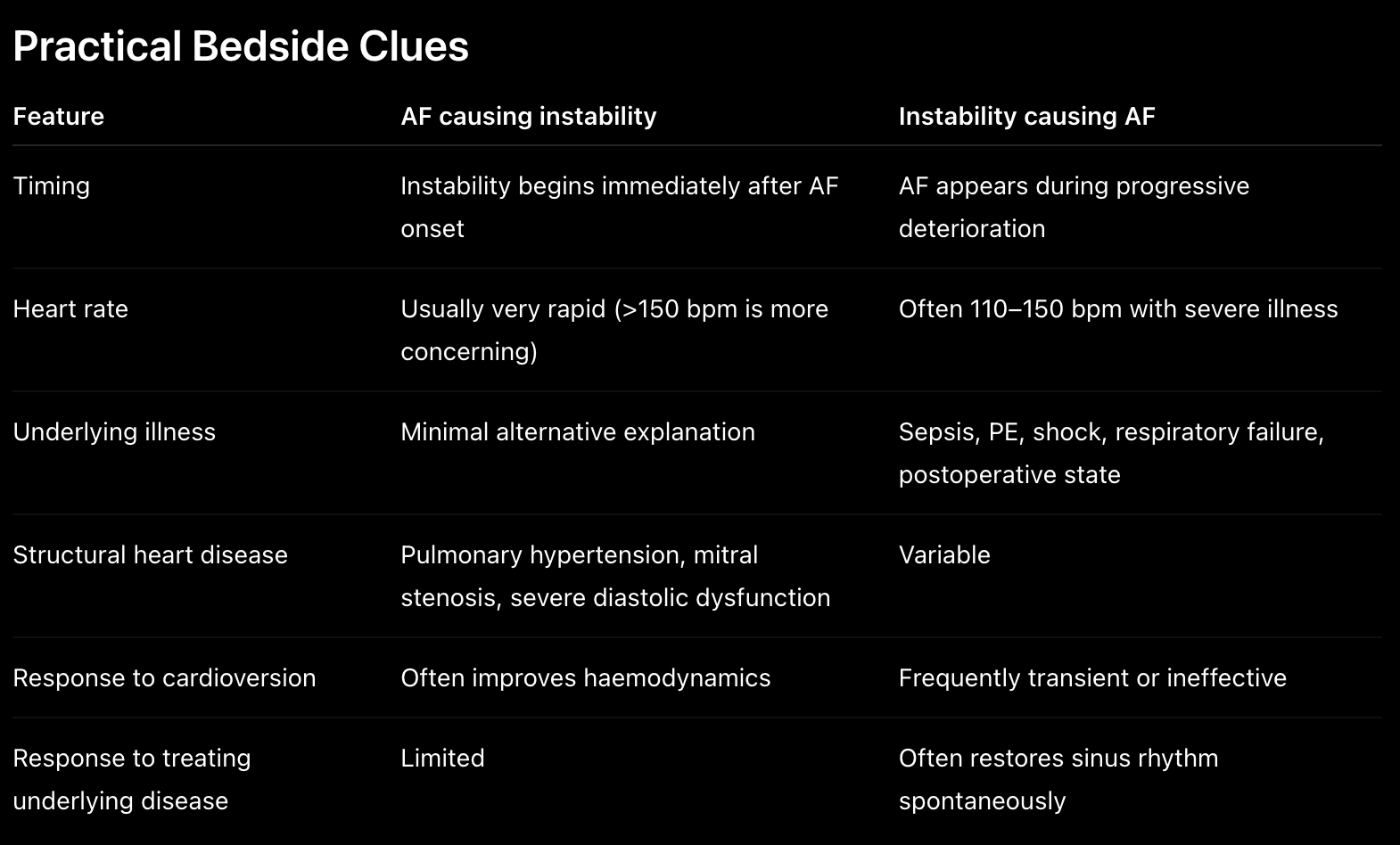
3. Is AF causing instability or is instability causing AF?
This question separates experienced clinicians from reflexive treatment. Not every patient with hypotension and AF requires immediate cardioversion.
Instead, ask:
Did hypotension begin after AF?
Is the ventricular rate extremely rapid?
Does the patient have severe mitral stenosis, pulmonary hypertension, or marked diastolic dysfunction where loss of atrial contraction is poorly tolerated?
Heart rates below approximately 150 beats/min are less likely to be the sole cause of haemodynamic collapse. Conversely, severe sepsis, haemorrhage, pulmonary embolism, or cardiogenic shock frequently precipitate AF, making the arrhythmia a consequence rather than the cause of instability (Farkas, 2024).
“Not every hypotensive patient with atrial fibrillation needs cardioversion. The challenge is determining whether the arrhythmia is the culprit—or merely a witness to a much larger physiological crisis.”
One of the most common cognitive errors in acute care is assuming that the abnormal rhythm displayed on the monitor is responsible for the patient’s instability. In reality, atrial fibrillation is frequently a secondary manifestation of systemic physiological stress, particularly in critically ill patients. Sepsis, hypoxaemia, catecholamine excess, pulmonary embolism, myocardial ischaemia, electrolyte abnormalities, and acute volume shifts all increase atrial electrical instability and may precipitate AF. In these situations, the arrhythmia is often an epiphenomenon rather than the primary haemodynamic insult (Sibley et al., 2025).
Recognising this distinction is crucial because the management pathways diverge dramatically. Electrical cardioversion or aggressive rate reduction may rapidly improve a patient whose instability is directly attributable to AF. Conversely, if AF has developed as a consequence of severe sepsis or circulatory shock, suppressing the rhythm without correcting the underlying pathology is unlikely to improve haemodynamics and may even reduce compensatory cardiac output (Farkas, 2024).
4. What physiology needs to be restored?
Reviewed sources consistently emphasise that general physiological optimisation is often the most effective anti-arrhythmic intervention.
This includes:
Optimising oxygenation and ventilation
Correcting hypokalaemia and hypomagnesaemia
Treating sepsis
Managing pain and agitation
Reviewing vasoactive medications
Optimising intravascular volume
Addressing fluid overload when present
General supportive care frequently contributes more to successful rhythm restoration than antiarrhythmic drugs themselves (Farkas, 2024; Sibley et al., 2025).
Rate Control or Rhythm Control?
Perhaps no debate in acute care generates more discussion. Interestingly, there are no large randomized trials directly comparing rate and rhythm control in general ICU populations.
Consequently, management must be individualized rather than algorithmic (Farkas, 2024).
Patients who often favour rate control
A rate-control strategy may be appropriate in patients with:
Chronic AF
AF lasting more than 48 hours without anticoagulation
Severe left atrial enlargement
Persistent physiological stress
Low likelihood of successful cardioversion.
In these patients, forcing sinus rhythm may be difficult, transient, or increase thromboembolic risk if atrial thrombus has developed.
Patients who may benefit from rhythm control
Rhythm control deserves stronger consideration in:
New-onset AF during critical illness
Pulmonary hypertension
Significant diastolic dysfunction
Mitral stenosis
Heart failure with reduced ejection fraction
Persistent atrial flutter
Failure of adequate rate control
These patients often depend on atrial contraction to maintain cardiac output, making restoration of sinus rhythm physiologically advantageous (Farkas, 2024).
Choosing the Right Drug
Drug selection should be guided by physiology rather than habit.
Magnesium
Magnesium deserves consideration early in many critically ill patients. Beyond correcting deficiency, intravenous magnesium has favourable safety data, may facilitate cardioversion, improve response to other antiarrhythmics, and assist with ventricular rate control (Farkas, 2024).
Amiodarone
Amiodarone remains one of the most frequently used antiarrhythmics in acute care because it provides both rhythm and rate control. Although cardioversion success varies, combining amiodarone with magnesium may improve rhythm maintenance (Sibley et al., 2025).
Look at QTc and hemodynamic trend before starting it.
Beta-blockers
Short-acting beta-blockers are increasingly supported in selected patients, particularly when adrenergic excess is driving tachycardia. Emerging data suggest effective heart-rate control without major haemodynamic compromise in carefully selected critically ill patients (Sibley et al., 2025).
Digoxin
Digoxin has a more limited role but may be useful in patients with reduced systolic function or decompensated heart failure where negative inotropic drugs are undesirable (Sibley et al., 2025).
What About Electrical Cardioversion?
Electrical cardioversion occupies an important place in advanced life support, but its role in critical illness is often overestimated.
Immediate cardioversion is appropriate when AF is clearly the primary cause of severe haemodynamic instability. However, this situation is less common than many clinicians assume.
When AF develops secondary to ongoing physiological stress, cardioversion alone frequently fails because the underlying substrate remains unchanged. Initial success rates are modest, and recurrence is common unless the precipitating illness is corrected (Sibley et al., 2025; Farkas, 2024).
Frontline Pearl
Shocking the rhythm without treating the physiology often produces only temporary success.
Why Atrial Flutter Deserves Separate Attention
Although often discussed alongside AF, atrial flutter behaves differently.
The ventricular response is frequently fixed around 150 beats/min because of 2:1 atrioventricular conduction, making pharmacological rate control frustratingly difficult. Consequently, rhythm-control strategies are often more successful and clinically attractive in atrial flutter than in AF (Farkas, 2024).
Recognising this distinction prevents repeated escalation of rate-control medications that may never adequately control ventricular rate.
Putting It All Together: A Bedside Framework
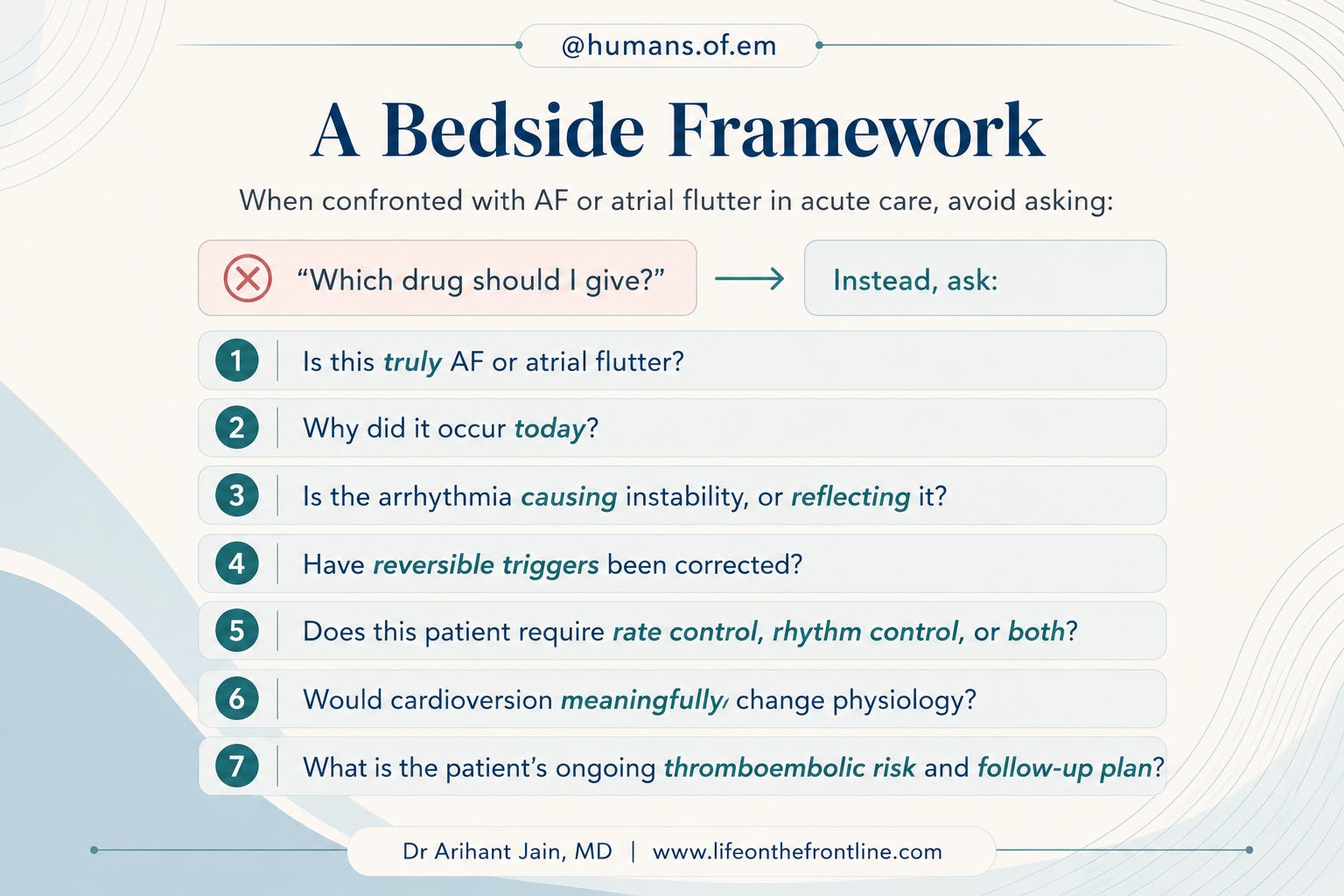
This physiology-first approach aligns with the central themes of both the 2025 narrative review and the EMCrit framework, emphasising individualized management rather than reflexive adherence to a single algorithm.
Take-Home
AF in acute care is rarely “just an arrhythmia.” More often, it is a window into the patient’s underlying physiology. Successful management begins not with amiodarone or cardioversion, but with understanding why the rhythm developed in the first place. Treat the sepsis, optimise oxygenation, correct electrolytes, restore haemodynamics, and reassess the rhythm. Drugs and shocks certainly have their place, but they are most effective when the underlying pathophysiological drivers have already begun to resolve.
Ultimately, the monitor should guide your attention but the patient’s physiology should guide your treatment.
References
1. Sibley S, Bedford J, Wetterslev M, et al. Atrial fibrillation in critical illness: state of the art. Intensive Care Med. 2025;51(5):904-916. doi:10.1007/s00134-025-07895-0
2. Farkas J. Atrial fibrillation (AF) & flutter complicating critical illness. Internet Book of Critical Care (IBCC), EMCrit Project. Updated April 6, 2024. Accessed August 6, 2026. https://emcrit.org/ibcc/af/