

By-
Dr Arihant Jain, MD | lifeonthefrontline.com
Instagram: @humans.of.em
X | Linkedin | ORCID
————————————————————————
We teach intubation relentlessly.
Indications.
Preoxygenation.
Drug choices.
Laryngoscopy.
Bougie.
Video laryngoscopy.
Failed-airway algorithms.
But once the tube is successfully placed, the attention often shifts.
The patient is stable.
The ventilator is doing the work.
The crisis seems over.
And then, sometime later, someone says:
“They passed the SBT. Let’s extubate.”
Perhaps that sentence deserves a little more hesitation.
Not because extubation should be delayed unnecessarily but because extubation is itself an airway procedure.
The 2026 Project for Universal Management of Airways (PUMA) guidelines make this point clearly: tracheal extubation warrants an equivalent level of evaluation, strategy, preparation and vigilance to tracheal intubation (Ellard et al., 2026).
And that changes how we should think about the tube coming out.
Extubation is not simply “successful weaning”
A spontaneous breathing trial answers an important question:
Can this patient sustain spontaneous breathing?
But it does not answer everything.
A patient may breathe adequately and still fail because they cannot:
protect their airway
clear secretions
maintain upper-airway patency
tolerate airway stimulation
maintain adequate oxygenation
recover rapidly if re-intubation becomes necessary.
Passing an SBT therefore does not automatically mean that the patient is ready for extubation. Airway protection and the risk of post-extubation airway problems must also be considered (Farkas, 2023).
So perhaps the better question isn’t:
“Did they pass the SBT?”
It is:
“If I remove this tube, what happens next and am I prepared for it?”
Think of extubation as a three-question problem
The PUMA guideline offers a useful way of translating risk assessment into strategy (Ellard et al., 2026).
1. Should I extubate now?
Look beyond the ventilator.
Has the reason for intubation improved?
Is the patient physiologically stable?
Are sedation and neuromuscular blockade adequately reversed?
Is there uncontrolled metabolic or respiratory pathology?
And importantly:
Will waiting actually make extubation safer?
Planned extubation is elective. That means we have something we rarely have during emergency intubation:
control over the circumstances.
We can choose the timing, location, personnel and resources. The PUMA guideline therefore recommends considering deferral when waiting is expected to significantly reduce extubation risk (Ellard et al., 2026).
2. What happens if it fails?
This is where extubation becomes an airway strategy rather than merely a ventilator decision.
Ask:
If the patient deteriorates, can I rapidly restore oxygenation?
And not just:
“Can I intubate them?”
But:
“Can I successfully manage their airway using the available airway lifelines?”
The PUMA framework emphasizes that if achieving airway success with a facemask, supraglottic airway or tracheal tube is not expected to be rapid and reliable, the extubation should be considered at risk (Ellard et al., 2026).
That is a powerful shift. The patient’s airway risk is not determined only by how difficult the original intubation was.
Something may have changed.
Edema.
Bleeding.
Trauma.
Surgery.
Secretions.
Reduced physiological reserve.
A deteriorated cardiopulmonary state.
The airway you had earlier may not be the airway you have after extubation.
3. What support will they need after extubation?
The procedure doesn’t end when the ETT leaves the mouth.
Some patients may benefit from high-flow nasal cannula (HFNC), while selected patients—particularly those with conditions such as COPD, heart failure or significant obesity—may benefit from non-invasive positive-pressure support (Farkas, 2023).
The post-extubation strategy should therefore be considered before extubation, not after the patient begins deteriorating.
The SBT is necessary but it isn’t the finish line
A practical SBT approach described in the IBCC is approximately:
Pressure support 5 + PEEP 5 cmH₂O for 30 minutes
or
CPAP ~5 cmH₂O with automatic tube compensation (Farkas, 2023).
During the trial, look at the whole patient rather than one number.
Oxygenation
Can they maintain acceptable oxygen saturation without excessive FiO₂?
Ventilation
Is tidal volume maintained?
Is minute ventilation falling?
Is EtCO₂ rising?
Respiratory mechanics
Are they developing:
marked tachypnoea?
diaphoresis?
accessory muscle use?
agitation?
fatigue?
And then there is the famous RSBI.
RR / tidal volume in litres
Traditionally:
RSBI <105 = reassuring.
But a number should never replace clinical reasoning.
An elevated RSBI should be interpreted in context rather than used as an absolute contraindication to extubation. Patients with chronic tachypnoea or respiratory dysfunction may have persistently elevated values despite being appropriate candidates for extubation (Farkas, 2023).
The patient is not a ratio.
Then ask the four questions the SBT cannot answer
After the breathing trial:
1. Are they awake enough?
Not necessarily perfectly normal—but sufficiently arousable to maintain their airway (Farkas, 2023).
2. Can they handle their secretions?
A patient requiring frequent suctioning is telling you something.
3. Do they have a cough?
A strong cough can be more clinically useful than another decimal point from the ventilator (Farkas, 2023).
4. Can they maintain ventilation?
This becomes particularly important in patients with chronic hypercapnia or impaired respiratory drive (Farkas, 2023).
And then comes the question we often forget:
What kind of extubation is this?
Not every tube removal is the same.
A patient with:
uncomplicated intubation
normal airway anatomy
reliable mask ventilation
reliable supraglottic airway rescue
adequate physiological reserve
is very different from a patient with:
difficult intubation
airway edema
facial trauma
bleeding
questionable mask ventilation
questionable SGA rescue
poor safe-apnoea time.
The PUMA framework therefore links risk to strategy (Ellard et al., 2026).
Low-risk airway
Standard extubation may be appropriate.
At-risk airway
Consider an awake extubation with an airway exchange catheter and a clear rescue strategy when this is required to provide an adequate margin of safety (Ellard et al., 2026).
Unreconstructible airway
The question may become whether extubation should occur at all—or whether conversion to a more secure airway is required (Ellard et al., 2026).
The key concept is beautifully simple:
Risk assessment is useful only when it changes what you do.
The PUMA guideline specifically emphasizes linking identified risks to the actual extubation strategy (Ellard et al., 2026).
The extubation moment itself matters
Extubation is not simply:
Deflate cuff → pull tube → oxygen.
The PUMA approach emphasizes preparation of the team, equipment, oxygenation, positioning and rescue plan before the tube comes out (Ellard et al., 2026).
And why all this preparation?
Because extubation can provoke airway stimulation, coughing, laryngospasm, obstruction, aspiration and other complications (Ellard et al., 2026).
Airway stimulation may be particularly important as sedatives and neuromuscular blocking drugs wear off, and laryngospasm can result in significant morbidity, including airway obstruction, negative-pressure pulmonary oedema and aspiration (Ellard et al., 2026).
What happens after the tube comes out?
The tube is out. But the procedure isn’t over.
Now comes the next phase:
Can the patient maintain the airway and ventilation without invasive support?
This is where planned post-extubation support matters. HFNC has been shown to reduce re-intubation and ICU length of stay in appropriate populations, while non-invasive positive-pressure ventilation may be particularly useful in selected high-risk groups (Farkas, 2023).
So before extubation, know what comes next.
Room air?
Conventional oxygen?
HFNC?
NIV?
The answer should not be decided only after the patient starts struggling.
Perhaps we need to change the language
One idea from the Critical Care Time discussion deserves to stay with us. (Critical Care Time, 2025)
We often say:
“The patient failed extubation.”
But perhaps a better phrase is:
“We failed to successfully extubate the patient.”
Because extubation is our clinical decision.
We choose the timing.
We assess readiness.
We assess the airway.
We choose the rescue strategy.
We choose the post-extubation support.
And sometimes, despite doing all of this correctly, re-intubation will still be necessary. That does not automatically mean the original decision was wrong.
Extubation cannot be predicted with perfect certainty. The IBCC describes it as a trial of extubation, recognising that both premature and unnecessarily delayed extubation can cause harm (Farkas, 2023).
The real goal isn’t zero re-intubations
Zero re-intubations sounds like excellent performance. But if achieving zero means keeping patients intubated longer than necessary, we may simply be exchanging one problem for another.
Prolonged mechanical ventilation carries its own burden, including delirium, infection, weakness, deconditioning and impaired mobility (Critical Care Time, 2025).
The Critical Care Time discussion highlights the substantial burden associated with each additional day of mechanical ventilation (Critical Care Time, 2025).
So the goal isn’t:
“Never re-intubate.”
And it isn’t:
“Extubate as early as possible.”
It is:
Extubate when the patient is ready,
with an airway strategy matched to their risk,
and with a rescue plan that is ready before the tube comes out.
A final thought from the ED
In the emergency department, extubation can be particularly easy to overlook.
The patient was intubated for a seizure.
Or an overdose.
Or a procedure.
Or transient respiratory failure.
The underlying problem improves. And suddenly the question becomes:
“Can we get the tube out?”
Maybe we should replace that question with:
“If I take this tube out right now, have I deliberately designed what happens next?”
That is the mindset shift. Intubation secures the airway. Extubation asks whether the patient can safely own it again. And that deserves just as much thought.
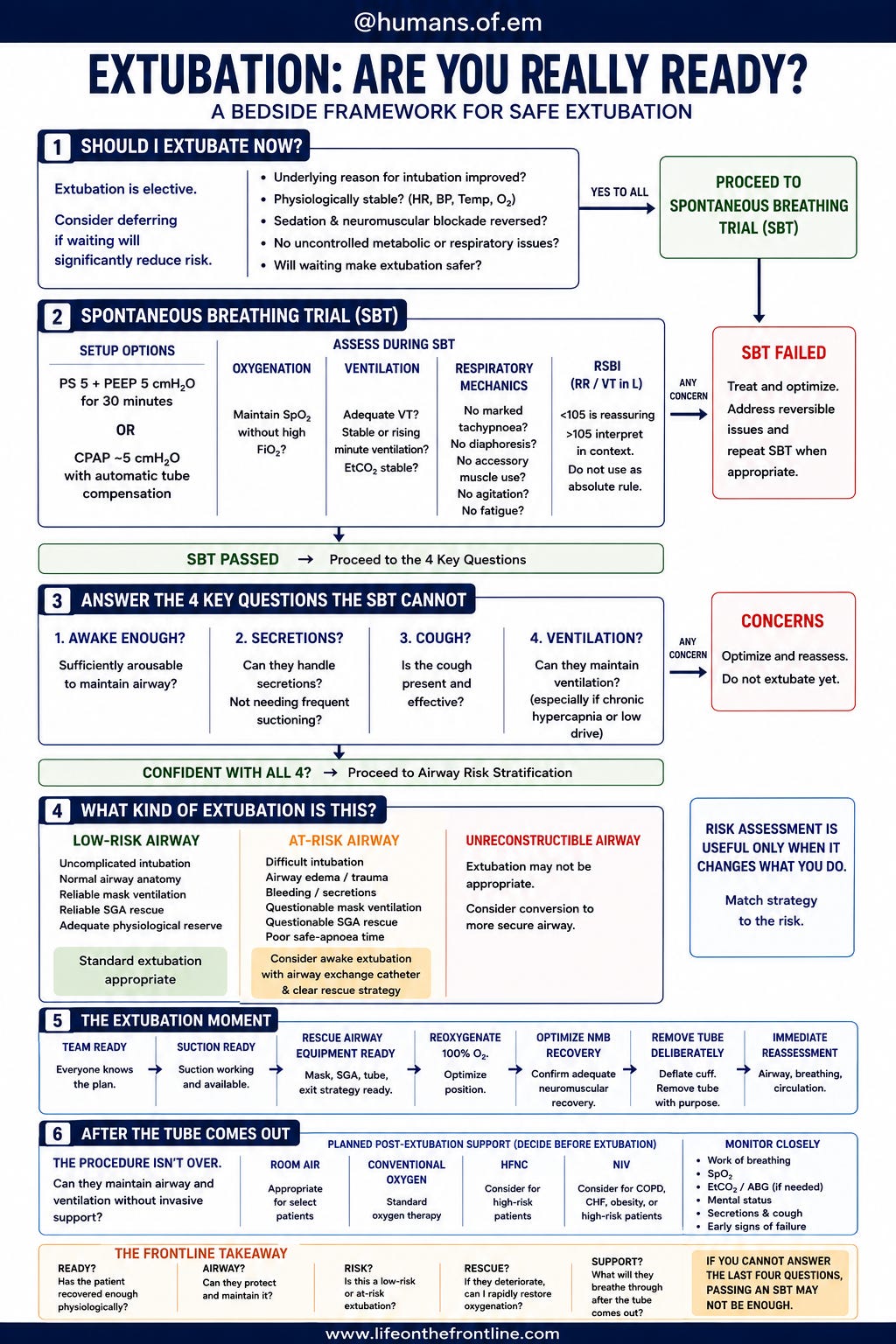
The Frontline Takeaway
Before every extubation, ask:
READY?
Has the patient recovered enough physiologically?
AIRWAY?
Can they protect and maintain it?
RISK?
Is this a low-risk or at-risk extubation?
RESCUE?
If they deteriorate, can I rapidly restore oxygenation?
SUPPORT?
What will they breathe through after the tube comes out?
If you cannot answer the last four questions, passing an SBT may not be enough.
References
Ellard L, Higgs A, Cooper RM, et al. Project for Universal Management of Airways: guidelines for tracheal extubation. Anaesthesia. 2026;81:1–31.
Farkas J. Liberation from the ventilator. Internet Book of Critical Care (IBCC). EMCrit Project. 2023.
Critical Care Time. Episode 47: Extubation: Tube Be or Not Tube Be. 2025.