

By-
Dr Arihant Jain, MD | lifeonthefrontline.com
Instagram: @humans.of.em
X | Linkedin | ORCID
—————————
Should We Be Doing More Than eFAST in Every Hypotensive Trauma Patient?
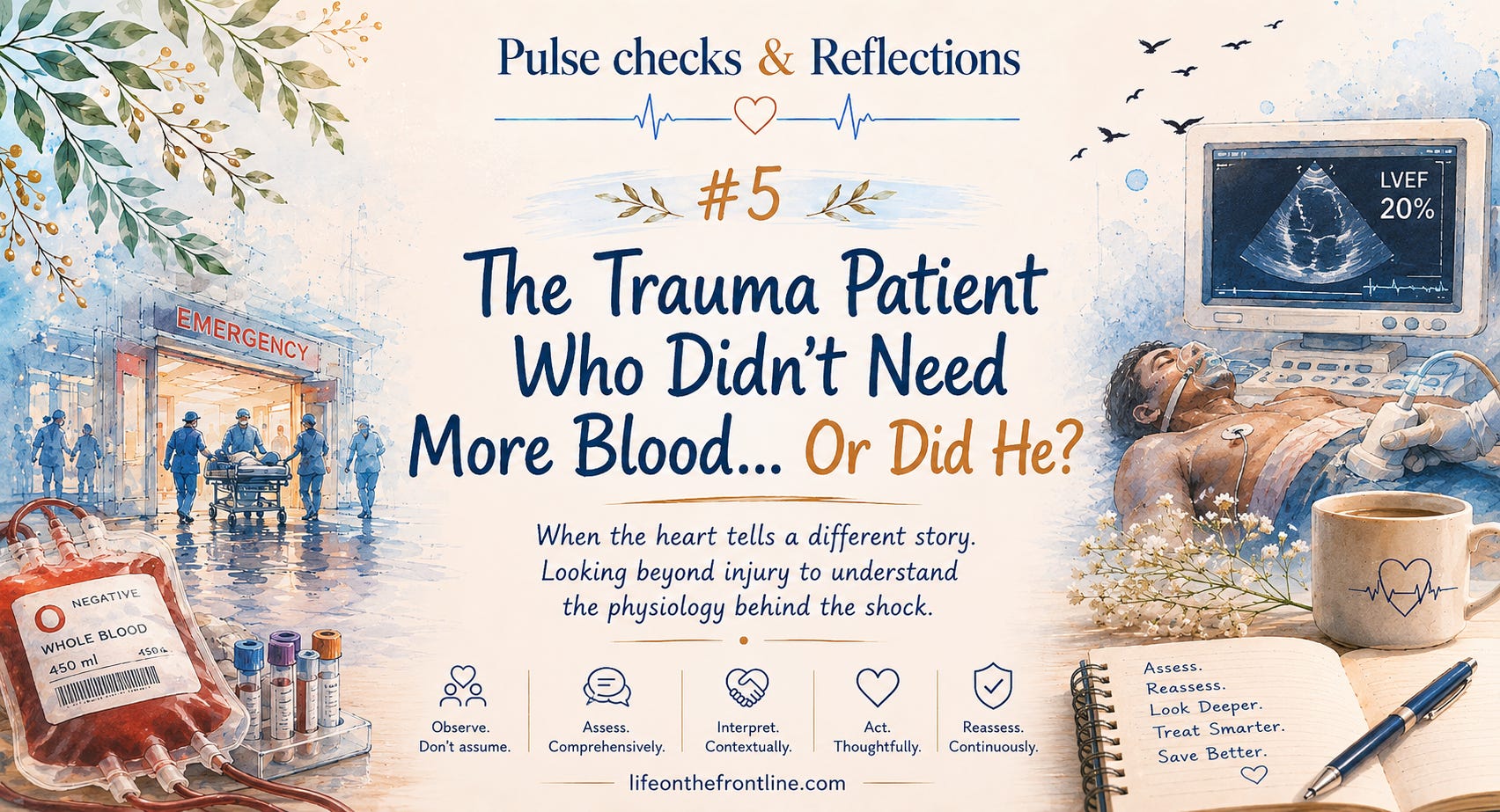
A 50-year-old man walked into our Emergency Department after a high-speed road traffic collision. He was the driver. A solo rider. No eyewitnesses. No accompanying family. No medical records. He had sustained blunt trauma. His blood pressure was low. His eFAST was positive in abdomen and lung. The diagnosis seemed obvious.
Hemorrhagic shock. We moved quickly.
A pneumothorax was identified and an intercostal drain was inserted. The lungs appeared relatively clear on the initial ultrasound examination. The FAST examination demonstrated free intra-peritoneal fluid.
Blood products were requested immediately. As they should have been. A hypotensive trauma patient with a positive FAST should be presumed to be bleeding until proven otherwise (Bloom & Gibbons, 2019; Savoia et al., 2023). The first 2 units of blood started running. Then things became interesting.
Something Didn’t Fit
Instead of improving, the patient’s oxygen saturation began to worsen. The chest tube was functioning. The pneumothorax had been addressed. The repeat examination revealed no obvious procedural complication. Yet the patient was becoming increasingly hypoxic. A repeat lung ultrasound was performed. This time, symmetrical and diffuse bilateral B-lines had appeared.
Pulmonary edema.
After approximately one litre of blood. That wasn’t what we expected. This was supposed to be hemorrhagic shock. So why was he behaving like a patient with acute heart failure?
Looking Beyond The eFAST
A focused cardiac ultrasound was performed. The answer appeared within seconds. The left ventricle was severely impaired. Estimated left ventricular ejection fraction: approximately 20%. (later confirmed that he had underlying DCMP when family arrived with old records)
Suddenly the entire physiology made sense. The patient was indeed bleeding. The eFAST was not wrong. The shock was real. The blood was necessary. But he was also carrying severe underlying cardiac dysfunction that nobody knew about.
No previous records existed. No previous echocardiogram was available. No family member was present to provide a history. He arrived not only with traumatic injuries, but also with a failing heart. The blood products were treating one problem while simultaneously exposing another.
The Reality Of Trauma Care In LMICs
Cases like this are not rare. Many trauma patients in low- and middle-income countries arrive with years of undiagnosed or poorly managed cardiovascular disease.
Hypertension.
Ischemic heart disease.
Dilated cardiomyopathy.
Valvular pathology.
Heart failure.
Often untreated. Often undocumented. Often unknown even to the patient. Yet our trauma algorithms generally assume that hypotension in trauma equals hemorrhagic shock until proven otherwise.
Most of the time, that assumption is correct. But not always. And when it is incomplete, our resuscitation strategy may become incomplete as well.
eFAST Is One Of The Greatest Success Stories In Trauma
Before discussing alternatives, it is important to acknowledge what eFAST does exceptionally well. The extended Focused Assessment with Sonography in Trauma (eFAST) remains one of the most validated point-of-care ultrasound examinations in emergency medicine and trauma care (Netherton et al., 2019; Bella et al., 2025).
It rapidly identifies:
Hemoperitoneum
Hemopericardium
Pneumothorax
Hemothorax
These are diagnoses that directly influence immediate management decisions.
A systematic review and meta-analysis involving 75 studies and over 24,000 trauma patients demonstrated high specificity for identifying traumatic pathology, making eFAST an excellent rule-in tool in hemodynamically unstable trauma patients (Netherton et al., 2019).
For the question:
“Is traumatic bleeding or thoracic injury contributing to this patient’s shock?”
eFAST is extraordinarily effective. This is why it remains embedded within trauma protocols and ATLS-based assessment pathways worldwide (Bloom & Gibbons, 2019; Savoia et al., 2023).
Nothing in this article argues otherwise.
But eFAST Answers A Trauma Question
Not A Physiology Question. This distinction is important. eFAST tells us where blood may be accumulating. It tells us whether there is free fluid. It tells us whether there is a pneumothorax. It tells us whether there is a pericardial effusion.
What it does not tell us is:
How well the heart is pumping.
Whether the patient has severe cardiomyopathy.
Whether the right ventricle is failing.
Whether the patient can tolerate aggressive volume administration.
In other words:
eFAST identifies injuries. It does not fully characterize shock physiology. And these are not always the same thing.
Enter RUSH
The Rapid Ultrasound in Shock and Hypotension (RUSH) examination was designed to evaluate undifferentiated shock by assessing what ultrasound educators often call:
The Pump
Cardiac contractility
Pericardial effusion
Right ventricular function
The Tank
Volume status
Inferior vena cava characteristics
Pulmonary edema
The Pipes
Aorta
Major venous structures
(Estoos et al., 2019; Talayeh et al., 2018)
Unlike eFAST, which asks:
“Where is the bleeding?”
RUSH asks:
“Why is this patient in shock?”
The difference may seem subtle. At the bedside, it can be profound.
Does The Evidence Support Replacing eFAST?
No. And this is where we must be careful.
The current literature does not support replacing eFAST with RUSH in hypotensive trauma patients. There are no high-quality comparative studies demonstrating that routine RUSH examination improves mortality, accelerates definitive interventions, or provides superior outcomes compared with eFAST alone in trauma populations (Stickles et al., 2019; Talayeh et al., 2018).
In fact, trauma-specific evidence remains substantially stronger for eFAST (Netherton et al., 2019; Bella et al., 2025).
A prospective study of 100 unstable polytrauma patients reported a sensitivity of 94.2% and diagnostic accuracy of 95.2% for RUSH when compared with CT findings and final diagnoses (Elbaih et al., 2018).
These findings are encouraging. But they do not establish superiority over eFAST.
At present, the evidence suggests that RUSH broadens the differential diagnosis of shock rather than replacing established trauma ultrasound pathways (Elbaih et al., 2018; Berger et al., 2024).
Maybe We Are Asking The Wrong Question
The debate should not be:
eFAST versus RUSH.
Perhaps the more useful question is:
Should selected hypotensive trauma patients receive a rapid RUSH-style extension immediately after eFAST?
Particularly when:
The physiology appears disproportionate to the injuries.
The patient is older with unknown medical history.
Shock persists despite apparently appropriate resuscitation.
Respiratory status worsens unexpectedly.
There is concern regarding cardiac reserve.
The response to blood products is not what we anticipated.
In these situations, a 30-second cardiac and lung ultrasound examination may provide information that fundamentally alters our understanding of the patient. Not necessarily the diagnosis. But certainly the physiology.
Returning To Our Patient
Would identifying an ejection fraction of 20% before transfusion have stopped us from giving blood?
Absolutely not. The patient was hypotensive. The patient was FAST positive. The patient was bleeding. Blood products were indicated.
But would it have changed how we administered those blood products?
Probably.
Would it have changed our monitoring strategy?
Almost certainly.
Would it have made pulmonary edema less surprising?
Definitely.
Would it have prompted earlier consideration of Surgical interventions, vasopressors, invasive monitoring, or damage-control resuscitation strategies tailored to limited cardiac reserve?
Possibly.
And perhaps that alone is enough reason to look beyond the abdomen.
The Frontline Takeaway
eFAST remains the cornerstone of ultrasound assessment in hypotensive trauma. The evidence supports it. The guidelines support it. The outcomes support it. But trauma patients are more than their injuries.
Especially in resource-limited settings, they often arrive carrying years of undocumented disease alongside their traumatic pathology.
A positive FAST explains where blood may be accumulating. It does not explain how the patient will respond to our resuscitation. The next evolution in trauma ultrasound may not be replacing eFAST with RUSH. It may simply be remembering to look at the heart before assuming that every shocked trauma patient needs the same resuscitation strategy. Sometimes the most important finding is not the free fluid. Sometimes it is the ventricle struggling silently beside it.
Pulse Checks and Reflections
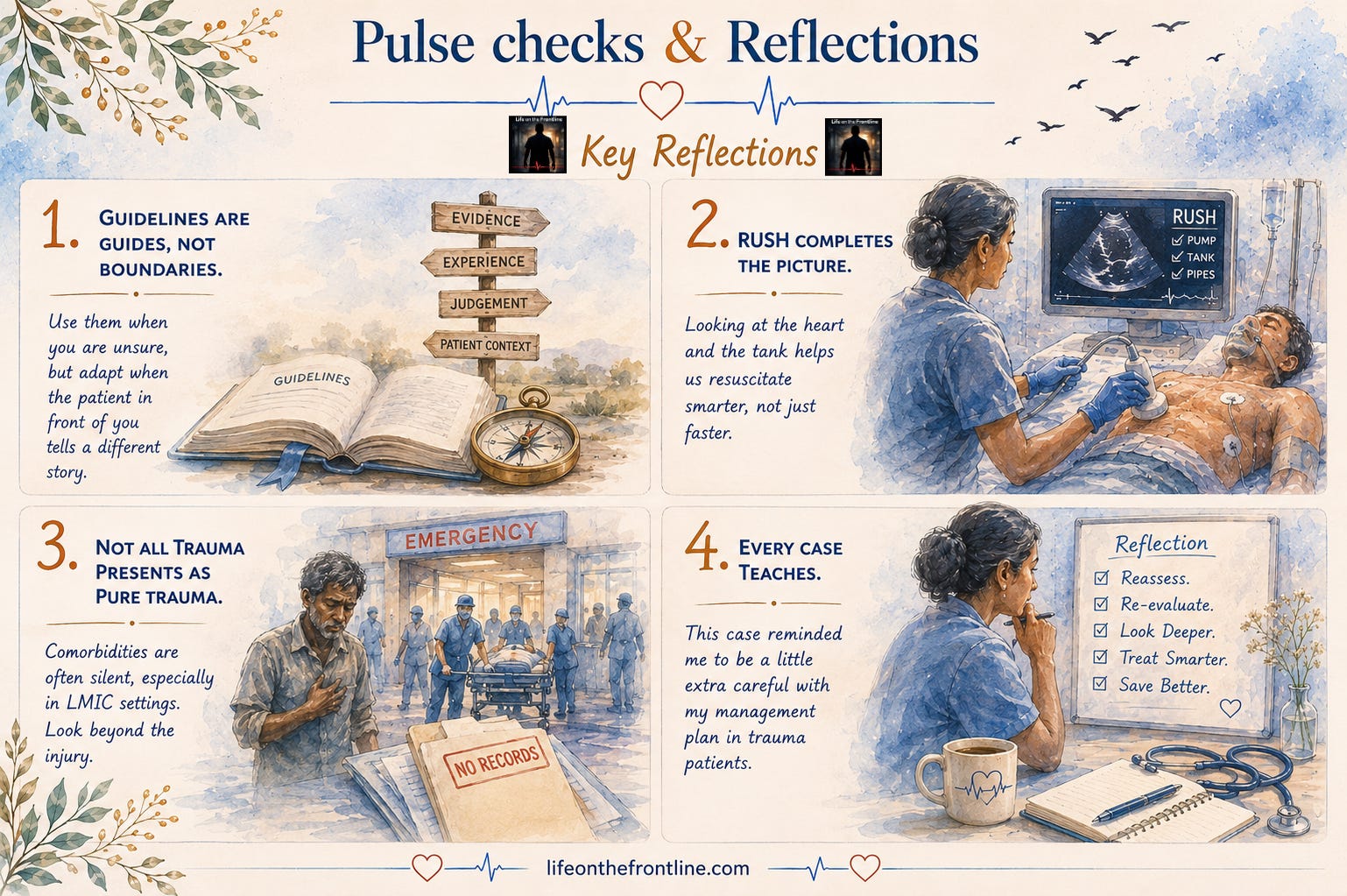
1. Guidelines Are Frameworks, Not Replacements for Clinical Judgment
Trauma guidelines exist to standardize care, reduce variability, and ensure that life-threatening injuries are identified and treated rapidly. They provide an essential framework, particularly in high-acuity situations where decisions must be made quickly.
However, no guideline can account for every patient, every physiology, or every clinical context. As clinicians gain experience, the challenge is not knowing when to follow guidelines, but recognizing when a patient’s physiology requires us to look beyond the algorithm while still respecting its principles.
In this case, the guideline-directed approach was appropriate. The experience simply reinforced the importance of continuously reassessing whether the patient’s response matches our expectations.
2. Looking Beyond eFAST Is Not Necessarily Departing From Trauma Principles
This reflection is not an argument against eFAST, nor is it a proposal to replace established trauma protocols.
Rather, it highlights the potential value of extending the ultrasound examination to include a rapid assessment of cardiac function and volume status in selected hypotensive trauma patients.
A RUSH-style examination incorporates the core components of eFAST while adding information about the heart and the patient’s overall shock physiology. The goal is not to change the diagnosis of hemorrhagic shock, but to better understand how a patient may tolerate ongoing fluid or blood product administration.
In some cases, identifying limited cardiac reserve early may allow clinicians to anticipate complications, tailor resuscitation strategies, and expedite definitive hemorrhage control when appropriate.
3. Trauma Patients Do Not Always Present With Trauma Alone
In many low- and middle-income countries, patients frequently arrive without prior medical records, medication lists, or accessible health information.
Significant comorbidities often remain undiagnosed or poorly documented. Conditions such as heart failure, ischemic heart disease, chronic kidney disease, and valvular pathology may coexist with traumatic injuries and influence the patient’s response to resuscitation.
While trauma may be the reason for presentation, underlying physiology often determines how that patient responds to treatment.
This case served as a reminder that understanding the patient sometimes requires looking beyond the injury itself.
4. A Personal Change in Practice
This case has not changed my belief in the value of eFAST or the principles of trauma resuscitation.
What it has changed is my threshold for performing a brief cardiac assessment in hypotensive trauma patients, particularly when the patient’s age, physiology, or response to treatment raises questions. Not because every patient requires it. Not because guidelines are inadequate. But because occasionally, a 30-second look at the heart may reveal information that helps us better understand the physiology in front of us. And sometimes, that additional piece of information can make all the difference.
"Trauma may explain why the patient is here. Physiology often explains how they will respond to what we do next."
References
Bella F, Bonfichi A, Esposito C, et al. Extended Focused Assessment with Sonography for Trauma in the Emergency Department: A Comprehensive Review. J Clin Med. 2025;14.
Berger M, Hussain J, Anshien M. RUSH to the Diagnosis: Identifying Occult Pathology in Hypotensive Patients. Clin Pract Cases Emerg Med. 2024;8:379-380.
Bloom BM, Gibbons R. Focused Assessment with Sonography for Trauma (FAST). 2019.
Elbaih A, Housseini A, Khalifa M. Accuracy and outcome of rapid ultrasound in shock and hypotension (RUSH) in Egyptian polytrauma patients. Chin J Traumatol. 2018;21:156-162.
Estoos E, Nakitende D, Bhimji S, Cole J. Diagnostic Ultrasound Use in Undifferentiated Hypotension. 2019.
Netherton S, Milenkovic V, Taylor MR, Davis P. Diagnostic accuracy of eFAST in the trauma patient: a systematic review and meta-analysis. CJEM. 2019.
Savoia P, Jayanthi SK, Chammas M. Focused Assessment with Sonography for Trauma (FAST). J Med Ultrasound. 2023;31:101-106.
Stickles S, Carpenter C, Gekle R, et al. The diagnostic accuracy of a point-of-care ultrasound protocol for shock etiology: A systematic review and meta-analysis. CJEM. 2019.
Talayeh R, et al. Early Protocolized Bedside Ultrasound in Shock: Renal Function Improvements and Other Lessons Learned. Int J Crit Care Emerg Med. 2018.