

By-
Dr Arihant Jain, MD | lifeonthefrontline.com
Instagram: @humans.of.em
X - dr__hunt
—————————————————————————
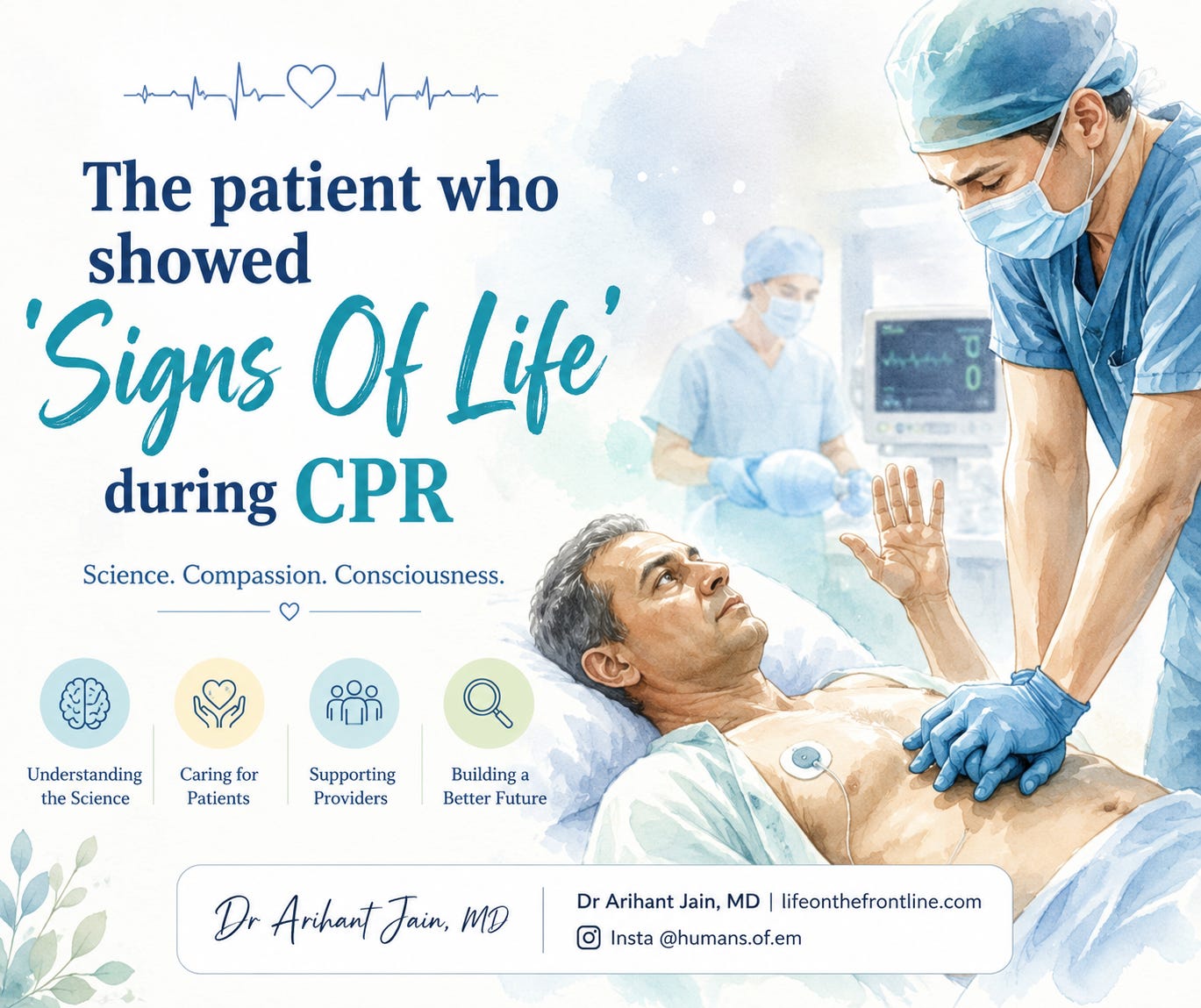
There are moments in emergency medicine/acute care that stay with you forever.
A patient in cardiac arrest.
No pulse. No measurable circulation.
A resuscitation in full motion.
And then suddenly—
The patient opens their eyes.
They try to push rescuers away.
They grimace in pain.
Some even attempt to speak.
The chest compressions stop for a pulse check earlier than complete cycle… and the movements disappear.
For decades, these moments were dismissed as anecdotal, misunderstood, or simply too uncomfortable to discuss openly. Today, however, a growing body of literature confirms that this phenomenon is real, increasingly recognized, and scientifically fascinating.
It is called CPR-Induced Consciousness (CPRIC).
What Exactly Is CPR-Induced Consciousness?
CPRIC refers to signs of awareness or purposeful neurological activity occurring during ongoing chest compressions, despite the absence of spontaneous circulation.
Patients may demonstrate:
Eye opening
Purposeful limb movement
Following commands
Speech or vocalization
Agitation or resistance to CPR
Emotional expression or pain response
What makes CPRIC unique is that these signs disappear when compressions stop. The “consciousness” exists only because CPR is generating enough cerebral perfusion to transiently sustain cortical activity.
In other words:
High-quality CPR may be creating a temporary bridge between death and consciousness.
(Abboud & Varanasi, 2022; West et al., 2022)
How Common Is It?
The true incidence remains uncertain, partly because many clinicians still hesitate to report or document it.
Current observational data estimate CPRIC occurs in approximately 0.23–0.9% of resuscitations (Doan et al., 2020; West et al., 2022; Brede et al., 2024).
That number may appear small. But in high-volume emergency systems worldwide, it translates to thousands of cases annually.
Even more striking:
Surveys suggest that nearly half of prehospital clinicians have witnessed CPRIC at least once in their careers (Gregory et al., 2021; Carty & Bury, 2022).
The phenomenon is no longer rare enough to ignore.
Why Does It Happen?
The physiology behind CPRIC challenges traditional assumptions about cardiac arrest.
For years, cardiac arrest was viewed as a binary state:
circulation absent
consciousness impossible
But modern resuscitation science paints a far more nuanced picture.
High-quality compressions—particularly with early initiation, shockable rhythms, and mechanical CPR devices—can generate sufficient cerebral blood flow to preserve intermittent higher neurological function.
This is supported by one of the most remarkable recent studies in resuscitation science:
The AWARE-II Study
In the multicenter study by Sam Parnia and colleagues (2023), continuous EEG monitoring during CPR demonstrated organized brain activity—including delta, theta, and alpha waves associated with consciousness—occurring up to 35–60 minutes into resuscitation.
This finding fundamentally changes our understanding of the dying brain. The brain during cardiac arrest may not simply “switch off.” Instead, consciousness may persist in fragmented, fluctuating, or covert forms far longer than previously believed.
CPRIC May Actually Signal Better Survival
Paradoxically, CPRIC may represent effective resuscitation rather than failed resuscitation.
Multiple studies have shown associations between CPRIC and:
higher ROSC rates
better survival to discharge
witnessed arrests
shockable rhythms
early CPR initiation
(Doan et al., 2020; Zhou & Sun, 2024)
This makes intuitive sense.
If compressions are generating enough cerebral perfusion to produce awareness, they are likely generating better systemic perfusion overall.
CPRIC may therefore be a marker of high-quality CPR physiology.
The Psychological Reality Nobody Talks About
For providers, CPRIC can be profoundly unsettling.
Emergency clinicians are trained to perform CPR on an unconscious patient. CPRIC breaks that expectation completely.
Some providers report:
hesitation to continue compressions
emotional distress
confusion about stopping CPR
intrusive recollections after the event
insomnia or mood changes afterward
(Gregory et al., 2021; Brede et al., 2024)
Imagine delivering chest compressions while a patient looks directly at you.
The ethical discomfort is enormous.
But perhaps the more important question is:
What does the patient experience?
Research suggests some survivors retain memories during resuscitation.
In AWARE-II, approximately 39% of interviewed survivors described experiences suggestive of consciousness during CPR, ranging from dream-like perceptions to vivid recollections (Parnia et al., 2023).
Another study by Jaffe et al. (2021) found higher rates of depression and possible PTSD among survivors who recalled awareness during cardiac arrest.
This forces us to confront a difficult possibility:
Some patients may be experiencing pain, fear, awareness, or distress while CPR is ongoing.
The Sedation Dilemma
And this is where resuscitation medicine enters ethically uncharted territory.
Should conscious patients during CPR receive sedation?
Current practice varies wildly.
Reported approaches include:
ketamine
fentanyl
midazolam
physical restraint
combinations of the above
(Pourmand et al., 2019; Switalski & Lechleuthner, 2025)
But there is a major problem:
Sedatives can worsen hypotension and impair perfusion during a state where circulation is already critically dependent on compressions.
So clinicians face competing priorities:
relieve suffering
preserve cerebral perfusion
avoid interrupting CPR
maintain team safety
And currently, there are no universally accepted international guidelines for managing CPRIC (West et al., 2022; Yusty-Prada et al., 2025).
CPRIC Is Forcing a Redefinition of Death
Historically, consciousness and pulse were inseparable.
CPRIC breaks that framework.
A patient can:
have no pulse
meet criteria for cardiac arrest
yet still demonstrate awareness
This blurs the boundary between life and death in ways medicine is only beginning to understand.
Perhaps cardiac arrest is not a singular event.
Perhaps it is a process.
And CPR—when performed effectively—may transiently reverse parts of that process in ways previously thought impossible.
What Needs to Happen Next?
The literature is clear on one thing:
We are only at the beginning of understanding CPRIC.
Future priorities must include:
standardized definitions
international reporting systems
sedation algorithms
EEG and perfusion studies
survivor psychological follow-up
provider debriefing frameworks
ethical guidance for conscious resuscitation
Because CPRIC is no longer an isolated curiosity.
It is now a legitimate frontier in resuscitation science.
Final Thoughts
Every emergency physician, paramedic, intensivist, and resuscitationist eventually learns that medicine is not always binary.
CPRIC reminds us of that in the most confronting way possible.
The patient with open eyes during CPR is not merely a dramatic anecdote.
They are evidence that modern resuscitation may be preserving fragments of consciousness far beyond what we once believed possible.
And perhaps the most important question is no longer:
“Can consciousness occur during CPR?”
But rather:
“What responsibility do we have once we know that it can?”
In Summary:
What CPR-Induced Consciousness Really Means
CPR-induced consciousness (CPRIC) is more than a resuscitation curiosity. It is likely a physiological marker of effective perfusion during cardiac arrest—and at the same time, a phenomenon with profound ethical, psychological, and clinical consequences.
What Positive Things Does CPRIC Indicate?
Current evidence suggests CPRIC is often associated with:
High-quality CPR
Better cerebral perfusion during compressions
Early recognition and treatment of arrest
Witnessed cardiac arrest
Shockable rhythms
Higher likelihood of ROSC and survival
(Doan et al., 2020; West et al., 2022)
In many ways, CPRIC may represent a “physiological success signal” during resuscitation—evidence that chest compressions are generating meaningful circulation to the brain.
It also challenges older assumptions that consciousness immediately disappears after cardiac arrest, opening new scientific understanding about the dying brain and cerebral resilience.
What Negative Consequences Can It Lead To?
Despite its possible association with better outcomes, CPRIC creates major challenges:
For the Patient
Potential pain and distress during compressions
Awareness of invasive procedures
Psychological trauma
Possible PTSD, depression, or recalled traumatic experiences
(Jaffe et al., 2021; Parnia et al., 2023)
For the Resuscitation Team
Hesitation to continue CPR
Increased interruptions in compressions
Emotional distress among providers
Ethical uncertainty regarding sedation and restraint
(Gregory et al., 2021; Brede et al., 2024)
For Systems of Care
Lack of protocols
Inconsistent sedation practices
No universally accepted international guidelines
Poor documentation and underreporting
(West et al., 2022; Zhou & Sun, 2024)
So What Is the Way Forward?
Until stronger evidence and formal guidelines emerge, the most reasonable approach is likely a balanced, physiology-driven strategy:
1. Recognize and confirm CPRIC Early
Providers should understand that purposeful movements during CPR do not necessarily indicate ROSC. Confirm using POCUS during next pulse check.
Stopping compressions repeatedly for pulse checks may worsen outcomes.
2. Prioritize Uninterrupted High-Quality CPR
The primary objective remains:
effective compressions
defibrillation when indicated
reversible cause management
CPRIC should not distract from core resuscitation priorities.
3. Develop Structured Sedation Protocols
Sedation may become necessary when:
CPR is interrupted
defibrillation becomes unsafe
patient agitation compromises resuscitation
But future protocols must balance:
patient comfort
cerebral perfusion
hemodynamic effects
provider safety
At present, ketamine is frequently discussed because of relative hemodynamic stability, but evidence remains limited.
4. Introduce Team Debriefing and Psychological Support
CPRIC events can be emotionally difficult for clinicians and survivors alike.
Formal debriefing should become part of post-resuscitation care.
5. Expand Research Aggressively
The next decade of resuscitation science should focus on:
EEG-guided CPR research
cerebral perfusion monitoring
sedation trials during CPR
long-term neuropsychological outcomes
ethical frameworks for conscious cardiac arrest
Because CPRIC may ultimately redefine not only how we perform resuscitation—but how we understand consciousness itself.
6. Avoid Premature Termination of Resuscitation
One important implication of CPRIC is that visible neurological activity may coexist with profoundly low-flow states during cardiac arrest.
When point-of-care ultrasound (POCUS) during pulse checks demonstrates cardiac standstill, clinicians should be cautious about prematurely terminating resuscitation if:
CPRIC is present,
high-quality CPR is ongoing,
and the patient remains within an active resuscitation pathway.
A practical approach may be to:
continue a complete cycle of uninterrupted high-quality CPR before making termination decisions,
reassess rhythm, physiology, and reversible causes systematically,
and avoid allowing transient CPRIC-related confusion to alter structured cardiac arrest management.
This is especially relevant because CPRIC itself indirectly indicates that compressions are generating meaningful cerebral perfusion.
At present, there is insufficient evidence to define how CPRIC should influence termination-of-resuscitation decisions, making this an important future research priority.
References
Abboud Y, Varanasi S. Cardiopulmonary resuscitation induced consciousness—A case report from United Arab Emirates. Open J Emerg Med. 2022;10(2). doi:10.4236/ojem.2022.102007
Atbi A, Mandhari A, Reesi A. Cardiopulmonary resuscitation induced consciousness: A case report. Oman Med J. 2022;37:e356. doi:10.5001/omj.2021.51
Brede J, Skjærseth E, Rehn M. Prehospital anaesthesiologists experience with cardiopulmonary resuscitation-induced consciousness in Norway – A national cross-sectional survey. Resuscitation Plus. 2024;18. doi:10.1016/j.resplu.2024.100591
Carty N, Bury G. Prehospital practitioner awareness and experience of CPR-induced consciousness. J Paramed Pract. 2022;14(9):358-364. doi:10.12968/jpar.2022.14.9.358
De Sousa Arci M, De Sá L, Oliveira L, et al. Cardiopulmonary resuscitation-induced consciousness (CPRIC): Occurrence and perception of health professionals and firemen. Int J Cardiovasc Sci. 2025. doi:10.36660/ijcs.20240130
Doan T, Adams L, Schultz B, et al. Insights into the epidemiology of cardiopulmonary resuscitation-induced consciousness in out-of-hospital cardiac arrest. Emerg Med Australas. 2020;32. doi:10.1111/1742-6723.13505
Gregory P, Mays B, Kilner T, Sudron C. An exploration of UK paramedics’ experiences of cardiopulmonary resuscitation-induced consciousness. Br Paramed J. 2021;5(4):9-17. doi:10.29045/14784726.2021.3.5.4.9
Hoa N, Cong D, Diep N. Cardiopulmonary resuscitation induced consciousness in asystolic cardiac arrest: A case report from Vinmec Smart City Hospital, Vietnam. Asian J Med Health. 2025. doi:10.9734/ajmah/2025/v23i101306
Jaffe I, Shirazi T, Gonzales A, Parnia S. Psychological outcomes and awareness during CPR in cardiac arrest survivors. Chest. 2021. doi:10.1016/j.chest.2021.07.1028
Mansour A, Ali L, Abbas Y, et al. An unusual resuscitation experience: The phenomenon of CPR-induced consciousness. Glob J Crit Care Emerg Med. 2025. doi:10.33425/3065-5641.1013
Migiel Ł, Darocha T, Hymczak H, et al. CPR-induced consciousness in hypothermic cardiac arrest: Where is the limit of tolerance of the human brain? A case report. Scand J Trauma Resusc Emerg Med. 2025;33. doi:10.1186/s13049-025-01426-y
Olaussen A, Shepherd M, Nehme Z, Smith K, Bernard S, Mitra B. Return of consciousness during ongoing cardiopulmonary resuscitation: A systematic review. Resuscitation. 2015;86:44-48. doi:10.1016/j.resuscitation.2014.10.017
Parnia S, Shirazi T, Patel J, et al. AWAREness during REsuscitation-II: A multicenter study of consciousness and awareness in cardiac arrest. Resuscitation. 2023. doi:10.2139/ssrn.4246760
Pourmand A, Hill B, Yamane D, Kuhl E. Approach to cardiopulmonary resuscitation induced consciousness, an emergency medicine perspective. Am J Emerg Med. 2019;37(4):751-756. doi:10.1016/j.ajem.2019.01.051
Switalski J, Lechleuthner A. Cardiopulmonary resuscitation-induced consciousness (CPRIC). Die Anaesthesiologie. 2025;74:765-776. doi:10.1007/s00101-025-01593-8
West R, Otto Q, Drennan I, et al. CPR-related cognitive activity, consciousness, awareness and recall, and its management: A scoping review. Resuscitation Plus. 2022;10. doi:10.1016/j.resplu.2022.100241
Yusty-Prada J, Portuguez-Jaramillo N, Piñeros-Alvarez J. Cardiopulmonary resuscitation-induced consciousness in an elderly patient: A case report in the prehospital setting. Int J Emerg Med. 2025;18. doi:10.1186/s12245-025-01032-w
Zhou X, Sun B. CPR-induced consciousness during ventricular fibrillation: Case report and literature review. Emerg Med Int. 2024;2024. doi:10.1155/2024/2834376