

“The most dangerous complication of vasopressor therapy may not be extravasation. It may be delay.”
By-
Dr Arihant Jain, MD | lifeonthefrontline.com
Instagram: @humans.of.em
X | Linkedin | ORCID
————————

A patient arrives in septic shock. Blood pressure is 72/40 mmHg. The lactate is climbing. Capillary refill is prolonged. The patient needs vasopressors.
Yet in many emergency departments and ICUs, treatment pauses while clinicians prepare for central venous access.
The assumption is simple:
Central line first. Vasopressors second.
But modern evidence increasingly challenges this approach.
The Cost of Waiting
Shock is fundamentally a disease of inadequate tissue perfusion.
Every minute of persistent hypotension contributes to worsening organ dysfunction, cellular hypoxia, and increased mortality.
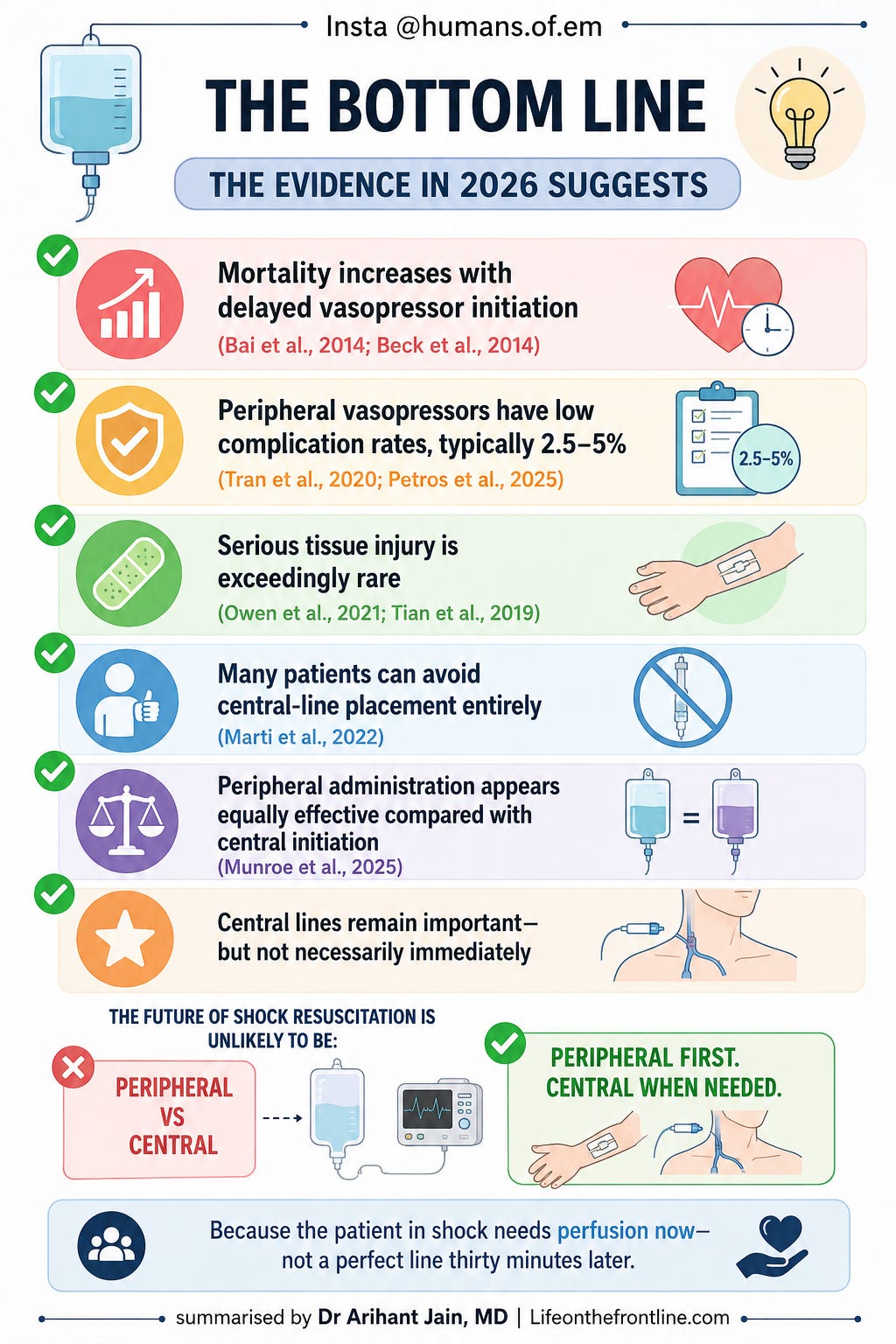
Perhaps one of the most compelling reasons to reconsider routine delays for central line placement comes from studies examining the timing of vasopressor initiation. In septic shock, mortality increases by approximately 2–3% for every hour delay in vasopressor administration after shock recognition (Bai et al., 2014; Beck et al., 2014).
In other words:
The patient is not waiting for a central line. Their organs are not waiting either.
Where Did the Fear Come From?
Historically, vasopressors were considered unsafe for peripheral administration because of concerns regarding extravasation, tissue necrosis, and limb ischemia.
Many of these concerns arose from older reports involving distal intravenous sites, prolonged infusions, small-caliber catheters, and limited monitoring (Loubani & Green, 2015).
Over time, anecdote became dogma. However, contemporary evidence paints a very different picture.
What Does the Modern Evidence Show?
A systematic review by Tian et al. (2019) evaluated 1,382 patients receiving peripheral vasopressors and found an extravasation rate of just 3.4%, with no reported tissue necrosis or limb ischemia.
A larger meta-analysis by Owen et al. (2021) involving more than 16,000 patients reported an overall adverse event rate of only 1.8% in adults, with most complications consisting of mild extravasation, erythema, or phlebitis.
More recently, Wu et al. (2025) analyzed 6,852 patients and reported:
Extravasation: 1.43%
Thrombosis: 1.47%
Infection: 0.72%
Across modern cohorts and systematic reviews, the overall complication rate of peripheral vasopressors generally ranges between 2.5–5%, with the overwhelming majority of events being minor and managed conservatively (Tran et al., 2020; Zichichi et al., 2024; Petros et al., 2025).
Most importantly, contemporary prospective studies have reported virtually no requirement for surgical intervention following peripheral vasopressor extravasation (Petros et al., 2025; Asher et al., 2023).
Central Lines Are Not Risk-Free
When discussing peripheral vasopressors, clinicians often focus on what could go wrong. But central venous catheters carry their own complications:
Pneumothorax
Hemothorax
Arterial puncture
Arterial cannulation
Major bleeding
Venous thrombosis
Catheter-associated bloodstream infections (CLABSI)
Serious central-line complications occur in approximately 3% of insertions and remain an important source of patient morbidity (Chen et al., 2025).
In the CLOVERS secondary analysis, peripheral vasopressor complications occurred in only 0.6% of patients, compared with 3.7% central-line complications (Munroe et al., 2025).
The comparison therefore is not:
Risk versus no risk
It is:
Peripheral risks versus central-line risks.
Does Peripheral Administration Affect Mortality?
The answer appears to be no.
Multiple contemporary studies have demonstrated comparable outcomes between peripheral and central vasopressor initiation (Delaney et al., 2020; Asher et al., 2023; Munroe et al., 2023; Munroe et al., 2025; Shyu et al., 2025).
Across these studies:
Mortality was similar
Clinical effectiveness was similar
Organ support requirements were similar
No convincing evidence suggests that initiating vasopressors through a peripheral IV worsens outcomes.
Another Unexpected Benefit: Fewer Central Lines
One of the most consistent findings across modern studies is that many patients never require a central venous catheter at all. Institutions implementing peripheral vasopressor protocols have demonstrated that approximately 30–60% of patients started on peripheral vasopressors avoid central-line placement altogether (Marti et al., 2022; Dansereau et al., 2024; Shyu et al., 2025).
This translates into:
Fewer invasive procedures
Lower CLABSI risk
Reduced procedural complications
Lower healthcare costs
Location Matters: Where Should We Place the IV?
Not all peripheral lines are created equal.
Avoid
❌ Hand veins
❌ Wrist veins
These smaller distal veins are associated with higher risks of infiltration and tissue injury.
Use Caution
⚠️ Antecubital fossa
Although commonly used during resuscitation, frequent elbow movement can lead to catheter dislodgement, delayed recognition of infiltration, and increased extravasation risk.
Preferred Sites
✅ Mid-forearm veins
✅ Basilic vein
✅ Cephalic vein
✅ External jugular vein
The ideal site is a large-caliber vein with reliable blood flow and minimal catheter movement.
Monitoring Is More Important Than the Catheter
The safest peripheral vasopressor protocol is not a specific gauge or brand of catheter.
It is vigilance. Evidence-based recommendations emphasize:
Dedicated vasopressor line
Frequent site inspection
Documentation of catheter location
Verification of patency
Assessment at the start of every nursing shift
Structured monitoring protocols consistently demonstrate lower complication rates than non-protocolized care (Tran et al., 2020; Chen et al., 2025).
How Long Can Peripheral Vasopressors Be Used?
(Inspired by Dr Eddy’s lecture in ResusX’ 26)
Follow & Subscribe - Dr Eddy - for top notch similar content !
Traditionally many institutions restricted peripheral vasopressors to 24 hours.
However, contemporary evidence suggests this limit may be unnecessarily conservative.
Most studies report average infusion durations between 12 and 24 hours (Tian et al., 2019; Owen et al., 2021).
More recent protocolized programs have demonstrated safe administration for up to 48 hours, and occasionally longer, when strict monitoring protocols are followed (Marti et al., 2022; Zichichi et al., 2024; Petros et al., 2025).
The risk appears to rise substantially only with prolonged administration extending over several days.
How Much Vasopressor Can Be Given Peripherally?
There is currently no universally accepted upper dose limit.
However, contemporary literature reports successful peripheral administration at doses approaching:
Norepinephrine
Up to approximately 0.7 mcg/kg/min
(≈48 mcg/min in a 70-kg adult)
Phenylephrine
Up to approximately 3.5 mcg/kg/min
(≈200 mcg/min)
Epinephrine
Up to approximately 0.3 mcg/kg/min
(≈13 mcg/min)
Vasopressin
Up to 0.08 units/min
These represent reported doses from observational studies and institutional protocols rather than universally validated safety thresholds (Marti et al., 2022; Chen et al., 2025; Zichichi et al., 2024).
Many institutions also mitigate risk by administering vasopressors at lower concentrations when peripheral access is used.
What If Extravasation Occurs?
Extravasation remains uncommon, but every clinician administering peripheral vasopressors should know how to respond.
The severity ranges from:
Grade 1
Minor swelling or leakage
Grade 2
Localized tissue injury
Grade 3–4
Progressive ischemia, tissue compromise, or necrosis
Fortunately, severe injuries remain exceptionally rare (Tran et al., 2020; Owen et al., 2021).
Immediate Management of Extravasation
Step 1
Stop the infusion immediately.
Step 2
Leave the catheter in place.
Step 3
Attempt aspiration through the existing catheter to remove as much infiltrated drug as possible.
Step 4
Outline and photograph the affected area.
Step 5
Document the event thoroughly.
Step 6
Administer antidotes when indicated.
For catecholamine vasopressors:
Phentolamine remains the preferred antidote and should be infiltrated locally using sterile technique and a small-gauge needle.
For vasopressin extravasation:
No specific antidote currently exists. Topical nitroglycerin paste may be considered.
Step 7
Monitor progression closely.
Grade 3–4 injuries warrant early surgical consultation.
The goal is simple:
Document. Learn. Improve. Prevent recurrence.
Where Do We Go From Here?
Despite rapidly accumulating evidence, an important limitation remains. Nearly all available literature consists of observational studies, cohort studies, systematic reviews, and meta-analyses. Large definitive randomized controlled trials are still lacking. A pilot randomized trial evaluating peripheral versus central vasopressor strategies is currently underway (NCT06920173) and may provide important answers regarding safety and efficacy.
Until then, the available evidence strongly supports development of institutional protocols that allow protocolized peripheral vasopressor administration during the early phases of shock resuscitation.
References
Bai X, Yu W, Ji W, et al. Early versus delayed administration of norepinephrine in patients with septic shock. Crit Care. 2014;18(5):532. doi:10.1186/s13054-014-0532-y
Beck V, Chateau D, Bryson GL, et al. Timing of vasopressor initiation and mortality in septic shock: a cohort study. Crit Care. 2014;18(3):R97. doi:10.1186/cc13868
Tian DH, Smyth C, Keijzers G, et al. Safety of peripheral administration of vasopressor medications: a systematic review. Emerg Med Australas. 2020;32(2):220-227. doi:10.1111/1742-6723.13406
Owen VS, Rosgen BK, Cherak SJ, et al. Adverse events associated with administration of vasopressor medications through a peripheral intravenous catheter: a systematic review and meta-analysis. Crit Care. 2021;25(1):146. doi:10.1186/s13054-021-03553-1
Tran QK, Mester G, Bzhilyanskaya V, et al. Complication of vasopressor infusion through peripheral venous catheter: a systematic review and meta-analysis. Am J Emerg Med. 2020;38(11):2434-2443. doi:10.1016/j.ajem.2020.09.047
Delaney A, Finnis M, Bellomo R, et al. Initiation of vasopressor infusions via peripheral versus central access in patients with early septic shock: a retrospective cohort study. Emerg Med Australas. 2020;32(2):210-219. doi:10.1111/1742-6723.13394
Marti K, Hartley C, Sweeney E, Mah J, Pugliese N. Evaluation of the safety of a novel peripheral vasopressor pilot program and the impact on central line placement in medical and surgical intensive care units. Am J Health Syst Pharm. 2022;79(24):2238-2245. doi:10.1093/ajhp/zxac144
Asher E, Karameh H, Nassar H, et al. Safety and outcomes of peripherally administered vasopressor infusion in patients admitted with shock to an intensive cardiac care unit: a single-center prospective study. J Clin Med. 2023;12(17):5734. doi:10.3390/jcm12175734
Dansereau A, Marti K, Mah J, Pugliese N. Evaluation of the safety and efficacy of peripheral vasopressors to decrease central line placement and associated bloodstream infections. J Infect Prev. 2024;25(4):153-160. doi:10.1177/17571774241245437
Zichichi A, Wallace R, Daniell J, et al. Safety of peripherally infused sympathomimetic vasopressors in the intensive care unit and emergency department. Ann Pharmacother. 2024;59(4):397-405. doi:10.1177/10600280241284796
Chen G, Shen C, Pan C, et al. Summary of best evidence for safe management of vasopressors through peripheral intravenous catheters. BMC Nurs. 2025;24:35. doi:10.1186/s12912-025-03635-3
Munroe E, Co I, Douglas IS, et al. Peripheral vasopressor use in early sepsis-induced hypotension. JAMA Netw Open. 2025;8(7):e2529148. doi:10.1001/jamanetworkopen.2025.29148
Petros A, Melkie A, Kotiso K, et al. Peripheral line for vasopressor administration: prospective multicenter observational cohort study for survival and safety. PLoS One. 2025;20:e0333275. doi:10.1371/journal.pone.0333275
Wu W, Yang X, Kou L. Extravasation, thrombosis, and infection with vasopressor infusion through peripheral intravenous catheters: a systematic review and meta-analysis. Cardiovasc Diagn Ther. 2025;15(3):847-860. doi:10.21037/cdt-2025-290
Shyu D, Ingraham N, Linke C, et al. Overview of peripheral vasopressor usage in an academic health system. Ann Am Thorac Soc. 2025. doi:10.1513/AnnalsATS.202411-1135OC
Loubani OM, Green RS. A systematic review of extravasation and local tissue injury from administration of vasopressors through peripheral intravenous catheters and central venous catheters. J Crit Care. 2015;30(3):653.e9-653.e17. doi:10.1016/j.jcrc.2015.01.014
Brewer JM, Puskarich MA, Jones AE. Can vasopressors safely be administered through peripheral intravenous catheters compared with central venous catheters? Ann Emerg Med. 2015;66(6):629-631. doi:10.1016/j.annemergmed.2015.05.026
The strongest part of this argument is that it changes the moral status of waiting.
In clinical practice, delay often does not look like delay from the inside. It looks like caution, like preparation, like fidelity to the procedure we were taught to trust. That is why it is so hard to challenge: nobody feels as if they are withholding treatment, they feel as if they are preventing harm.
But the body in shock does not receive our caution as caution. It receives it as time without perfusion. That is the uncomfortable shift your piece makes visible: the risk we are trying to avoid has to be weighed against the risk we are actively creating while we avoid it.
This is where a protocol does its real work, not by making anyone less careful, but by protecting action from a fear the data has already outgrown.
Which may be the deeper lesson. Sometimes the dangerous dogma is not an obviously wrong action. It is a cautious pause that still feels virtuous after the evidence has moved on.