

By-
Dr Arihant Jain, MD | lifeonthefrontline.com
Instagram: @humans.of.em
X | Linkedin | ORCID
—————————————————————
The Patient in Front of You
It’s 2 AM.
A 72-year-old woman arrives in your Emergency Department with new-onset atrial fibrillation. Her CHA₂DS₂-VASc score is 4.
A few bays away, a 55-year-old man is diagnosed with a segmental pulmonary embolism.
Meanwhile, the oncology service calls regarding a patient with metastatic colon cancer and recurrent DVT despite anticoagulation.
Three patients. Three thrombotic problems. One recurring question:
Which anticoagulant should we choose ?
Not long ago, the answer was usually warfarin.
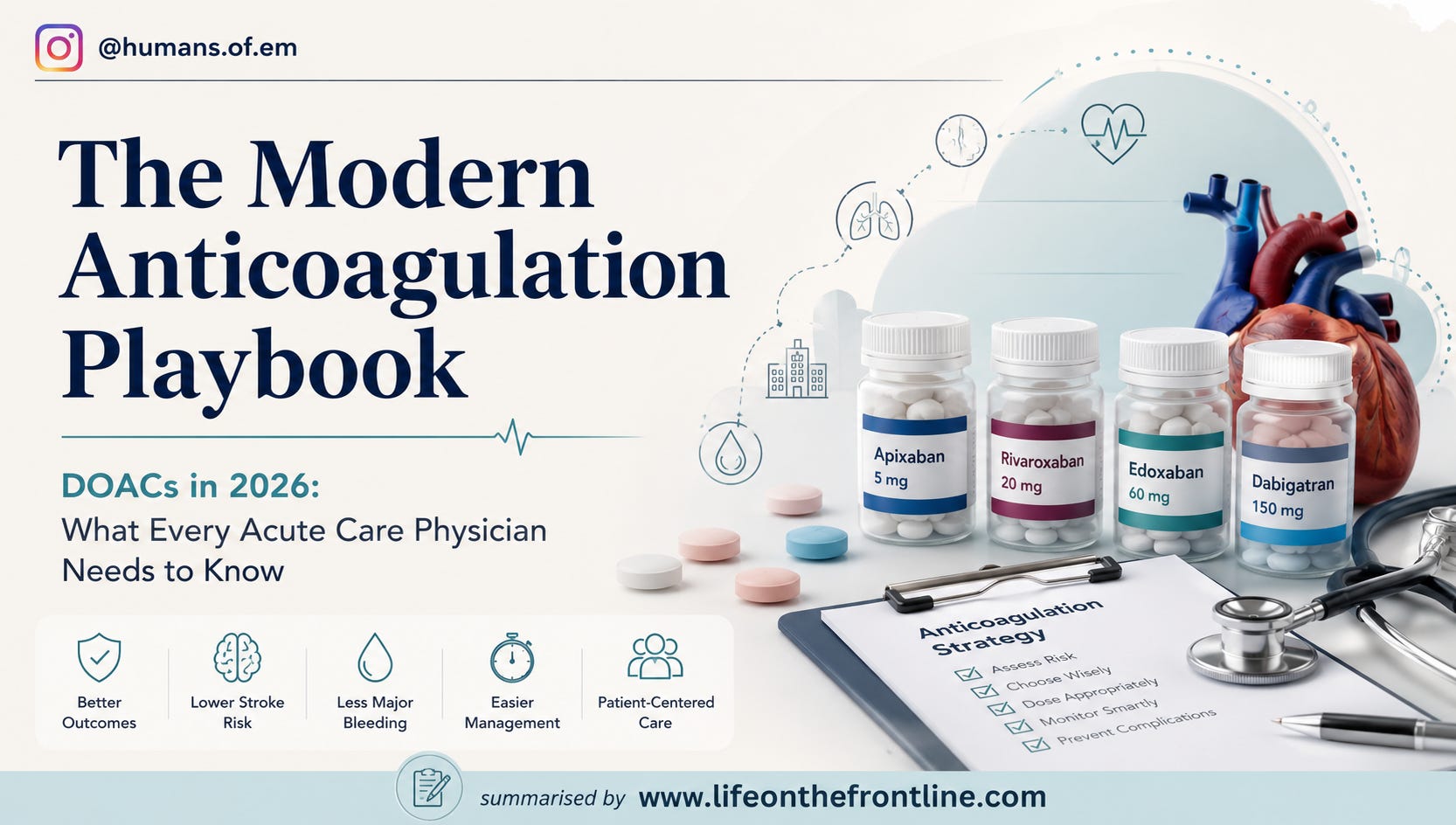
Today, Direct Oral Anticoagulants (DOACs) have fundamentally changed how we prevent and treat thromboembolic disease. The recently released 2026 ACC Scientific Statement represents perhaps the most comprehensive modern review of DOAC use across atrial fibrillation, venous thromboembolism, cancer-associated thrombosis, stroke prevention, and special populations (Kumbhani et al., 2026).
But while DOACs have become standard therapy, their optimal use remains surprisingly misunderstood. This article explores what has changed, what hasn’t, and how acute care physicians should approach anticoagulation in 2026.
Why DOACs Changed Everything
For decades, warfarin dominated anticoagulation. It worked, but it came with significant challenges:
Narrow therapeutic window
Frequent INR monitoring
Numerous food interactions
Multiple drug interactions
High variability between patients
DOACs were developed to overcome these limitations and now account for nearly 80% of oral anticoagulant prescriptions in many regions (Kumbhani et al., 2026).
The currently available DOACs include:
Factor Xa inhibitors
Apixaban
Rivaroxaban
Edoxaban
Direct thrombin inhibitor
Dabigatran
(Kumbhani et al., 2026)
Unlike warfarin, these agents provide predictable pharmacokinetics, fixed dosing, and generally do not require routine laboratory monitoring (Kumbhani et al., 2026).
The result?
A simpler, safer, and often more effective approach to anticoagulation.
The Most Important Update: Think Risk, Not Scores
One of the subtle but important shifts highlighted in the ACC statement is that anticoagulation decisions should increasingly be based on absolute thromboembolic risk rather than rigid dependence on CHA₂DS₂-VASc alone (Kumbhani et al., 2026).
Historically, clinicians memorized:
CHA₂DS₂-VASc ≥2 → anti-coagulate
CHA₂DS₂-VASc <2 → don’t
Reality is more nuanced. Patients with similar scores may have markedly different actual stroke risks depending on AF burden, cardiac substrate, renal function, and co-morbidities.
The modern approach emphasizes:
Shared decision-making
Individualized risk assessment
Consideration of additional modifiers beyond traditional scoring systems
(Kumbhani et al., 2026).
Atrial Fibrillation: DOACs Are the New Default
For most patients with atrial fibrillation requiring anticoagulation, DOACs are now unequivocally preferred over warfarin (Kumbhani et al., 2026).
The reasons are straightforward:
Similar or better stroke prevention
Less intracranial hemorrhage
Easier use
No INR monitoring
The ACC Scientific Statement strongly supports DOACs as first-line therapy for non-valvular AF.
But There Are Two Major Exceptions
1. Mechanical Heart Valves
Despite years of hope, DOACs remain unsuitable. The RE-ALIGN trial demonstrated excess thromboembolic events and bleeding with dabigatran compared with warfarin in mechanical valve patients (Eikelboom et al., 2013).
More recently, the PROACT Xa trial showed higher rates of valve thrombosis and thromboembolic events with apixaban compared with warfarin (Kumbhani et al., 2026).
For mechanical valves:
Warfarin remains king.
2. Rheumatic Mitral Stenosis
The INVICTUS trial demonstrated superior outcomes with vitamin K antagonists compared with rivaroxaban among patients with rheumatic heart disease and AF (Connolly et al., 2022; Kumbhani et al., 2026).
This remains another domain where warfarin continues to outperform DOACs.
Acute VTE: The Era of DOAC Dominance
The management of DVT and PE has changed dramatically. Multiple pivotal trials and meta-analyses have demonstrated that DOACs achieve similar efficacy with less major bleeding than warfarin (Kumbhani et al., 2026).
Today:
DOACs are first-line treatment for most patients with acute VTE.
(Kumbhani et al., 2026)
Is Apixaban Becoming the Preferred DOAC?
If one theme repeatedly emerges throughout contemporary literature, it is the growing prominence of apixaban.
The 2026 ACC statement notes that recent evidence suggests an apixaban-based strategy may be associated with lower bleeding compared with rivaroxaban during VTE treatment (Kumbhani et al., 2026).
The COBRRA trial further strengthened this observation, showing lower bleeding rates with apixaban in acute VTE management (Kumbhani et al., 2026).
Additionally, the ACC consensus highlights apixaban as the preferred option in:
Frailty
Advanced age
Prior bleeding
Chronic kidney disease
(Kumbhani et al., 2026).
This does not mean rivaroxaban is obsolete. It means that when uncertainty exists, apixaban increasingly appears to offer the best balance between efficacy and safety.
The Most Common Mistake: Stopping Too Early
Many clinicians continue to think of anticoagulation as a 3–6 month treatment. For many patients, this is no longer true.
The ACC statement emphasizes extended anticoagulation for:
Unprovoked VTE
Recurrent VTE
Persistent risk factors
High recurrence risk profiles
(Kumbhani et al., 2026).
In these patients:
The question is not whether treatment lasts beyond six months.
The question is whether treatment should ever stop.
Cancer-Associated Thrombosis: One of the Biggest Changes in Modern Medicine
Perhaps no area has evolved faster than cancer-associated thrombosis (CAT). For years, LMWH was the unquestioned standard.
That paradigm has shifted. A 2022 meta-analysis by Frère et al. demonstrated significantly lower recurrent VTE rates with DOACs compared with LMWH, without differences in mortality.
Similarly, Schrag et al. (2023) reported recurrent VTE rates of 6.1% versus 8.8% in favor of DOACs during a randomized trial involving cancer patients.
The strongest contemporary evidence supports:
Apixaban
Edoxaban
Rivaroxaban
for selected cancer patients (Masini et al., 2023; Fujisaki et al., 2024).
But Not Every Cancer Patient Is the Same
Bleeding risk remains highly tumor-specific. The literature consistently identifies:
Gastrointestinal cancers
Gastroesophageal tumors
Some genitourinary malignancies
as populations where bleeding risk may outweigh benefits (O’Connell et al., 2020; Sabatino et al., 2020; Masini et al., 2023).
This is where individualized medicine still matters.
Chronic Kidney Disease: A Persistent Challenge
Anticoagulation in advanced CKD remains difficult. Evidence remains limited, particularly in dialysis populations.
The ACC statement concludes:
Apixaban may be considered in dialysis patients
Dabigatran should generally be avoided
(Kumbhani et al., 2026).
For acute care physicians, this often translates into one practical rule:
If severe renal dysfunction is present, pause before reflexively prescribing a DOAC.
Obesity: Time to Retire an Old Myth
Many clinicians remain hesitant to prescribe DOACs in severe obesity. Current evidence no longer strongly supports this concern.
The ACC statement specifically endorses:
Apixaban
Rivaroxaban
for patients with BMI ≥40 kg/m² (Kumbhani et al., 2026). The assumption that obesity automatically requires warfarin is increasingly outdated.
What If Your Hospital Doesn’t Have Reversal Agents?
This question frequently arises in low- and middle-income settings. Can DOACs still be used if idarucizumab or andexanet alfa are unavailable?
The literature suggests yes.
Reviews by Weitz (2017), Chaudhary et al. (2019), and Grottke et al. (2024) conclude that most DOAC-associated bleeding can be managed through supportive care, temporary drug interruption, and standard resuscitative measures.
Specific antidotes are primarily reserved for:
Life-threatening bleeding
Catastrophic hemorrhage
Emergency surgery
(Gómez-Outes et al., 2023; Grottke et al., 2024).
When antidotes are unavailable, PCCs remain a reasonable rescue strategy despite lower-quality evidence (Pozzi et al., 2024; Tran et al., 2025).
The practical message:
DOACs do not require onsite antidotes to be prescribed safely.
However, hospitals should maintain protocols for catastrophic bleeding management.
The Future: Beyond AF and DVT
The 2026 ACC Scientific Statement hints at the future direction of anticoagulation.
Emerging areas include:
Device-detected subclinical AF
Atrial myopathy
Post-ablation anticoagulation
Left atrial appendage closure strategies
Expanded cancer-associated thrombosis pathways
(Kumbhani et al., 2026).
Many of tomorrow’s anticoagulation decisions may depend less on rhythm and more on underlying atrial disease biology.
Pulse Check
A decade ago, anticoagulation was largely a warfarin-versus-not-warfarin discussion.
In 2026, the conversation has evolved.
DOACs have become the default anticoagulants for most patients with atrial fibrillation and venous thromboembolism. Yet success lies not in prescribing them blindly, but in selecting the right drug, at the right dose, for the right patient.
The emergency physician’s challenge is no longer:
“Should I anticoagulate?”
It is:
“Which anticoagulant offers this patient the greatest net clinical benefit?”
Increasingly, the answer is a DOAC.
And more often than not, it may be apixaban.
References
Kumbhani DJ, et al. 2026 ACC Scientific Statement on Direct Oral Anticoagulants.
Frère C, et al. 2022.
Schrag D, et al. JAMA. 2023.
Fujisaki T, et al. JACC CardioOncology. 2024.
Grottke O, et al. Eur J Anaesthesiol. 2024.
Tran HA, et al. Internal Medicine Journal. 2025.
Weitz JI. Semin Respir Crit Care Med. 2017.
Chaudhary R, et al. J Thromb Thrombolysis. 2019.
Masini M, et al. Curr Oncol Rep. 2023.
O’Connell C, et al. The Oncologist. 2020.
Sabatino J, et al. JACC CardioOncology. 2020.
What stands out to me is the shift from simply asking “Does this patient need anticoagulation?” to “Which anticoagulation strategy best fits this patient’s thrombotic and bleeding phenotype?”, a much more clinically meaningful way to think about net benefit.
This is a great example of how modern anticoagulation has evolved from a relatively blunt approach into increasingly individualized risk management. The central challenge is always balancing two competing risks: preventing thromboembolism while minimizing clinically significant bleeding.
As a physician-scientist, I think the most important shift is moving beyond the idea that there is one “best” anticoagulant for everyone. The right choice depends on the indication, kidney and liver function, age, comorbidities, drug interactions, adherence, procedural plans, and critically, the patient’s individual risk of both thrombosis and bleeding.
What makes this field particularly interesting is how rapidly the evidence continues to evolve. Newer agents and reversal strategies have expanded our options, while better risk stratification and monitoring may allow us to tailor treatment more precisely.
Thank you!