

By-
Dr Arihant Jain, MD | lifeonthefrontline.com
Instagram: @humans.of.em
X - dr__hunt
—————————————————————————
It was a little after 9 PM when I walked into the observation area for my night shift. Among the many patients waiting for care was a frail eight-year-old boy.
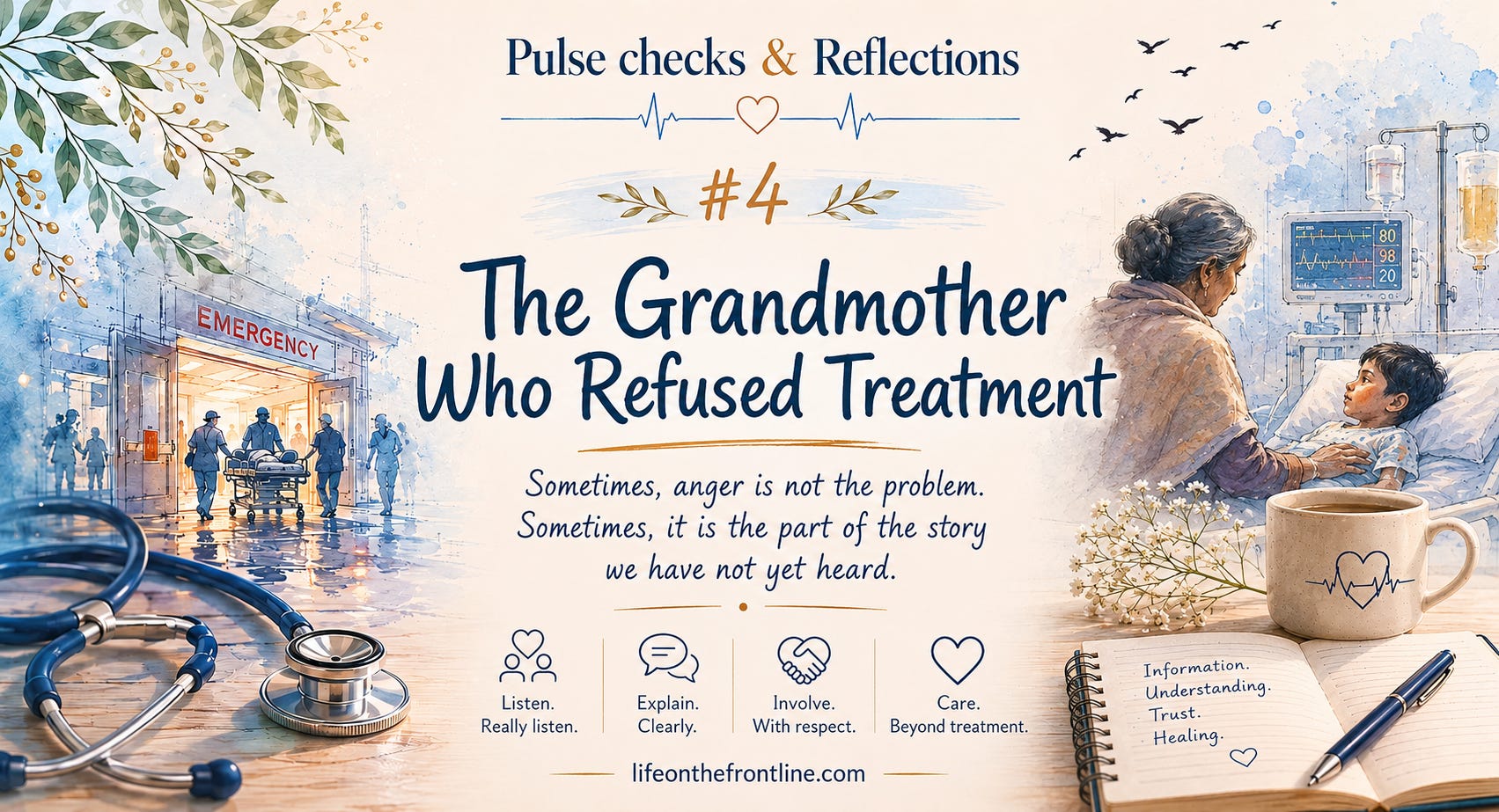
He was thin, malnourished, and battling aplastic anemia. His hemoglobin was critically low. His platelet counts were dangerously reduced. Earlier imaging had revealed a small intracranial bleed—a consequence of the severe thrombocytopenia. Fortunately, he was awake, talking, and neurologically intact.
Beside him sat his grandmother. She looked tired. More than tired—angry. At first, it was easy to mistake that anger for hostility. Around midnight, the platelets arrived. Within minutes, voices began rising from the bedside.
“Why are you giving him this yellow fluid?”
“He has a blood disease.”
“He needs blood.”
“No one is listening to me.”
My junior resident and the nursing staff tried to continue the transfusion, but the grandmother resisted. At one point, she removed the transfusion herself. The situation quickly became tense.
From the healthcare team’s perspective, the treatment plan was straightforward.
The child had active bleeding inside his skull. Platelets were urgently needed to reduce the risk of further hemorrhage. Red blood cells would also be transfused, but in carefully calculated doses appropriate for his weight. Giving multiple units rapidly was neither safe nor necessary.
Medically, the plan made perfect sense. But there was a problem. Nobody had explained it to her. To understand what was happening, we need to step away from the monitor and look at the person sitting beside the bed.
This grandmother had become everything for that child.
The burden of a chronic blood disorder had slowly pushed everyone else away. She was the one accompanying him to hospital visits, standing in outpatient queues, arranging previous transfusions, and somehow earning enough to keep life moving. Over time, she had learned one thing:
Whenever her grandson became weak, he needed blood.
That was the pattern she understood. That was the reality she had lived. Now she was being told that the doctors were refusing to give blood and were instead hanging a yellow-colored bag she had never seen before. From her perspective, it looked as though the people caring for her grandson were ignoring the obvious.
Her anger was not opposition. It was fear. It was exhaustion. It was love trying to protect someone when it did not have enough information to understand what was happening. When we sat down and explained the situation, everything changed.
We explained that her grandson was bleeding inside his brain. We explained the role of yellow fluid (platelets). We explained why platelets were more urgent than red blood cells at that moment. We explained why blood transfusions had to be given carefully slowly and safely. Most importantly, we explained the plan.
For the first time that night, she could see what we were seeing. The resistance disappeared. The arguments stopped. She agreed to treatment.
The next morning, she thanked the team. The art of medicine had not changed.
The communication had. As we grow older in this profession, many of us realize that some of the biggest challenges in medicine are not clinical.
They are human.
Families enter emergency departments carrying fear, financial stress, exhaustion, grief, and uncertainty. They are suddenly surrounded by unfamiliar equipment, unfamiliar medications, unfamiliar decisions, and unfamiliar language. When they don’t understand what is happening, that fear often comes out as anger.
Sometimes we label them as difficult. Sometimes we become frustrated. Sometimes, in the exhaustion of a busy shift, we forget that they are trying to make sense of a world that is completely foreign to them.
Communication is often viewed as a soft skill. In reality, it is a clinical skill.
‘Good communication prevents conflict.
Good communication improves adherence to treatment.
Good communication builds trust.
Good communication protects patients, families, and healthcare workers alike.’
In another setting, with a different relative, this encounter could easily have escalated into verbal abuse or even violence. The ingredients were all there: fear, misunderstanding, emotional distress, and a crowded emergency department.
The solution was not a better transfusion. It was a better conversation.
This was not a failure of an individual doctor, nurse, or family member. It was a reminder of a system under pressure, where exhausted clinicians care for more patients than time allows and where explanations are often sacrificed to urgency. Yet those few minutes spent explaining may be among the most important interventions we perform. Because medicine is not only about making the right decision.
It is about helping others understand why that decision is right. Sometimes the difference between conflict and cooperation is not another test, another drug, or another procedure. Sometimes it is simply a chair pulled beside a worried grandmother and a conversation she desperately needed to hear.
Pulse Checks and Reflection
Before we ask why a family member is angry, perhaps we should first ask:
‘What important piece of the story do they not know yet?
A grandmother saw a yellow bag.
We saw platelets.
She saw delay in correct treatment.
We saw protection.
She saw danger.
We saw treatment.
Between what she saw
and what we knew
stood only a conversation.
And sometimes,
the distance between conflict and trust
is no greater than that.’