By-
Dr Arihant Jain, MD | lifeonthefrontline.com
Instagram: @humans.of.em
X | Linkedin | ORCID
————————
The tube is in. The monitor looks better. Everyone exhales.
And then the team moves on.
The difficult airway is over. The checklist is complete. The adrenaline fades.
But here’s the uncomfortable truth:
Your patient is still critically ill.
In fact, the first 15–30 minutes after intubation may be among the most dangerous periods in the entire resuscitation.
Over the last decade, emergency medicine has dramatically improved its focus on pre-intubation optimization. We talk about delayed sequence intubation, hemodynamic resuscitation, apneic oxygenation, ketamine versus etomidate, and peri-intubation hypotension.
Yet I continue to see a recurring problem:
Once the tube passes the cords, many clinicians mentally declare victory.
The patient is “airway secured,” and attention shifts elsewhere. But intubation is not the endpoint of resuscitation.
It is only the beginning.
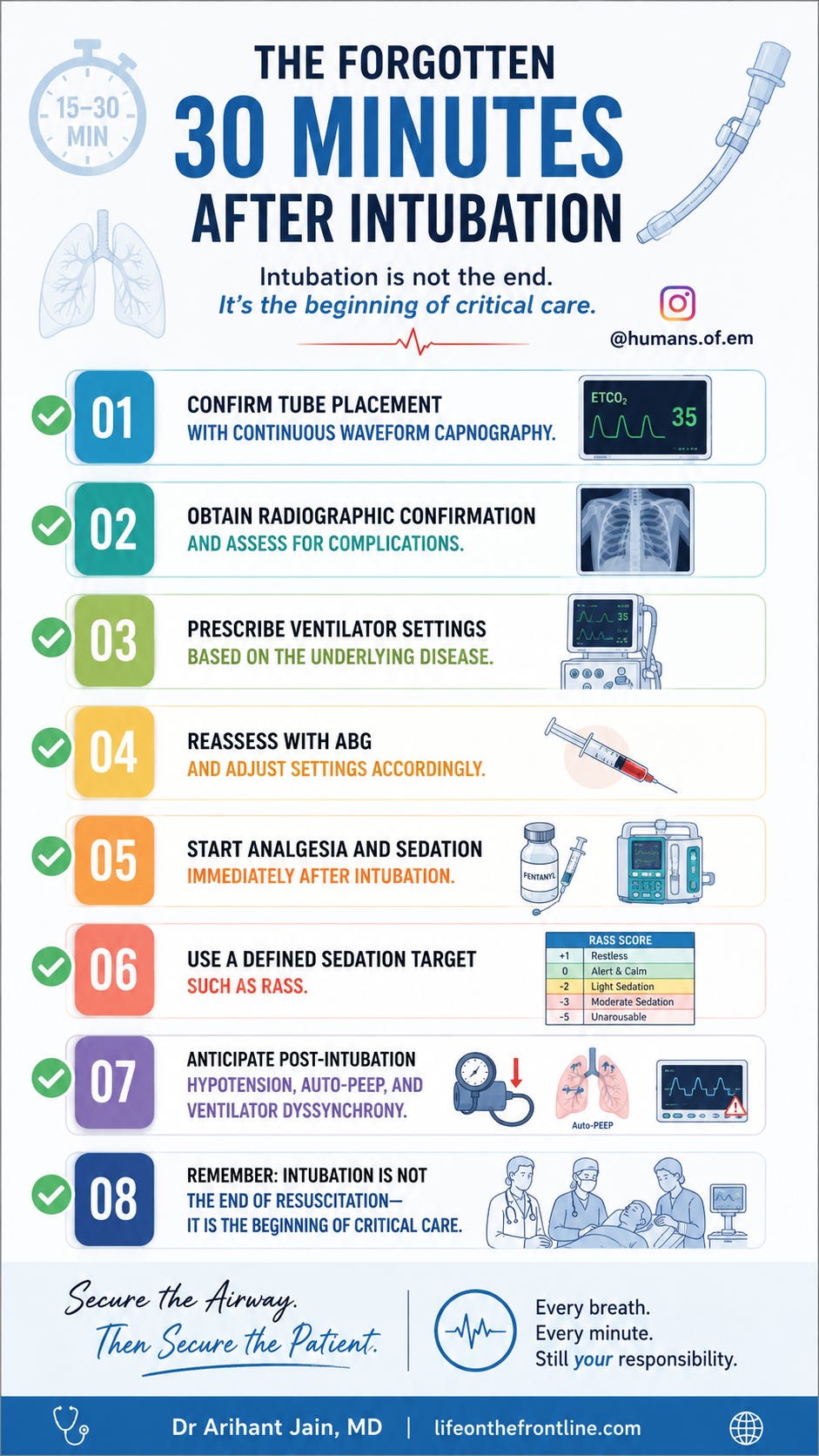
The Post-Intubation Bundle
Whenever I intubate a patient, I immediately ask myself five questions:
Is the tube really where I think it is?
Are the ventilator settings appropriate?
Have I reassessed gas exchange and ventilation?
Is the patient comfortable?
Have I prevented the next physiologic disaster?
Let’s walk through each.
Step 1: Confirm the Tube — Then Confirm It Again
Successful laryngoscopy does not equal successful intubation. The gold standard for immediate confirmation remains:
Continuous waveform capnography
A persistent waveform with exhaled CO₂ confirms tracheal placement. Not colorimetric devices. Not chest rise. Not misting in the tube. Not auscultation alone.
Waveform capnography is king.
Additional confirmation
After waveform capnography:
Bilateral chest rise
Equal breath sounds
Absence of gastric sounds
Improvement in oxygenation
Appropriate ventilator waveforms
Chest X-ray
Once the patient is stabilized:
Confirm tube depth
Evaluate for right mainstem intubation
Look for pneumothorax
Assess evolving pulmonary pathology
A useful target:
Tube tip approximately 3–5 cm above the carina
Remember:
The first confirmation is physiologic. The second confirmation is radiographic.
Both matter.
Step 2: Don’t Let the Ventilator Ventilate by Default
One of the most common errors after intubation is accepting whatever settings were initially entered. The ventilator should be prescribed like any other critical medication.
Start with the diagnosis
The ventilator settings for:
Severe asthma
ARDS
Septic shock
Traumatic brain injury
Diabetic ketoacidosis
are not the same. Yet many patients receive identical settings.
A practical starting strategy
For most adults:
Mode
Volume Assist-Control
Tidal Volume
6–8 mL/kg predicted body weight
Respiratory Rate
16–22 breaths/min
PEEP
5 cmH₂O initially
Higher if hypoxemic
FiO₂
Start at 100%
Rapidly titrate down
Avoid oxygen toxicity
After stabilization:
Target:
SpO₂ 92–96% in most patients
Avoid prolonged unnecessary FiO₂ 100%
Disease-specific reminders
ARDS
Low tidal volume ventilation
6 mL/kg predicted body weight
Higher PEEP strategy
Severe Asthma
Low respiratory rate
Long expiratory time
Avoid Auto-PEEP
Traumatic Brain Injury
Avoid hypoxia
Avoid severe hypercapnia
Target normocapnia
Metabolic Acidosis (DKA, Salicylates)
The ventilator must match or approximate the patient’s pre-intubation minute ventilation. Failure to do so can rapidly worsen acidosis and precipitate arrest.
Step 3: The ABG is Not a Trophy. It’s Feedback.
Many clinicians order an ABG after intubation. Far fewer actually use it to change management. The purpose of an ABG is not documentation. The purpose is ventilator adjustment.
Obtain an ABG
Usually within:
15–30 minutes after intubation
Then ask:
Is oxygenation adequate?
If PaO₂ is excessive: Reduce FiO₂.
If inadequate: Increase PEEP before endlessly increasing oxygen concentration.
Is ventilation adequate?
If PaCO₂ is high: (see here )
Increase minute ventilation:
Increase respiratory rate
Adjust tidal volume when appropriate
If PaCO₂ is too low:
Reduce minute ventilation.
Repeat when needed
Every ventilator change should trigger reassessment.
The ABG closes the loop between physiology and intervention.
Step 4: The Paralytic Has Worn Off. The Patient Is Awake.
Perhaps the most important post-intubation principle:
Sedation should begin immediately after intubation.
(Read more in detail from here)
Many patients receive:
Induction agent
Paralytic
and then nothing.
Ten minutes later they are awake, frightened, unable to speak, and fighting the ventilator. This is one of the most distressing experiences a critically ill patient can endure.
Analgesia First
Pain should be treated before sedation whenever possible.
A common strategy:
Fentanyl, Morphine
Then Sedation
Common options:
Propofol, Ketamine, Dexmed, Midazolam (new post will be released on individual drugs)
Target a Sedation Goal
Sedation should never be:
“Run propofol at 40.”
Sedation should be:
“Target RASS -2 to 0.”
The 2018 SCCM PADIS guidelines support protocolized sedation with defined targets and favor maintaining lighter levels of sedation whenever clinically feasible.
A practical target
Most newly intubated ED patients:
RASS -2 to -3 initially
Then lighten as physiology allows.
Step 5: Anticipate the Post-Intubation Crash
The patient who looked stable before intubation may suddenly become unstable afterward.
Why?
Positive pressure ventilation changes physiology.
Watch for:
Hypotension
Causes:
Reduced venous return
Sedatives
Occult hypovolemia
Management:
Fluids when appropriate
Vasopressors early
Reassess shock state
Auto-PEEP
Particularly in:
Asthma
COPD
Look for:
Rising airway pressures
Hypotension
Ventilator dyssynchrony
Pneumothorax
Especially after:
Trauma
Difficult ventilation
High airway pressures
Ventilator Dyssynchrony
A fighting patient is not always “agitated.”
Sometimes they are:
In pain
Undersedated
Air hungry
Incorrectly ventilated
Treat the cause.
Not just the monitor.
The Tube Is Not the Finish Line
One of the most dangerous myths in emergency medicine is that intubation is a procedure.
It isn’t, It’s a transition.
The patient has moved from spontaneous physiology to physician-controlled physiology.
For the next 30 minutes, every breath, every milliliter of ventilation, every molecule of oxygen, every sedative dose, and every hemodynamic consequence is now your responsibility.
The airway may be secured. But the resuscitation is far from over.