

Dr. Arihant Jain, MD
lifeonthefrontline.com | Insta - @humans.of.em | X - @dr__hunt
The Problem We Don’t Talk About Enough
In resuscitation, we rely on TTE (POCUS)—until it fails.
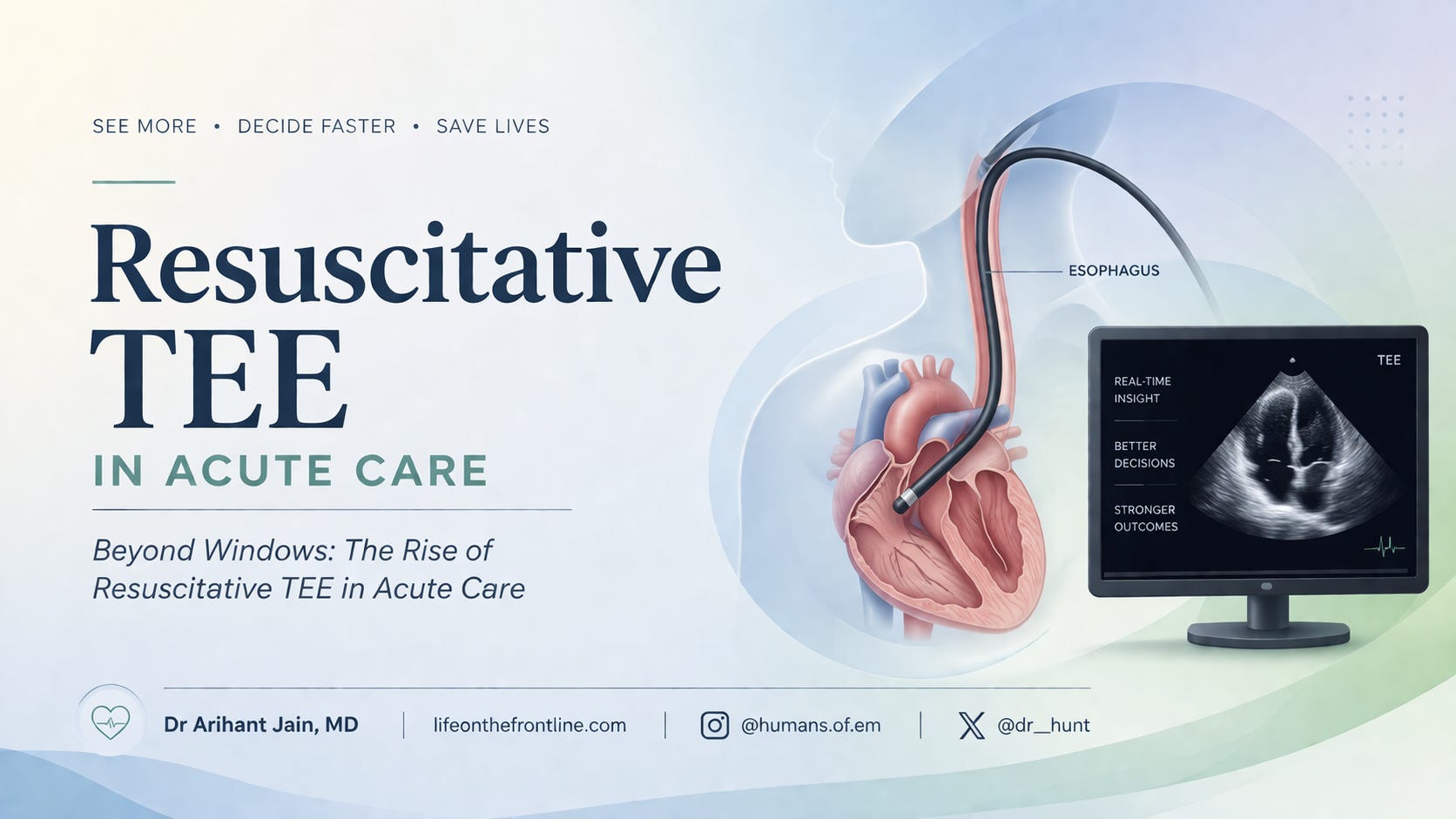
And it does fail:
Obesity
Mechanical ventilation
Ongoing CPR
Chest trauma / emphysema
Dressings, drains, defibrillator pads
At the exact moment when physiology is collapsing, our window disappears.
This is where Resuscitative TEE emerges—not as an adjunct, but as a shift in how we see critically ill patients.
What Is Resuscitative TEE?
Resuscitative TEE is:
A focused, goal-directed, point-of-care transesophageal echocardiographic exam used during cardiac arrest, shock, and critical illness to guide real-time management (Teran et al., 2025).
It evolved from:
Rescue TEE (Shillcutt et al., 2012)
Critical care TEE (Mayo et al., 2015)
But today, it represents a distinct resuscitation tool.
Why TEE? — The Physiological Edge
TEE works where TTE fails because:
Esophagus = direct acoustic window to heart
No lung or chest wall interference
Continuous imaging during CPR
👉 Especially valuable when TTE windows are limited (Teran et al., 2025; Torre & Pirri, 2025; Prager et al., 2022).
This allows:
Continuous monitoring
Superior image quality
Additional diagnostic planes
Procedural visualization
Where TEE Changes Practice
1. Cardiac Arrest — From Blind CPR to Visual Resuscitation
TEE enables:
Identification of reversible causes:
Tamponade
Massive PE
Aortic dissection
Severe hypovolemia (Teran et al., 2020; Edmiston et al., 2024)
Differentiation of:
True PEA vs pseudo-PEA
Fine VF missed on monitor (Jung et al., 2020; Parker et al., 2018)
Optimization of CPR:
Avoid LVOT compression (Hwang et al., 2009; Cha et al., 2013)
Improve compression location
Reduction in CPR interruptions (Fair et al., 2019)
👉 TEE identifies the cause of arrest in ~25–35% of cases (Prager et al., 2022; Edmiston et al., 2024).
2. Undifferentiated Shock
TEE excels when TTE is inadequate in ICU patients.
It allows:
LV/RV function assessment
Obstructive pathology detection
Volume responsiveness (SVC collapsibility) (Vieillard-Baron et al., 2004)
Continuous reassessment
👉 Leads to change in diagnosis in ~52–78% and management in ~32–89% of cases.(Prager et al., 2022; Kegel & Chenkin, 2023; Teran et al., 2024).
3. Hemodynamic Monitoring — The Hidden Superpower
TEE enables continuous bedside monitoring, unlike TTE:
Stroke volume / cardiac output
Ventricular function trends
Response to fluids/inotropes
👉 Validated as a monitoring tool in critical care (Vignon, 2017; Porter et al., 2015)
👉 Particularly useful in:
Sepsis
Cardiogenic shock
Mixed shock states
4. Trauma & Acute Care
TEE provides simultaneous diagnosis + resuscitation:
Blunt aortic injury detection (Osman et al., 2020)
LVOT obstruction in trauma physiology (Prager et al., 2024)
👉 Critical when CT is not feasible.
5. Procedural Guidance — From Blind to Visual
TEE enhances:
ECMO cannulation (Fair et al., 2016; Banfi et al., 2016)
Transvenous pacing (Lerner et al., 2020)
PA catheter placement (Cronin et al., 2017)
👉 Reduces complications and improves accuracy.
6. Special Situations
Prone ARDS → TEE remains feasible (Mekontso Dessap et al., 2011)
COVID / severe hypoxemia → identifies shunts (Teran et al., 2020)
TELUS → posterior lung imaging (Cavayas et al., 2016)
Real-World Impact (What the Data Shows)
Diagnostic change: 52–78%
Management change: 32–89%
Interpretable images: >98–99% success
Complications: rare to negligible
(Wray et al., 2021; Arntfield et al., 2018; Reardon et al., 2021; Teran et al., 2024)
👉 This is not just imaging—this is decision-altering technology.
Critical Appraisal — The Balanced View
Advantages
1. Continuous Imaging During CPR
No interruptions → better perfusion
2. High Diagnostic Yield
Especially when TTE fails
3. Real-Time Decision Support
Immediate therapeutic impact
4. Procedural Precision
Safer ECMO, pacing, catheter placement
5. Broad Applicability
ED + ICU + OR integration
Pitfalls
1. Operator Dependence
Requires structured training
2. Misinterpretation Risk
Incorrect findings → wrong interventions
3. Lack of Standardized Protocols
Still evolving (Tseng et al., 2025)
4. Cognitive Load
Can overwhelm inexperienced teams
Disadvantages
1. Invasive Modality
Potential complications:
Esophageal injury
Oropharyngeal trauma
Though rare (~0.01–0.08%) (Kallmeyer et al., 2001; Ramalingam et al., 2020)
👉 Large ICU series show no major complications (Prager et al., 2022).
2. Training Gap
Requires TTE foundation
Simulation-based learning
Supervised exams (~30 studies) (Charron et al., 2013)
3. Resource Barriers
Probe cost
Maintenance
Credentialing
👉 Major implementation barriers (Teran et al., 2023; McGuire et al., 2022)
4. Limited High-Level Evidence
Strong observational data
Limited RCTs
👉 Field still evolving.
TEE vs TTE — Not a Competition
FeatureTTE (POCUS) Resuscitative TEEInvasivenessNon-invasiveSemi-invasiveImage qualityVariableConsistently highCPR compatibilityLimitedContinuousMonitoringIntermittentContinuousAccessibilityHighLimited
👉 TEE is a complement, not replacement.
Where the Field Is Heading (2025–2026)
Recent literature shows:
Rapid growth in adoption and research (Tseng et al., 2025)
Expansion beyond arrest → full-spectrum critical care
Increasing ED uptake (~20% programs in NA) (Teran et al., 2023)
Emergence of registries and multicenter data (Teran et al., 2024)
👉 We are witnessing the mainstreaming of resuscitative TEE.
Take-Home Points
Resuscitative TEE is a high-impact tool in acute care
Most useful in:
Cardiac arrest
Undifferentiated shock
Procedural guidance
Provides continuous, real-time hemodynamic insight
Improves:
Diagnosis
Decision-making
Procedural safety
But:
Requires training
Needs resources
Still evolving in evidence
Final Thought
The next leap in resuscitation is not faster hands—but better vision.
TEE gives us that vision.
References
Teran F, Diederich T, Owyang CG, et al. Resuscitative transesophageal echocardiography in critical care. J Intensive Care Med. 2025;40(11):1133-1142.
Via G, Hussain A, Wells M, et al. International evidence-based recommendations for focused cardiac ultrasound. J Am Soc Echocardiogr. 2014;27(7):683.e1-683.e33.
Shillcutt SK, Markin NW, Montzingo CR, Brakke TR. Use of rapid “rescue” perioperative echocardiography. J Cardiothorac Vasc Anesth. 2012;26(3):362-370.
Mayo PH, Narasimhan M, Koenig S. Critical care transesophageal echocardiography. Chest. 2015;148(5):1323-1332.
Teran F. Resuscitative cardiopulmonary ultrasound and transesophageal echocardiography in the ED. Emerg Med Clin North Am. 2019;37(3):409-430.
Arntfield R, Lau V, Landry Y, et al. Impact of critical care TEE in ICU patients. J Intensive Care Med. 2018;35(9):896-902.
Arntfield R, Pace J, Hewak M, Thompson D. Focused TEE by emergency physicians. J Emerg Med. 2016;50(2):286-294.
Teran F, Dean AJ, Centeno C, et al. TEE in out-of-hospital cardiac arrest. Resuscitation. 2019;137:140-147.
Teran F, Burns KM, Narasimhan M, et al. Critical care TEE during COVID-19. J Am Soc Echocardiogr. 2020;33(8):1040-1047.
Teran F, Owyang C, Wray T, et al. Development of a multicenter registry for resuscitative TEE. Ann Emerg Med. 2024.
Teran F, West FM, Jelic T, et al. Resuscitative TEE in EDs: cross-sectional survey. Am J Emerg Med. 2023;76:164-172.
Prager R, Bowdridge J, Pratte M, et al. Indications, clinical impact, and complications of critical care TEE. J Intensive Care Med. 2022;38(3):245-272.
Wray T, Johnson M, Cluff S, et al. TEE by intensivists and emergency physicians: 5-year experience. J Intensive Care Med. 2021;37(7):917-924.
Reardon R, Chinn E, Plummer D, et al. Feasibility and safety of TEE in emergency medicine. Acad Emerg Med. 2021;29(3):334-343.
Kegel F, Chenkin J. Resuscitative TEE in the ED: case series. Scand J Trauma Resusc Emerg Med. 2023;31:XX.
Edmiston T, Sangalli F, Soliman-Aboumarie H, et al. TEE in cardiac arrest. Resuscitation. 2024;XX:110372.
Bora V, Pulijal S. Transesophageal echocardiography in critical care. Curr Pulmonol Rep. 2024;13:152-172.
Torre D, Pirri C. Point-of-care TEE in emergency and intensive care. Biomedicines. 2025;13:XXXX.
Tseng B, Yang C, Sun J, et al. Trends in TEE research in emergency medicine. West J Emerg Med. 2025;26:469-477.
McGuire D, Johnson S, Mielke N, Bahl A. TEE in the ED: implementation and QA. JACEP Open. 2022;3:e12758.
Parker BK, Salerno A, Euerle BD. TEE during cardiac arrest: literature review. J Ultrasound Med. 2018;38:1421-1430.
Vieillard-Baron A, Slama M, Mayo P, et al. SVC collapsibility and volume status. Intensive Care Med. 2004;30:2283-2289.
Vieillard-Baron A, Millington SJ, Sanfilippo F, et al. A decade of progress in critical care echocardiography. Intensive Care Med. 2019;45:770-788.
Vignon P. Hemodynamic assessment using echocardiography Doppler. Curr Opin Crit Care. 2005;11:227-234.
Porter TR, Shillcutt SK, Adams MS, et al. Echocardiography for therapeutic monitoring. J Am Soc Echocardiogr. 2015;28:40-56.
Osman A, Fong CP, Wahab SFA, et al. TEE for blunt aortic injury. J Emerg Med. 2020;59(3):418-423.
Prager R, Walser E, Balta KY, et al. Resuscitative TEE in trauma. J Crit Care. 2024;79:154426.
Fair J, Tonna J, Ockerse P, et al. TEE-guided ECMO cannulation. Am J Emerg Med. 2016;34:1637-1639.
Banfi C, Pozzi M, Siegenthaler N, et al. VV-ECMO cannulation techniques. J Thorac Dis. 2016;8(12):3762-3773.
Cronin B, Robbins R, Maus T. PA catheter placement using TEE. J Cardiothorac Vasc Anesth. 2017;31:178-183.
Lerner RP, Haaland A, Lin J. Transvenous pacing under TEE guidance. Am J Emerg Med. 2020;38:1044.e3-1044.e4.
Cavayas YA, Girard M, Desjardins G, Denault AY. Transesophageal lung ultrasonography. Can J Anaesth. 2016;63(11):1266-1276.
Mekontso Dessap A, Proost O, Boissier F, et al. TEE in prone ARDS patients. Intensive Care Med. 2011;37:430-434.
Hwang SO, Zhao PG, Choi HJ, et al. LVOT compression during CPR. Acad Emerg Med. 2009;16:928-933.
Cha KC, Kim YJ, Shin HJ, et al. Optimal compression position in CPR. Emerg Med J. 2013;30:615-619.
Fair J, Mallin MP, Adler A, et al. TEE reduces CPR interruptions. Ann Emerg Med. 2019;73:610-616.
Jung WJ, Cha KC, Kim YW, et al. Intra-arrest TEE findings and outcomes. Resuscitation. 2020;154:31-37.
Kim YW, Jung WJ, Cha KC, et al. Diagnosis of aortic dissection during CPR with TEE. Am J Emerg Med. 2021;39:92-95.
I’m an icu doc and was taught this 5 years post fellowship by one of our cardiologists. It’s a game changer if you have it. But in training you rarely get opportunity due to cardiology culture.