

By-
Dr Arihant Jain, MD | lifeonthefrontline.com
Instagram: @humans.of.em
X - dr__hunt
—————————————————————————
Lately, I realised that I had become so busy moving forward that I had stopped looking back.
The next shift.
The next responsibility.
The next paper.
The next presentation.
The next thing that needed to be done.
And somewhere in between all of that, I had stopped appreciating how far I had already come. A colleague recently reminded me of that.
They congratulated me - not for an award, a publication, or anything particularly tangible but for inspiring them to work harder.
That conversation made me pause. Because some of the things that I now consider ordinary were things I had quietly hoped for six or twelve months ago.
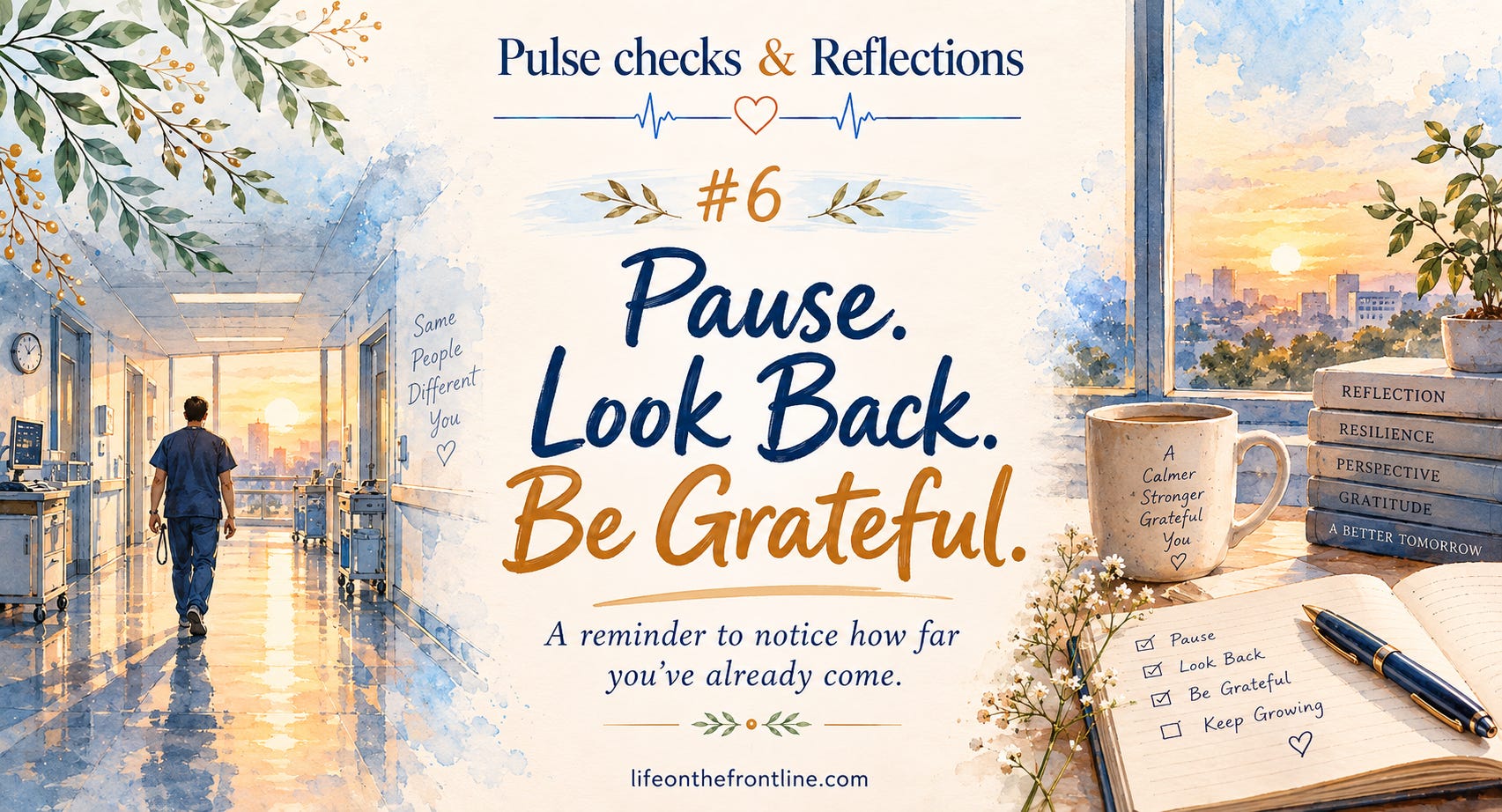
And perhaps that is something we all do. We achieve something, get used to it, and immediately move the goalpost.
What was once a dream becomes today’s normal. And then we start feeling as though we haven’t done enough.
But perhaps we are measuring ourselves against the wrong people. Medicine makes comparison almost inevitable.
Someone has more publications.
Someone is giving more talks.
Someone is more senior.
Someone has achieved something earlier.
Someone seems to be progressing faster.
And if we constantly look sideways, there will always be someone ahead. There will always be another milestone.
Another CV.
Another achievement.
Another person who seems to have figured it all out.
So perhaps the more meaningful question isn’t:
“Am I doing better than them?”
It is:
“Am I doing better than the person I was six months ago?”
That is the comparison that matters.
Did I learn something I didn’t know before?
Did I handle a difficult situation better?
Did I become a little calmer?
Did I become more patient?
Did I listen better?
Did I become a better teammate?
Did I recover from setbacks a little faster?
Did I become a doctor I would have trusted a year ago?
Sometimes growth is not something you can put on a CV. Sometimes it is simply becoming a little better version of yourself. And that deserves recognition too.
As we become more senior in Emergency Medicine or in any branch of medicine—the job slowly changes.
Clinical knowledge and technical excellence remain essential. But they are no longer enough. You begin to understand that medicine is a team sport.
In Emergency Medicine, the patient doesn’t belong to one doctor. The resuscitation belongs to the entire team.
Doctors.
Nursing officers.
Technicians.
Radiographers.
Laboratory teams.
Housekeeping.
Security.
Every person who keeps the system moving.
And as you become more senior, leadership becomes less about being the person with all the answers and more about helping the entire team move forward.
Sometimes you compromise.
Sometimes you make a decision that isn’t your personal preference because it is better for the group. Sometimes you absorb the pressure so someone else doesn’t have to. And sometimes you do something important without anyone ever knowing that you did it.
There isn’t always recognition for leadership. And perhaps there shouldn’t be. Some of the most important things a leader does happen quietly, behind the stage.
You learn to remain calm when everyone around you is anxious. You learn to observe before reacting. You learn that not every problem needs an immediate answer. You learn that uncertainty isn’t always something to eliminate.
Sometimes, it is something you learn to navigate. And perhaps that is what fascinates me most about Emergency Medicine.
The art of uncertainty.
The art of acute care.
The ability to find some calm in chaos.
To make decisions with incomplete information.
To keep moving even when the outcome isn’t guaranteed.
Medicine also teaches us resilience. We see people arrive at some of the worst moments of their lives. Sometimes we help them through. Sometimes we don’t.
We experience failure, rejection, exhaustion, disappointment and uncertainty , professionally and personally.
And slowly, we learn that life will always bring obstacles. We cannot control all of them.But we can learn how to respond to them.
One of the hardest things to train is the mind itself. Especially when it naturally focuses on what went wrong, what is missing, or what could go wrong next.
But perhaps gratitude can be trained too. To notice the good. The colleague who supported you. The patient who got better. The mentor who believed in you. The team that stood beside you. The opportunity you once hoped for. The ordinary day when nothing went wrong. The quiet walk home after a difficult shift.
And sometimes, simply the realisation that you are already living a part of the life you once wished for.
Medicine also teaches us resilience. We see people arrive at some of the worst moments of their lives. Sometimes we help them through. Sometimes we don’t.
We experience failure, rejection, exhaustion, disappointment and uncertainty—professionally and personally.
And slowly, we learn that life will always bring obstacles. We cannot control all of them. But we can learn how to respond to them.
One of the hardest things to train is the mind itself. Especially when it naturally focuses on what went wrong, what is missing, or what could go wrong next.
Over time, I have realised that one part of resilience is actively choosing where to place your attention. Not pretending that the negative things didn’t happen. Not ignoring the difficult shifts, the mistakes, the losses or the disappointments.
But refusing to let them become the only story you tell yourself.
If a shift had ten difficult moments and one meaningful positive outcome, the mind can spend hours replaying the ten difficult ones. Sometimes, you have to consciously redirect it.
Remember the patient who improved.
Remember the decision that helped.
Remember the person you supported.
Remember the small thing that went right.
The negative deserves reflection. The positive deserves remembrance.
Perhaps that is another skill medicine teaches us—the ability to acknowledge what went wrong, learn from it, and then deliberately turn our attention back toward what went right.
Because what we repeatedly focus on eventually shapes how we experience our lives.
So this is my pulse check today.
Not a celebration of achievements.
Not a comparison with anyone else.
Just a reminder to myself to stop occasionally and look back.
To compare myself with the person I was—not with the person standing next to me.
To recognise the small changes.
The lessons.
The failures I survived.
The things I learned.
The person I am slowly becoming.
Because perhaps growth isn’t about constantly proving that you are ahead.
Perhaps it is simply being able to look back and say:
“I am not where I was.”
And maybe, for today, that is enough.
Keep growing.
Keep learning.
Keep moving forward.
But don’t forget to pause.
Look back.
Take a breath.
And be grateful.
Because somewhere behind you is a version of yourself who would probably be incredibly proud to see where you are today.
Pulse check: When was the last time you stopped; not to ask how far you still have to go, but to appreciate how far you’ve already come?
‘Medicine teaches us how to save lives.
Perhaps the journey also teaches us how to live one.’
- Dr Arihant Jain, MD