

By-
Dr Arihant Jain, MD | lifeonthefrontline.com
Instagram: @humans.of.em
X | Linkedin | ORCID
————————————————————————
A patient arrives tachypneic.
ABG:
pH 7.21
PaCO₂ 24 mmHg
HCO₃⁻ 10 mmol/L
You say:
“Metabolic acidosis.”
But is that the whole diagnosis?
What does acidemia actually mean?
Is acidosis the same thing?
What does the base excess tell you?
Is this HAGMA or NAGMA?
Is the respiratory response appropriate?
Could there be a second metabolic disorder hiding underneath?
And importantly:
Can a patient have a normal pH and still have a major acid–base disorder?
This is where we move beyond simply reading the bicarbonate.

1. Acidemia ≠ Acidosis
This should be the first major teaching point.
Acidemia
A state of the blood in which:
pH < 7.35
Acidosis
A physiological process that tends to lower pH.
Similarly:
Alkalemia
pH > 7.45
Alkalosis
A physiological process that tends to raise pH.
Why does this distinction matter?
Because a patient can have multiple simultaneous processes. For example:
Metabolic acidosis + metabolic alkalosis
may produce a near-normal pH.
So:
A normal pH does not exclude an acid–base disorder.
And:
Acidemia tells you the net result. Acidosis tells you about one of the processes producing that result.
2. Where does the metabolic component fit?
Once you identify the pH, look at:
PaCO₂ + HCO₃⁻
Metabolic acidosis
HCO₃⁻ ↓
Metabolic alkalosis
HCO₃⁻ ↑
But don’t immediately label the disorder.
First ask:
Is the change appropriate compensation, or is another disorder present?
3. Base Excess: the often-underused number on the ABG
Base excess summarises the complete metabolic component of an acid–base disorder, independent of the respiratory component.
Base excess is the amount of strong acid or base required to return blood to pH 7.40 under standardized conditions, with a normal range around −3 to +3 mmol/L. modified abg (1)(3)
Think of it simply:
Negative BE → metabolic acidosis
Positive BE → metabolic alkalosis
For example:
BE −12 → significant metabolic acid load / base deficit.
BE +8 → metabolic alkalosis.
Base deficit vs base excess
Be careful with terminology:
Base excess −10
and
Base deficit +10
describe the same direction of metabolic disturbance but use opposite signs.
Practical message
HCO₃⁻ tells you the bicarbonate concentration. Base excess helps quantify the metabolic component.
4. Metabolic Acidosis
Now build the actual framework.
Typical ABG:
pH ↓
HCO₃⁻ ↓
The PaCO₂ should fall as respiratory compensation develops.
But we need to determine:
Is compensation appropriate?
Is there an anion gap?
If there is an anion gap, is there another metabolic disorder?
5. Step 1 — Check respiratory compensation
Winter’s formula
Expected PaCO₂ = 1.5 × HCO₃⁻ + 8 ± 2
Example
HCO₃⁻ = 12
Expected:
1.5 × 12 + 8 = 26
Expected PaCO₂:
24–28 mmHg
If actual PaCO₂ is:
26
→ appropriate compensation
40
→ metabolic acidosis + respiratory acidosis
18
→ metabolic acidosis + respiratory alkalosis
So:
Compensation should be calculated, not assumed.
6. Step 2 — Find the Anion Gap
AG = Na⁺ − (Cl⁻ + HCO₃⁻)
12 ± 4 mEq/L as the conventional normal range. (Confirm with your own lab)
The conceptual question is:
Why has bicarbonate fallen?
7. HAGMA (High-Anion-Gap Metabolic Acidosis)
Here, acids accumulate and their accompanying anions are not routinely measured.
Think:
“New unmeasured anions have appeared.”
GOLD MARK
G — Glycols
O — Oxoproline
L — L-lactate
D — D-lactate
M — Methanol
A — Aspirin
R — Renal failure
K — Ketoacidosis
Then add the clinical context:
DKA
Alcoholic ketoacidosis
Starvation ketoacidosis
Lactic acidosis
Renal failure
Toxic alcohols
Salicylates
8. Don’t forget albumin
Albumin is an important unmeasured anion.
Therefore:
Hypoalbuminemia can make the anion gap look deceptively normal.
Corrected AG
Corrected AG = measured AG + 2.5 × (4 − albumin g/dL)
Your source gives this correction explicitly. modified abg (1)(3)
Example
AG = 14
Albumin = 2 g/dL
Corrected AG:
14 + 2.5 × (4−2) = 19
So what initially looked like a modest AG may actually represent a significant HAGMA.
9. NAGMA (Normal-Anion-Gap Metabolic Acidosis)
Also called:
Hyperchloremic metabolic acidosis
Here:
HCO₃⁻ ↓ but:
Cl⁻ ↑
maintains electrical neutrality.
Major causes
GI bicarbonate loss
Diarrhea
High-output intestinal losses
Renal
Renal tubular acidosis
Drugs
Acetazolamide
Iatrogenic
Large-volume 0.9% saline
The key mental model:
HAGMA = addition of unmeasured acid/anions
NAGMA = bicarbonate loss/reduction with relative chloride increase
10. But what if the patient has TWO metabolic disorders?
This is where the article becomes more interesting.
Delta gap / Delta ratio
Once you identify HAGMA:
ΔAG
AG − 12
ΔHCO₃
24 − measured HCO₃
Then:
Delta ratio = ΔAG / ΔHCO₃
<1 - HAGMA + NAGMA
1–2 - Predominantly HAGMA
>2 - HAGMA + metabolic alkalosis
11. Why is this useful?
Imagine: AG = 30
Therefore: ΔAG = 18
And: HCO₃⁻ = 18
Therefore: ΔHCO₃ = 6
Delta ratio:
18 / 6 = 3
That’s too high for a pure HAGMA.
It suggests:
HAGMA + metabolic alkalosis
This is exactly the type of patient we miss if we stop at:
“The patient has DKA.”
12. Metabolic Alkalosis
the other side of the metabolic spectrum.
Typical pattern:
pH ↑
HCO₃⁻ ↑
The respiratory response should be:
PaCO₂ ↑
because hypoventilation provides respiratory compensation.
A useful approximation:
Expected PaCO₂ ≈ 0.7 × (HCO₃⁻ − 24) + 40 ± 2
Again:
If the PaCO₂ is substantially outside the expected range, think:
Metabolic alkalosis + a second respiratory disorder.
13. Causes of metabolic alkalosis
I’d keep this clinically oriented rather than getting too deep into renal physiology.
Vomiting / gastric losses
Loss of:
H⁺ + Cl⁻
→ metabolic alkalosis
Nasogastric suction
Same principle.
Diuretics
Especially:
Loop diuretics
Thiazides
Volume/chloride depletion
The alkalosis can be maintained by continued volume and chloride depletion.
Mineralocorticoid excess
Think:
Primary hyperaldosteronism
Cushing physiology
Other mineralocorticoid states
Hypokalemia
Can contribute to maintenance of alkalosis.
14. Chloride-responsive vs chloride-resistant
Chloride-responsive
Think:
Vomiting | NG suction | prior diuretic use | volume depletion
Chloride-resistant
Think:
Mineralocorticoid excess | ongoing renal causes | severe hypokalemia
This gives the reader a practical next step after simply identifying metabolic alkalosis.
15. Mixed metabolic disorders
Example 1
DKA + diarrhea
→ HAGMA + NAGMA
Example 2
DKA + vomiting
→ HAGMA + metabolic alkalosis
Example 3
Diarrhea + vomiting
→ NAGMA + metabolic alkalosis
Example 4
Sepsis + lactic acidosis + vomiting
→ HAGMA + metabolic alkalosis
And these can coexist with a respiratory disorder as well.
16. The “normal pH” trap
pH 7.40 does not mean normal.
look at the anion gap, normal pH with increased anion gap, might mean it is mixed disorder
look at base excess/deficit if abnormal , it is mixed disorder (respiratory plus metabolic)
A patient may have:
Metabolic acidosis + metabolic alkalosis
with the two processes partially cancelling each other.
(to look at elevated anion gap for this)
Or:
Metabolic acidosis + respiratory alkalosis
producing a relatively normal pH.
(To look at anion gap and base excess for this)
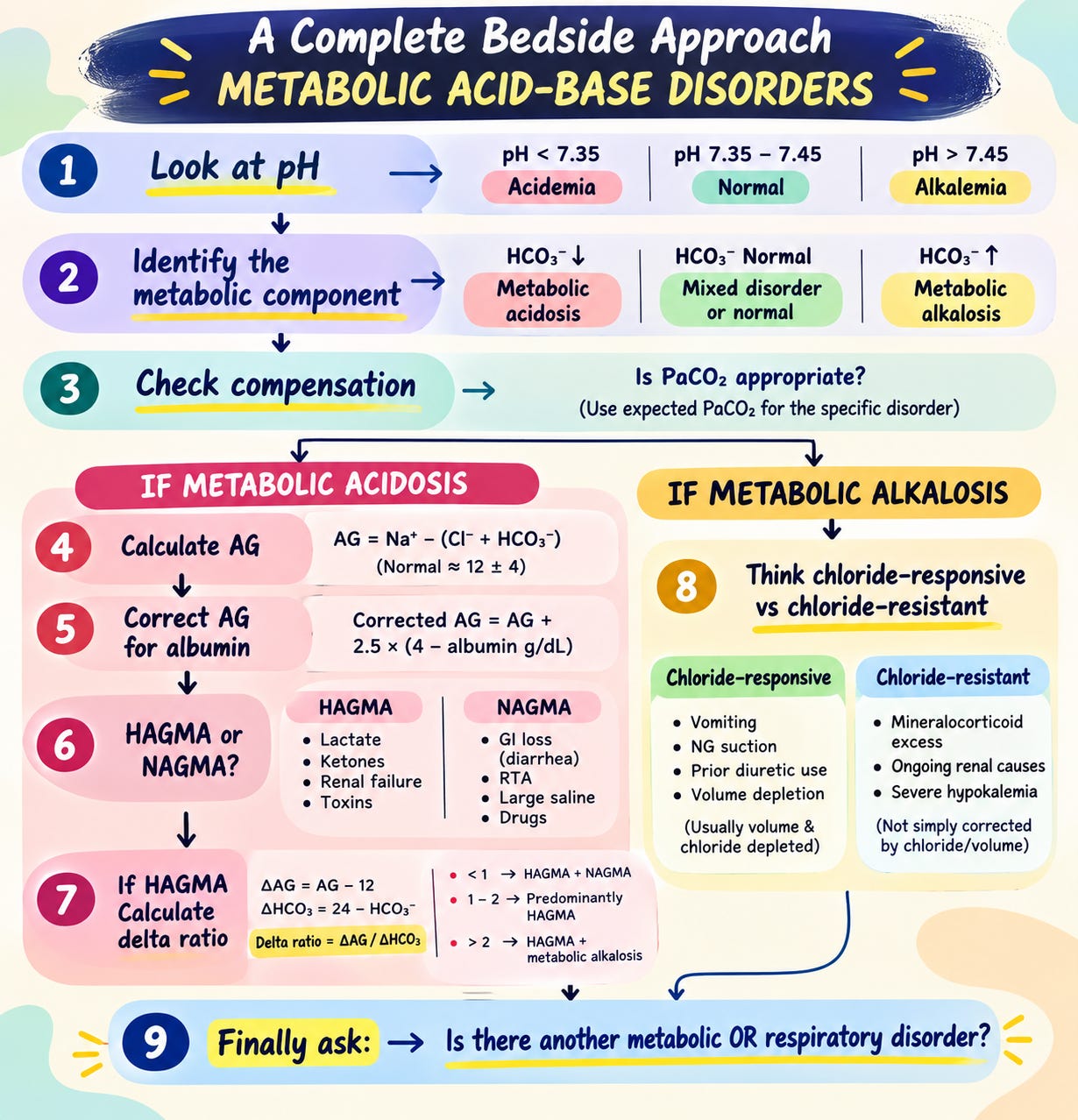
Final message of the article
Don’t let the pH fool you.
Acidemia is a state. Acidosis is a process.
Base excess tells you about the metabolic component.
The anion gap tells you where to look.
The delta ratio tells you whether one metabolic process is enough.
And compensation tells you whether the lungs are responding appropriately — or whether another respiratory disorder is hiding underneath.
The goal isn’t to name the abnormal number.
The goal is to explain the entire acid–base picture.