

By-
Dr Arihant Jain, MD | lifeonthefrontline.com
Instagram: @humans.of.em
X | Linkedin | ORCID
————————————————————————
We often learn a simple rule:
PaCO₂ 35–45 mmHg = normal ventilation.
But physiology doesn’t always follow the reference range.
PaCO₂ has to be interpreted in context.

Here are 3 patients who can make a “normal” PaCO₂ look very different.
CASE 1 — The acidotic patient with a PaCO₂ of 30
A 24-year-old man with severe DKA arrives tachypnoeic and dehydrated.
ABG:
pH 7.10
HCO₃⁻ 8 mmol/L
PaCO₂ 25 mmHg
At first glance:
“PaCO₂ is low. He’s ventilating well.”
But here’s the important question:
Is PaCO₂ of 25 actually appropriate for this degree of metabolic acidosis?
Use Winter’s formula:
Expected PaCO₂ = 1.5 × HCO₃⁻ + 8 ± 2
= 1.5 × 8 + 8
= 20 ± 2 mmHg
His PaCO₂ is 25 mmHg.
So despite the fact that his PaCO₂ is low, it is higher than expected. He is not compensating adequately.
There may already be an additional respiratory acidosis. This is one of the most important concepts when assessing ventilation:
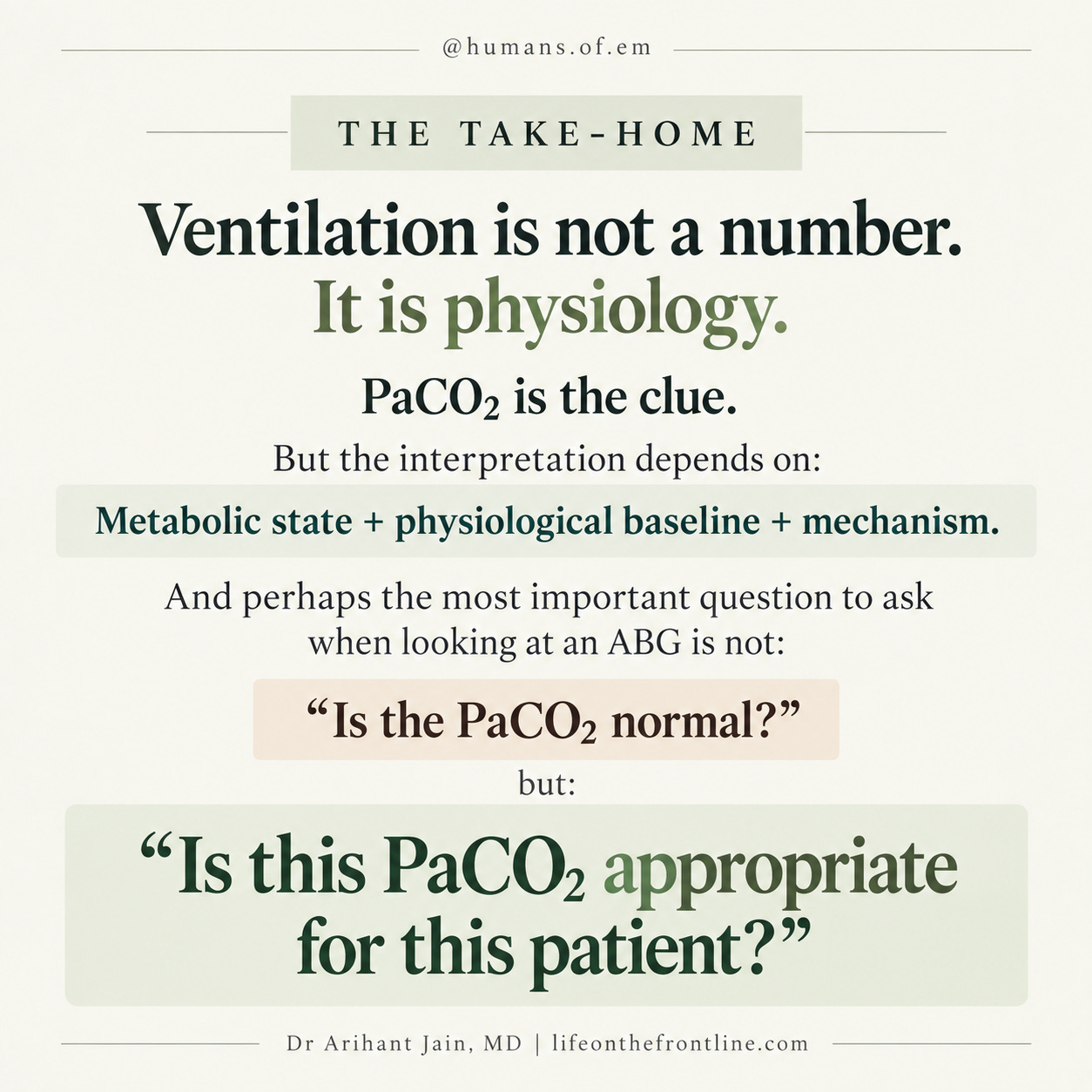
The “normal” PaCO₂ is not necessarily 40.
The appropriate PaCO₂ depends on the metabolic disturbance.
In severe metabolic acidosis, the patient’s low PaCO₂ is part of the compensatory response. The ventilatory response can become so important that losing it during intubation may cause a rapid rise in PaCO₂ and worsening acidemia.
I wrote about this in detail here:
Ventilating the Acidotic Patient: VCV Strategies to Preserve Compensation
The key lesson:
Don’t ask:
“Is the PaCO₂ normal?”
Ask:
“Is the PaCO₂ appropriate for this patient’s metabolic state?”
CASE 2 — The pregnant patient with a PaCO₂ of 40
A 30-year-old woman in her third trimester presents with dyspnea.
ABG:
pH 7.40
PaCO₂ 40 mmHg
HCO₃⁻ 24 mmol/L
Looks completely normal. Right?
Not necessarily.
Pregnancy changes the baseline. Progesterone increases respiratory drive, producing increased minute ventilation and a physiological respiratory alkalosis.
Typical pregnancy values are approximately:
PaCO₂: 28–32 mmHg
HCO₃⁻: 18–21 mmol/L
pH: ~7.40–7.47
So in a pregnant patient:
PaCO₂ of 40 mmHg is not reassuring.
It may represent relative hypoventilation compared with the expected pregnancy baseline. In fact, literature describing obstetric critical illness notes that a PaCO₂ of 35–40 mmHg during pregnancy can indicate respiratory compromise.
Why does this matter? Because maternal CO₂ needs to remain lower than fetal CO₂ to maintain the maternal–fetal CO₂ gradient and facilitate fetal CO₂ elimination.
So remember:
A “normal” PaCO₂ in pregnancy may actually be abnormal.
Reference ranges are not universal truths.
They are population-dependent.
CASE 3 — The patient with hypercapnia
Now let’s say the PaCO₂ really is high. PaCO₂ 65 mmHg
What do you do? Don’t immediately write:
“Hypercapnic respiratory failure.”
Instead ask:
WHY is the CO₂ high?
Because hypercapnia is a physiological signal, not a diagnosis.
My previous Life on the Frontline post frames it beautifully:
Hypercapnia means alveolar ventilation is inadequate relative to CO₂ production.
And that can happen through several mechanisms.
Quick link : Acute Hypercapnia: A Mechanistic Approach to Ventilator Troubleshooting
1. The patient WON’T breathe
Central / drive problem
The respiratory drive is inadequate.
Think:
Opioids
Sedatives
CNS disease
Brainstem injury
Central hypoventilation
Inadequate ventilatory response to metabolic demand
The lungs may actually be structurally normal.
The problem is control.
2. The patient CAN’T breathe
Mechanical / pump problem
The patient has respiratory drive — but effective ventilation is limited.
Think:
COPD
Asthma
Airway obstruction
Dynamic hyperinflation
Intrinsic PEEP
Increased dead space
Here, simply increasing the respiratory rate may actually make things worse if it further reduces expiratory time and increases air trapping.
3. The patient is being asked to do more than they can
This is an under-appreciated mechanism.
For example:
Severe metabolic acidosis
The metabolic demand for CO₂ elimination is enormous.
The patient may be breathing at 30–40/min and generating huge minute ventilation just to maintain the compensatory PaCO₂.
If that compensation becomes inadequate:
PaCO₂ rises → pH falls further → physiology deteriorates.
This is why a rising PaCO₂ in severe metabolic acidosis can be particularly dangerous.
So how should we read ventilation on an ABG?
Don’t use:
PaCO₂ = 35–45 → “normal ventilation”
as your only rule.
Instead:
STEP 1
Look at PaCO₂.
Is it high, low or apparently normal?
STEP 2
Ask whether it is appropriate for the metabolic state.
In metabolic acidosis:
Use Winter’s formula.
STEP 3
Know the patient’s physiological baseline.
Pregnancy is a classic example.
STEP 4
If PaCO₂ is elevated:
Find the mechanism.
Won’t breathe?
Can’t breathe?
Or simply can’t meet the metabolic demand?
Read next
For a deeper dive into the mechanisms behind rising PaCO₂ and how to troubleshoot hypercapnia:
Acute Hypercapnia: A Mechanistic Approach to Ventilator Troubleshooting
And for the special problem of preserving respiratory compensation in severe metabolic acidosis:
Ventilating the Acidotic Patient: VCV Strategies to Preserve Compensation
Next in ABG Series → Deep dive into metabolic problems