

There’s a moment every new intern experiences in the Emergency Department.
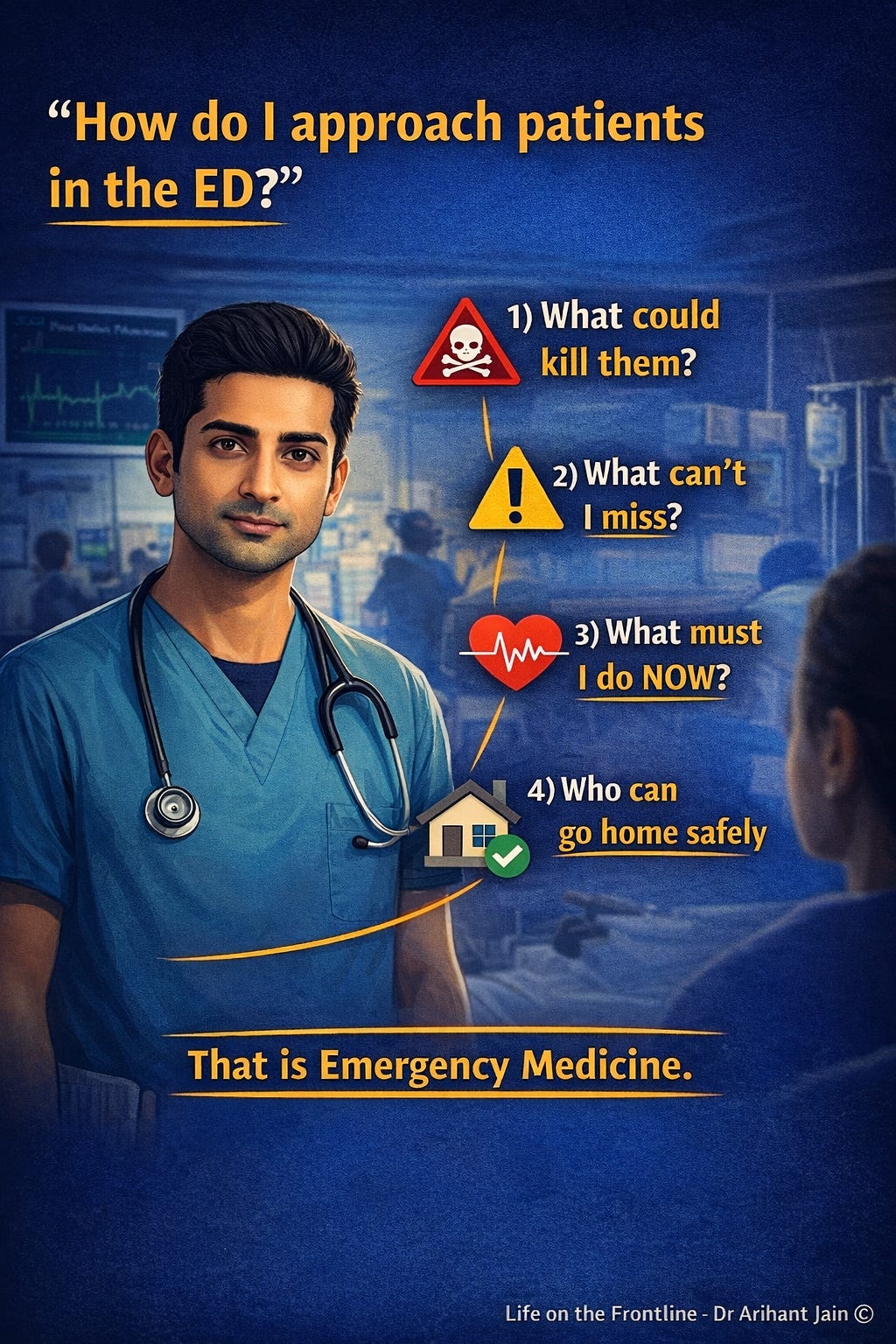
You walk in with your “medical school brain.”
You start taking history in a perfect sequence.
You want to complete everything: complaint → history → examination → investigations → diagnosis.
And then ED happens.
A nurse interrupts: “BP is dropping.”
A relative screams: “Doctor, she’s not breathing!”
Two patients arrive at once.
Your “structured order” breaks in 30 seconds.
And you realise:
Emergency Medicine is not about what the patient has.
Emergency Medicine is about what the patient needs — NOW.
That one sentence explains why EM is different from elective specialties.
How ED Approach is Different from Other Branches
In outpatient medicine, the goal is usually:
✅ accurate diagnosis → definitive long-term plan
In emergency medicine, the goal is:
✅ identify dangerous conditions early
✅ stabilize first
✅ reduce risk
✅ decide disposition safely
So while other branches may ask:
“What is the diagnosis?”
The ED asks:
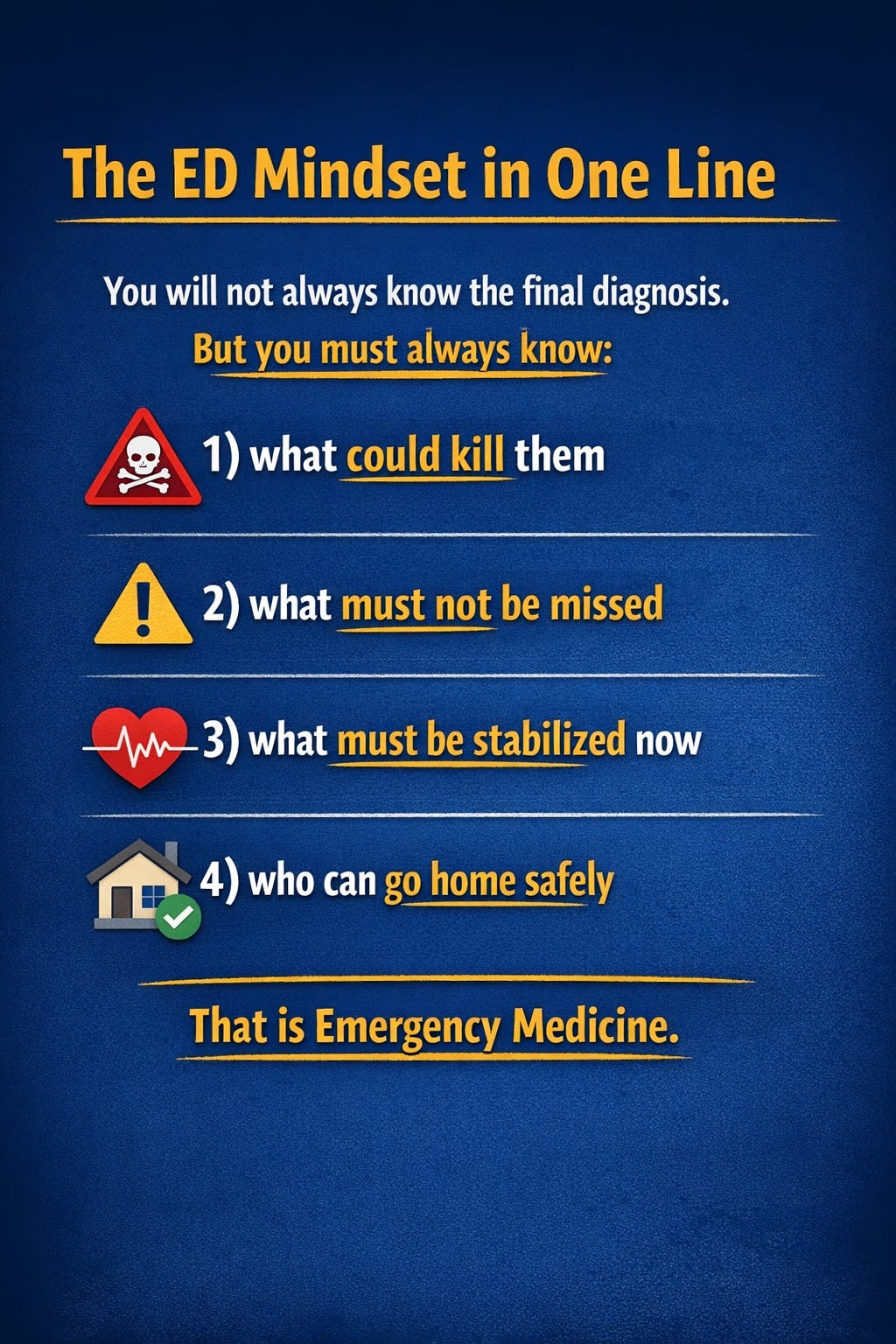
“What could kill them — and what do they need right now?”
The EM Thinking Model
1) Timing + Triggers + Targeted Exam (TiTrATE thinking)
Most medical learning is diagnosis-based.
Emergency medicine is pattern-based + risk-based.
So we classify presentations rapidly by:
Timing (sudden vs progressive)
Triggers (provoked vs spontaneous)
Targeted exam (tests you do at bedside that actually change probability)
2) Hypothetico-Deductive Reasoning (EM’s real superpower)
This is how the best ED doctors think:
form a hypothesis
ask questions/examine to test it
see if data matches
confirm or falsify
update hypothesis
Not linear.
Not slow.
Not perfect.
But fast, adaptive, and safe.
You are constantly asking:
“What is the most dangerous possibility here?”
Before You Enter the Patient’s Room: The EM Pre-Work
Good EM doctors do a “mini-investigation” before history begins.
Chart Review
triage vitals
nurse notes
EMS run sheet
old visits/discharge summaries
Medication audit
Because in ED, meds are often the diagnosis:
beta-blockers / CCBs
insulin/sulfonylureas
anticoagulants
psych meds
Talk to EMS
EMS often carries the missing puzzle piece.
Pearl:
If you take history without reviewing pre-arrival info, you are already behind.
History in ED: A counter-intuitive rule
Here’s the opposite of what medical school teaches:
✅ Leave the obvious for last.
Because you won’t forget the chief complaint.
Start instead with:
past medical history
meds / recent changes
substance use
social context
functional baseline
Then address the complaint with a sharper lens.
The ED Physical Exam
In elective medicine, physical exam can be broad.
In ED:
Every manoeuver is a test.
Every sign has “diagnostic weight.”
Rules:
✅ undress properly
✅ functional assessment matters (walk them, sit them, move them)
✅ exam should be guided by dangerous differentials
Functional Heuristics: EM’s memory shortcuts
These are “rules” that protect you from missing killers.
Examples:
Severe bradycardia / heart block = hyperkalemia until potassium returns
Unexplained severe headache = check ocular pressure
Rhabdomyolysis = rule out compartment syndrome
This helps you survive busy shifts.
But there’s a second step:
Heuristic Cycling
It means:
If you keep doing something by reflex — write it down and later ask: is this still true?
Because outdated heuristics cause harm.
Test Ordering in ED: Stop ordering tests blindly
Emergency testing is decision-based, not curiosity-based.
Before ordering any test, ask:
“What will I do if it’s positive?”
“What will I do if it’s negative?”
“Will this change management today?”
If the answer is “nothing changes,” reconsider.
The ED “2–10% Rule”
This is a powerful way to avoid unnecessary tests.
If a dangerous diagnosis is <2% likely → harm of testing > benefit
If >10% likely → test is justified
If 2–10% (grey zone) → shared decision making
This is how experts reduce overtesting without being unsafe.
Preferred Error: The advanced ED decision tool
When stuck between two paths:
Ask:
“If I’m wrong, which mistake is less harmful?”
Overtreatment vs undertreatment.
Admission vs discharge.
CT now vs watchful waiting.
Experts don’t aim for “certainty.”
They aim for better failure modes.
That’s called preferred error.
Documentation: Why EM doctors document differently
In EM, documentation isn’t just a legal note.
It is a cognitive tool.
Done properly, it forces Type 2 thinking:
What are the dangerous differentials?
Why not this diagnosis?
Why did I choose this disposition?
A powerful ED hack:
✅ Use DDx templates (dangerous diagnosis macros)
Not to buff the chart.
To buff the brain.
The Emotional Side: ED Is Not Just Medicine
The best ED doctors develop:
emotional resilience
cognitive control
recovery rituals
Because ED forces constant uncertainty.
Tools used by experts:
✅ post-shift decision journaling
✅ premortems (what could go wrong?)
✅ meditation
✅ debrief + reflection
Note :
Inspired by Emergency Medicine Cases — “How EM Experts Think Part 2”
https://emergencymedicinecases.com/how-em-experts-think-part-2/
🎧 Podcast link (for more):
https://media.blubrry.com/emc/content.blubrry.com/emc/EMC-201-Jan2025-How-EM-Experts-Think-Part-2.mp3
Take-home
Emergency Medicine is not a branch.
It’s a way of thinking.
If you learn this framework early, you stop feeling overwhelmed and start feeling in control—even on the busiest shift.