

Bimanual ≠ BURP ≠ Cricoid Pressure
Ask 10 clinicians in a resus bay to apply “cricoid pressure,” and at least half will actually perform BURP… some will push the thyroid cartilage… and one person will crush the cricoid into the cervical spine like they’re ringing a doorbell. The result?(Levitan 2006)
➡️ Worse view
➡️ Prolonged attempt
➡️ Higher risk of desaturation and esophageal intubation
This chaos is not academic — it’s dangerous.
The rule for intubation
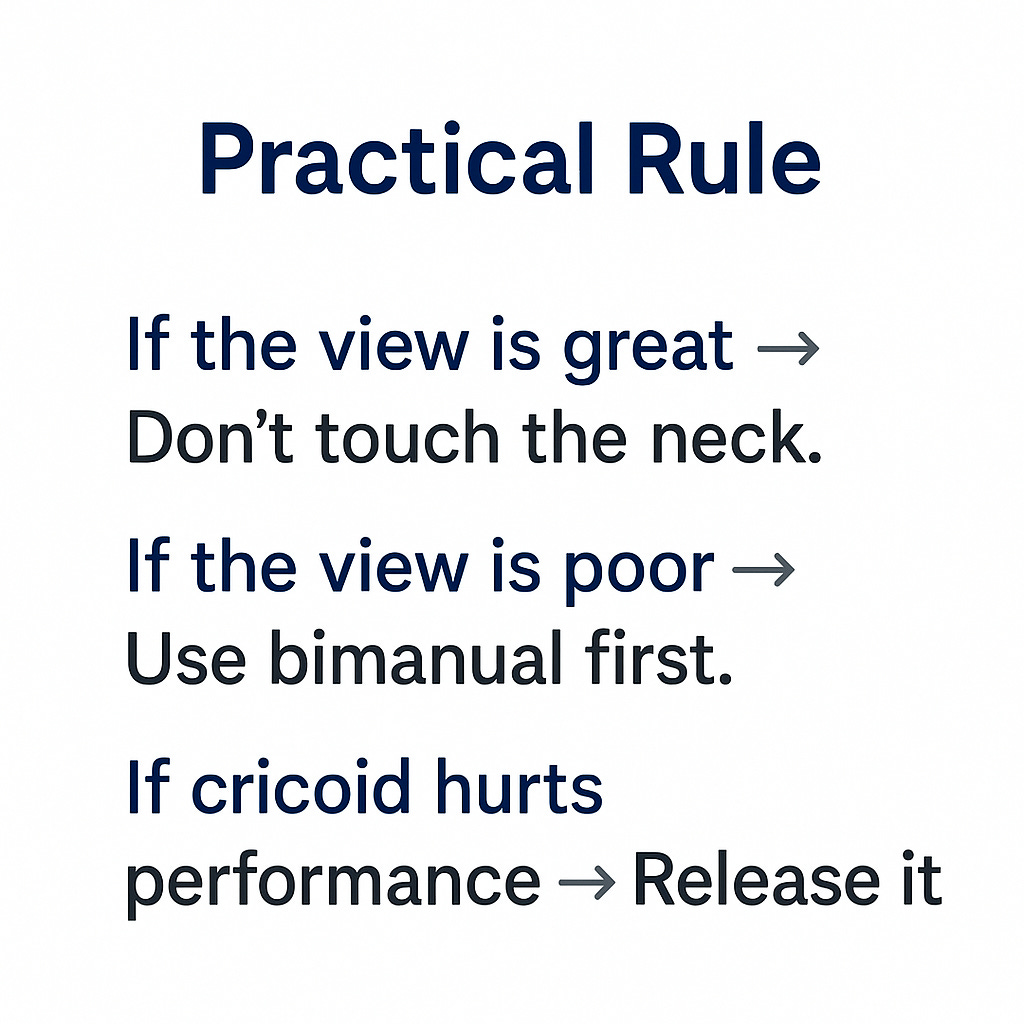
Bimanual laryngoscopy should be your default first manoeuvre. (Hwang 2013)
BURP is a reasonable backup. (Jain 2024)
Cricoid pressure adds little — and should be removed immediately if it worsens the view.(Birenbaum 2019)
Modern airway management is about first-pass success — not theoretical aspiration protection.(Salem 2017).
Bimanual Laryngoscopy (the default technique)
Goal: Improve glottic exposure by operator-guided laryngeal positioning. (Levitan 2006)
Steps
Hold the laryngoscope in the left hand as usual.
Use your right hand to palpate the thyroid cartilage.
Adjust the larynx individualised to each patient.
Once the best view is obtained,
→ Freeze position
→ Tell your assistant:
“Hold exactly where my fingers are.”Remove your right hand and pass the tube.
🧠 Key principle:
Operator locates the optimal pressure point first — assistant only maintains what works.
Not a guessing game.
“My right hand finds the best view — hold exactly where my fingers are.”
BURP Manoeuvre
Goal: Simple external manipulation to improve view when the operator can’t use both hands. (Jain 2024)
Steps
Identify the thyroid cartilage — NOT cricoid.
Apply Backward–Upward–Rightward Pressure:
Backward: Compress toward the spine
Upward: Toward the head/mandible
Rightward: Larynx shifted slightly to the patient’s right
Maintain gentle pressure while the operator views.
⚠️ If the view worsens → release immediately. (Levitan 2006)
Often useful in paediatrics due to floppy epiglottis — still inferior to bimanual (Kojima 2019)
Sellick’s Manoeuvre (Cricoid Pressure)
(traditionally during RSI, but use cautiously) (Parthasarathy 2024)
Goal: Theoretical oesophageal occlusion to reduce passive regurgitation.
Steps
Identify the cricoid cartilage (complete ring below the thyroid).
Apply posterior pressure only — straight back onto cervical spine.
Force target:
~10 N before LOC
~30 N after LOC
(Nobody measures it perfectly… but avoid the “brutal thumb” technique.)
Constant reassessment with laryngoscopy:
If the view worsens → reduce or remove
If bag-mask ventilation deteriorates → remove
If intubation is failing → remove
🚫 NEVER combine others and cricoid as a random mash-up.
That’s when airways go from manageable → impossible.
Cricoid pressure: outdated dogma (Salem 2017)
Sellick’s manoeuvre was introduced in 1961, before evidence. Modern studies show:
Esophagus not always midline → no reliable occlusion (Harris 2010 & Allman 1995)
Pressure narrows airway and worsens mask ventilation (Allman 1995 & Georgescu 1992)
Longer intubation attempts and worse view. (Harris 2010)
IRIS Trial: no aspiration-reduction benefit. (Birenbaum 2019)
Rule:
If the view worsens or ventilation becomes difficult → RELEASE the cricoid pressure. (Salem 2017)
When Not Required? (Fackler 2018)
External laryngeal manoeuvres (ELMs), including bimanual laryngoscopy, BURP, and Sellick’s manoeuvre (cricoid pressure) are valuable adjuncts when the view is difficult or aspiration risk is high. However, there are clear scenarios in which these manoeuvres are unnecessary or counterproductive, particularly when they worsen the glottic view, impede tube delivery, or compromise ventilation.
Situations Where These Manoeuvres Are Not Required
1️⃣ Optimal Glottic View Without Manipulation (Levitan 2006)
If a full or near-full glottic view is obtained initially, any manipulation risks worsening the view or delaying a successful first pass.
In controlled trials, ELMs provided benefit only with suboptimal visualisation — otherwise they reduced POGO scores and made intubation harder.
2️⃣ Routine Use Discouraged in Pediatrics
Pediatric airway guidelines emphasise selective use:
Indiscriminate ELM application → lower first-pass success in critically ill children. (Kojima 2019)
Use only when view is poor or after tube delivery difficulty. (Yamamoto 2020)
Young children have softer larynges, higher epiglottis, and smaller margin for error.
3️⃣ Video Laryngoscopy Provides an Already-Optimized View
Video devices often give excellent glottic visualisation without manipulation, reducing the need for ELMs or cricoid pressure. (Polo 2025)
ELMs may still assist with tube alignment when the camera view is good but the tube path is poor — but routine use is unnecessary. (Zhang 2024)
4️⃣ When Sellick’s Manoeuvre Worsens the View (or Ventilation) (Birenbaum 2019 & Harris 2010)
Cricoid pressure should never be applied rigidly:
No clinically meaningful aspiration reduction in RSI (IRIS trial)
Frequently worsens glottic view, prolongs attempts
May cause complete airway obstruction in select patients
👉 If visualisation or ventilation deteriorates → Release immediately.
5️⃣ Contraindications and Complications (Georgescu 1992)
Avoid ELMs and cricoid pressure when they aggravate airway compromise, such as:
Supraglottic tumors
Structural pathology
High airway resistance
Active obstruction
If airway patency is already tenuous, pressure may tip the balance toward complete obstruction.
First-pass success remains the best strategy to reduce aspiration risk and hypoxemia.
Conclusion
Bimanual laryngoscopy, BURP, and Sellick’s manoeuvre should not be used routinely. They are situation-dependent tools that help only when the view is insufficient. The priority in emergency airways is rapid, high-success intubation with minimal physiologic disruption — and unnecessary pressure on the neck can interfere with that goal.
References:
1️⃣ Levitan RM, Kinkle WC, Levin WJ, Everett WW. Laryngeal view during laryngoscopy: a randomized trial comparing cricoid pressure, backward-upward-rightward pressure, and bimanual laryngoscopy. Ann Emerg Med. 2006;47(6):548-555.
2️⃣ Hwang J, Park S, Huh J, et al. Optimal external laryngeal manipulation: modified bimanual laryngoscopy. Am J Emerg Med. 2013;31(1):32-36.
3️⃣ Jain K, Seth A, Kumar R, Yazhini A, Kohli S. BURP manoeuvre with C-MAC video-laryngoscope. J Anaesthesiol Clin Pharmacol. 2024;41:304-310.
4️⃣ Birenbaum A, Hajage D, Roche S, et al. Cricoid pressure vs sham during RSI: IRIS randomized clinical trial. JAMA Surg. 2019;154(1):9-17.
5️⃣ Allman KG. Effect of cricoid pressure on airway patency. J Clin Anesth. 1995;7(3):197-199.
6️⃣ Radkowski P, Kędziora B, et al. Rapid sequence intubation: current state of knowledge. Lek Wojsk. 2024;102(1):xx-xx.
7️⃣ Parthasarathy S, Johnson J, Theerth K. Sellick’s manoeuvre—new insights. Indian J Anaesth. 2024;68(6):407-408.
8️⃣ Kumar S, Naeem K, Wanwari M, et al. Knowledge and practices of cricoid pressure among anesthesiologists at tertiary care hospitals. J Med Health Sci Rev. 2025;5(1).
9️⃣ Harris T, Ellis D, Foster L, Lockey D. Cricoid pressure and laryngeal manipulation during pre-hospital emergency anesthesia. Resuscitation. 2010;81:810-816.
🔟 Salem M, Khorasani A, Zeidan A, Crystal G. Cricoid pressure controversies: narrative review. Anesthesiology. 2017;126:738-752.
1️⃣1️⃣ Georgescu A, Miller J, Lecklitner M. Sellick maneuver causing complete airway obstruction. Anesth Analg. 1992;74:457-459.
1️⃣2️⃣ Kojima T, Laverriere E, Owen E, et al. External laryngeal manipulation and intubation success in critically ill children. Pediatr Crit Care Med. 2019;19:106-114.
1️⃣3️⃣ Yamamoto T, Schindler E. Self-BURP maneuver in pediatric laryngoscopy. Anaesthesiol Intensive Ther. 2020;52:74-75.
1️⃣4️⃣ Niforopoulou P, Pantazopoulos I, Demestiha T, et al. Video-laryngoscopes in adult airway management. Acta Anaesthesiol Scand. 2010;54:1050-1061.
1️⃣5️⃣ Zhang K, Zhong C, Lou Y, et al. Video laryngoscopy improves intubation outcomes in critically ill patients: RCT meta-analysis. Emerg Med J. 2024;42(4):253-261.
1️⃣6️⃣ Polo P, Ramírez-Rodríguez R, Alejandro-Salinas R, et al. Video vs direct laryngoscopy for tracheal intubation in critically ill adults: systematic review. J Clin Med. 2025;14(6):1933.
1️⃣7️⃣ Maslanka M, Smereka J, Pruc M, et al. Airtraq versus Macintosh for airway management: meta-analysis. Disaster Emerg Med J. 2021;6(1):1-9.
1️⃣8️⃣ Sheikh S, Shamim F. Video laryngoscopy in emergency airway management — a paradigm shift. Arch Acad Emerg Med. 2022;10(1):e1474.