

By-
Dr Arihant Jain, MD | lifeonthefrontline.com
Instagram: @humans.of.em
X | Linkedin | ORCID
————————
COPD 2026: What Acute Care Physicians Need to Know
Why Every Exacerbation Matters More Than You Think ?
A patient arrives breathless.
They have increased cough, more sputum than usual, and worsening exercise tolerance over the last week. The oxygen saturation is 86%, respiratory rate is 32, and they are using every accessory muscle available.
For many clinicians, this is another COPD exacerbation.
For GOLD 2026, it is something more important.
An exacerbation is no longer viewed as a temporary flare-up that resolves with nebulizers, steroids, and a discharge summary. Instead, GOLD increasingly frames exacerbations as trajectory-changing events—episodes associated with accelerated lung function decline, increased risk of future hospitalization, reduced quality of life, and increased mortality.
For acute care physicians, this shift in thinking may be the most important update in the entire document. The goal is no longer simply treating today’s breathlessness. The goal is preventing tomorrow’s deterioration.
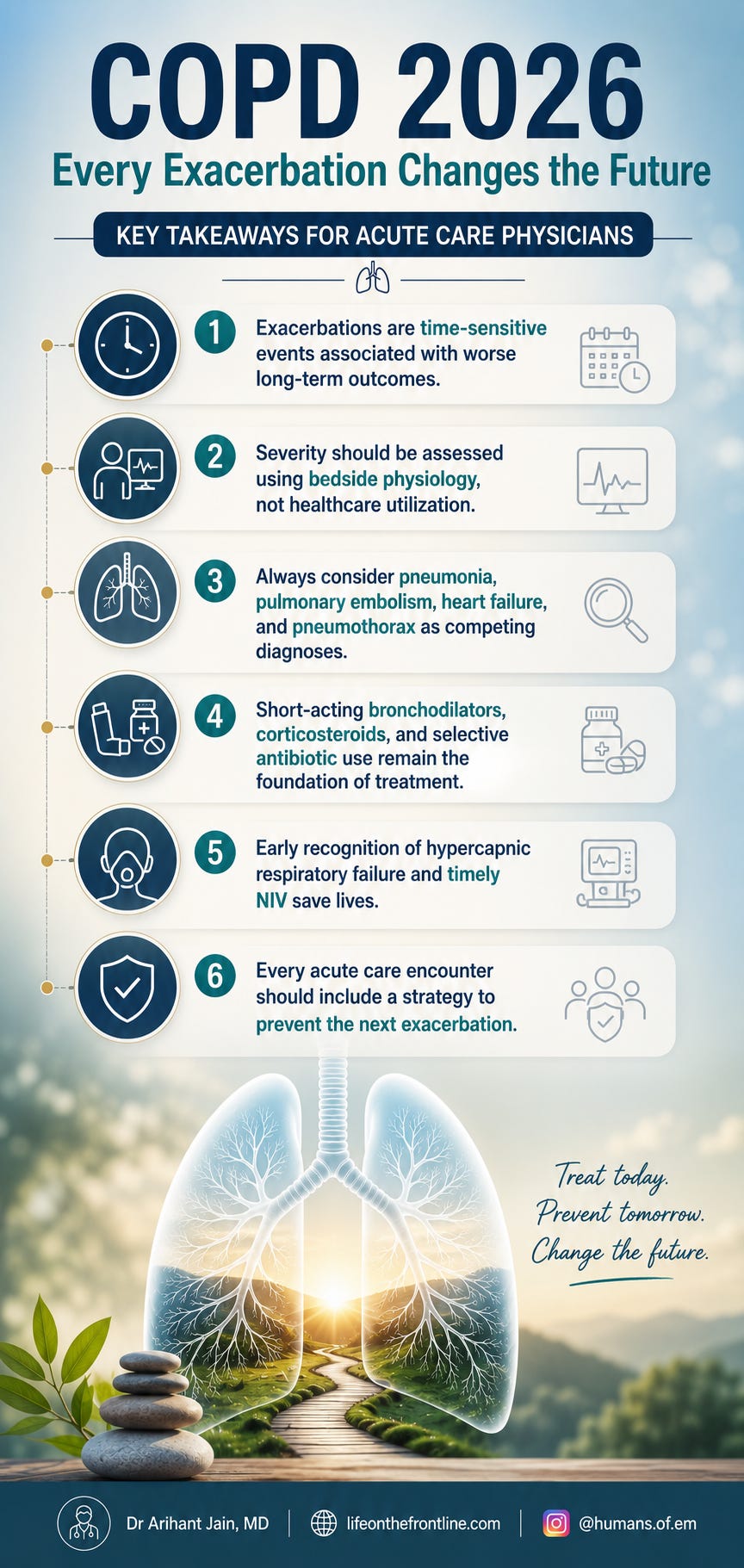
1. COPD Exacerbations Have a Clearer Definition
The 2026 GOLD update defines an exacerbation as an acute worsening of respiratory symptoms occurring over several days and up to 14 days, typically characterized by increased dyspnea and/or cough and sputum production, often accompanied by tachypnea or tachycardia.
At first glance, this seems like a minor wording change.
It isn’t.
The revised definition emphasizes the clinical syndrome itself rather than the treatment that follows. An exacerbation is not defined by whether a patient receives steroids, antibiotics, or hospitalization. It is defined by a recognizable pattern of symptom deterioration associated with increased airway and systemic inflammation.
For clinicians working in emergency departments, acute medical units, respiratory wards, and intensive care settings, this provides a more practical framework for diagnosis and management.
2. Not Every Breathless COPD Patient Has a COPD Exacerbation
One of the most important reminders in GOLD 2026 is that several conditions can mimic or worsen an exacerbation.
Among the most important are:
Pneumonia
Pulmonary embolism
Acute heart failure
Pneumothorax
Cardiac ischemia
Arrhythmias
Many patients admitted with presumed COPD exacerbation ultimately have a competing or coexisting diagnosis driving their deterioration.
The challenge for acute care physicians is not merely recognizing COPD. It is identifying what else may be happening simultaneously or what could have triggered this episode.
When a patient fails to respond as expected, reassessment should occur early rather than assuming treatment failure.
A “COPD exacerbation” diagnosis should never end clinical reasoning.
3. GOLD Has Moved Beyond Admission-Based Severity
Traditionally, exacerbation severity was inferred from healthcare utilization.
If a patient was admitted, the exacerbation was severe. If they were discharged, it was moderate.
This approach was convenient for research but often unhelpful at the bedside.
GOLD 2026 aligns severity assessment more closely with the Rome Proposal, emphasizing physiological assessment rather than disposition decisions.
Severity should be determined by:
Work of breathing
Respiratory rate
Oxygenation
Hypercapnia
Accessory muscle use
Mental status
Hemodynamic stress
Response to initial treatment
This reflects how acute care clinicians already think. A patient becoming progressively fatigued and hypercapnic is severe regardless of where they ultimately receive care.
Physiology matters more than location.
4. Early Treatment Remains the Cornerstone
Although the philosophy has evolved, the fundamentals of treatment remain remarkably consistent.
Bronchodilators
Short-acting beta-agonists remain first-line therapy. Short-acting anticholinergics may be added when additional bronchodilation is required.
Corticosteroids
Systemic corticosteroids improve lung function, shorten recovery time, reduce treatment failure, and decrease hospital length of stay. Current recommendations continue to support short courses of approximately five days.
Longer courses generally provide little additional benefit while increasing adverse effects.
Antibiotics
Antibiotics should be reserved for patients with evidence suggesting bacterial infection, particularly:
Increased sputum purulence
Increased sputum volume
Increased dyspnea
Five-day treatment courses are generally sufficient.
Methylxanthines
Despite their historical role, methylxanthines remain discouraged because the risk of adverse effects outweighs clinical benefit.
Sometimes the most important update is recognizing what has not changed.
5. Respiratory Failure Should Be Recognized Before Exhaustion Occurs
One of the recurring themes throughout modern COPD care is earlier intervention. This is particularly true for acute hypercapnic respiratory failure.
GOLD continues to strongly support:
Controlled oxygen therapy
High-flow oxygen systems when appropriate
Non-invasive ventilation (NIV)
The evidence remains compelling.
Early NIV improves gas exchange, reduces work of breathing, decreases intubation rates, shortens hospitalization, and improves survival.
The critical challenge is timing. Patients rarely deteriorate suddenly.
Most show warning signs hours beforehand:
Increasing respiratory rate
Rising carbon dioxide levels
Progressive fatigue
Reduced air movement
Altered mental status
The best outcomes occur when NIV is initiated before exhaustion develops. Waiting for collapse is rarely a successful strategy.
6. The Real Work Begins After Stabilization
Perhaps the most underappreciated message in GOLD 2026 is that recovery extends far beyond the acute episode. Recovery from an exacerbation often requires four to six weeks. Many patients never fully return to their previous baseline.
Every acute care encounter therefore represents an opportunity to reduce future risk.
Before transition of care, clinicians should consider:
Is maintenance therapy optimized?
Has inhaler technique been assessed?
Are there adherence barriers?
Were modifiable triggers identified?
Does the patient have elevated eosinophils that may support ICS-containing therapy?
Is appropriate follow-up arranged?
Acute care is not separate from chronic disease management. It is often the moment that determines the next year of a patient’s disease course.
What Changed the Most?
The most important change in GOLD 2026 is not a new medication. It is a new perspective. COPD exacerbations are increasingly viewed as biologically significant events that alter long-term outcomes. Each exacerbation increases the risk of future exacerbations. Each hospitalization increases future vulnerability. Each episode of respiratory failure carries consequences that persist long after discharge.
For acute care physicians, that means every exacerbation deserves urgency, careful evaluation, and a prevention-focused mindset. Because the objective is no longer simply getting patients through today’s crisis. The objective is changing what happens next.
References
Global Initiative for Chronic Obstructive Lung Disease (GOLD). Global Strategy for the Diagnosis, Management and Prevention of COPD. 2026 Report.
Celli BR, Fabbri LM, Aaron SD, et al. An Updated Definition and Severity Classification of COPD Exacerbations: The Rome Proposal. Am J Respir Crit Care Med. 2021;204(11):1251-1258.
Wedzicha JA, Seemungal TAR. COPD Exacerbations: Defining Their Cause and Prevention. Lancet. 2007;370:786-796.
Agustí A, Vogelmeier CF, Criner GJ, et al. Global Initiative for Chronic Obstructive Lung Disease 2026 Report.
Comprehensive yet succinct review of recent literature Thanq fr sharing...