This isn’t just an update
At first glance, the 2026 Surviving Sepsis Campaign guidelines look familiar.
Same bundles. Same urgency. Same resuscitation priorities.
But look closer.
This is not a routine revision.
It’s a philosophical shift — from protocol-driven sepsis care to context-aware, system-level, precision acute care.
And if you work in the emergency department or ICU, this changes how you think — not just what you do.
Follow us on Instagram: @humans.of.em
What Changed (and Why It Matters)
1. Sepsis is now a system problem, not just a bedside problem
2026:
Performance improvement programs + quality improvement (QI)
→ Strong recommendation, moderate certainty of evidenceIntroduction of:
“Code sepsis” / sepsis huddle
→ Conditional recommendation, low certainty
2021:
Performance programs recommended
→ Strong, moderate-quality evidence (screening)
What changed?
QI is no longer administrative — it’s therapeutic.
Acute care takeaway:
You’re not just treating septic shock anymore.
You’re part of a hospital-wide intervention system.
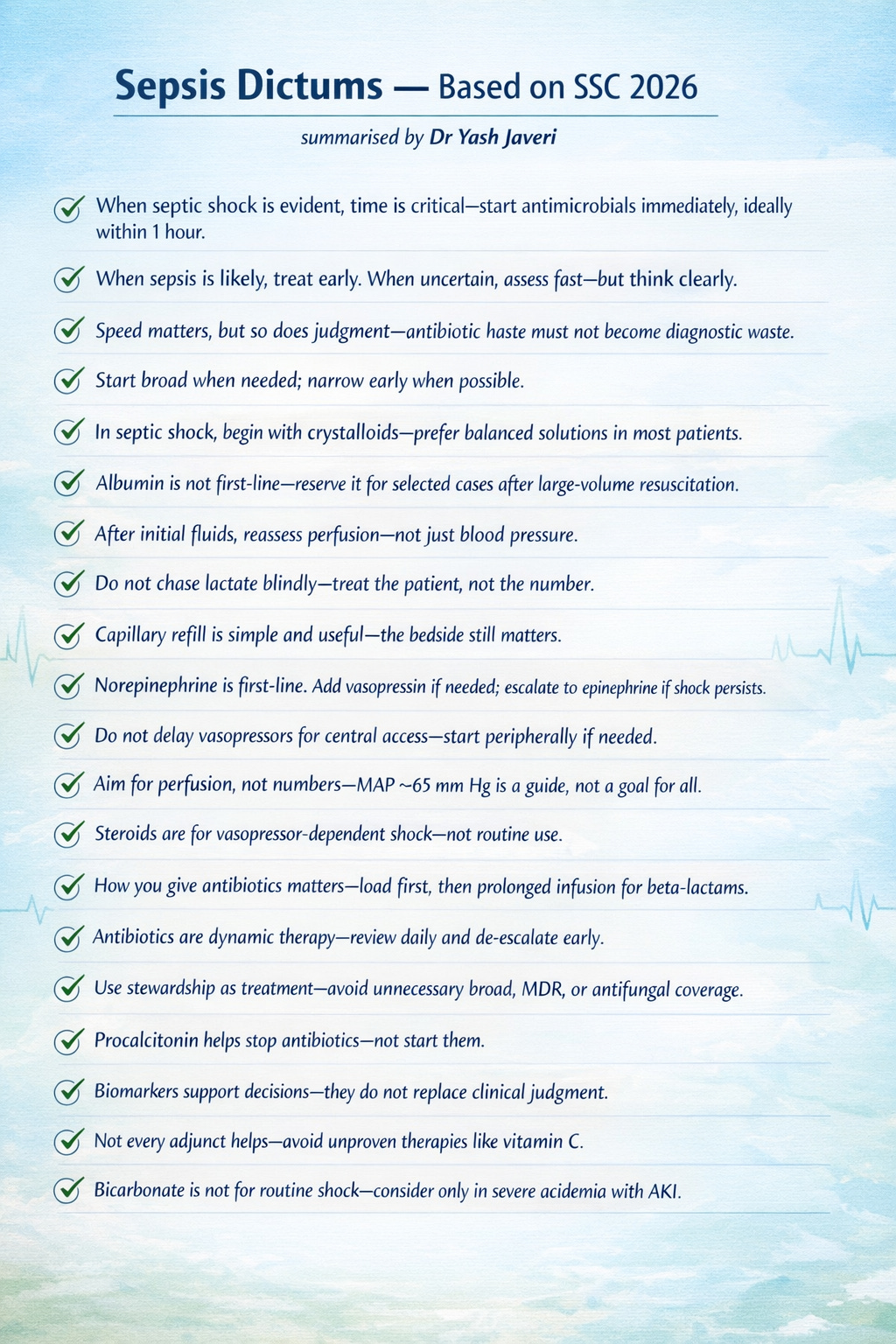
2. Antibiotics: The death of the “1-hour rule for everyone”
2021:
Antibiotics within 1 hour for all sepsis
→ Strong recommendation (low/very low evidence)
2026:
Septic shock / high suspicion → immediate antibiotics
Possible sepsis (no shock) → investigate, give within 3 hours
Low likelihood → defer antibiotics
👉 Evidence:
Strong (shock)
Weak / very low (non-shock)
Why this matters:
A major pivot toward antimicrobial stewardship
Acute care reality:
You now need to balance:
Delay = harm
Overuse = harm
That’s a harder — and more honest — guideline.
👉 Dosing strategy finally gets attention
Prolonged infusion of beta-lactams over bolus dosing
→ Weak recommendation, moderate-quality evidence
Why this matters
Aligns with PK/PD principles
Improves time above MIC, especially in:
Septic shock
Altered pharmacokinetics
Practical takeaway
Start thinking beyond “which antibiotic”
Move toward:
👉 How you give it matters as much as what you give
Antibiotics don’t just start early — they must stop early
👉 Daily assessment for de-escalation based on culture and susceptibility
→ Weak recommendation, very low-quality evidence
👉 Avoid prolonged broad-spectrum therapy once pathogen is identified
Why this matters
This is a major philosophical shift:
Earlier guidelines focused on early administration
2026 emphasizes early de-escalation
Acute care takeaway
Antibiotics are not a one-time decision
They are a dynamic therapy
👉 Start broad (when needed)
👉 Narrow early (when possible)
3. Screening: Less faith in qSOFA, more in broader tools
2021:
Against using qSOFA alone
→ Strong recommendation, moderate-quality evidence
2026 reinforces and clarifies:
👉 Use NEWS, NEWS2, MEWS, or SIRS over qSOFA as a single screening tool
→ Strong recommendation, moderate certainty of evidence
Also adds:
Prehospital screening
→ Conditional, very low evidence
Why this matters
qSOFA was attractive because it was simple.
But simplicity came at the cost of sensitivity.
👉 The 2026 guideline firmly moves away from qSOFA as a standalone tool.
Acute care takeaway
Stop relying on qSOFA alone
Use early warning scores + clinical judgment
Screening is not a number — it’s a system + process
4. Fluids: The quiet downgrade
2021:
30 ml/kg fluids
→ Weak recommendation, low-quality evidence (downgraded)
2026 direction:
Reinforces individualized resuscitation
Moves away from rigid fluid mandates
Takeaway:
The guideline no longer believes in “one-size-fits-all fluids”
5. Lactate, CRT, and monitoring: still here, still weak
Lactate-guided resuscitation
→ Weak, low-quality evidenceCapillary refill time
→ Weak evidence
Translation:
We use them.
We trust them.
But the evidence is still not strong.
6. Adjuncts: Less enthusiasm, more skepticism
Strong:
No starch → Strong, high-quality evidence
Norepinephrine first-line → strong
Weak / against:
Vitamin C → Weak against
Hemoperfusion → Weak against
Pattern:
Most adjuncts either:
Don’t work
Or don’t have good evidence
7. Ventilation: One of the few stable areas
Low tidal volume → Strong, high-quality evidence
Proning → Strong, moderate-quality evidence
HFNC over NIV → Weak, low-quality evidence
Insight:
Respiratory care remains one of the most evidence-consistent domains
8. New emphasis: survivorship and transitions of care
2026 expands into:
Goals of care discussions
Post-sepsis syndrome
Transitions of care
Mostly:
👉 Best practice / weak evidence
Shift:
Sepsis is no longer an ICU event.
It is a longitudinal disease process
If you remember only few things from 2026:
Think before antibiotics (unless shock)
How you give antibiotics (infusion strategy) matters
De-escalate early — stewardship is core care
Fluids are individualized, and type matters
What This Means: A Critical Appraisal
a). The uncomfortable truth: Evidence is still weak
Across domains:
Antibiotics (non-shock) → very low certainty
Fluids → low certainty
CRT/lactate → low certainty
Code sepsis → low certainty
👉 Despite decades of research, high-certainty evidence is limited
b). The “GRADE paradox”
The guideline uses structured GRADE methodology:
“We recommend” → strong
“We suggest” → conditional
But:
👉 Strong recommendations sometimes sit on low-quality evidence (especially earlier guidelines)
👉 Many new recommendations remain conditional
💡 Implication:
This is transparent science — but still uncertain medicine
c). From protocols → clinical judgment
Old era:
Bundles
Timelines
Protocol compliance
2026:
Diagnostic probability
Stewardship
Context-aware decisions
This is the real shift:
The guideline now expects thinking, not just following
d). The antibiotic pivot is the most practice-changing update
Before:
Everyone gets antibiotics early
Now:
Timing depends on:
Severity
Probability of infection
Clinical reality:
You are now balancing:
Sepsis mortality vs antimicrobial harm
This is harder — but more accurate.
e). Real-world applicability (especially LMIC settings)
The guideline acknowledges:
Resource variability
Need for adaptable systems
💡 Interpretation:
“Code sepsis” may help more in chaotic, resource-limited systems
Protocols alone don’t fix outcomes without infrastructure
f). The deeper truth: Sepsis remains poorly understood
Even in 2026:
Few high-certainty interventions
Many weak recommendations
Heavy reliance on physiology and pragmatism
👉 Sepsis is still a syndrome, not a single disease
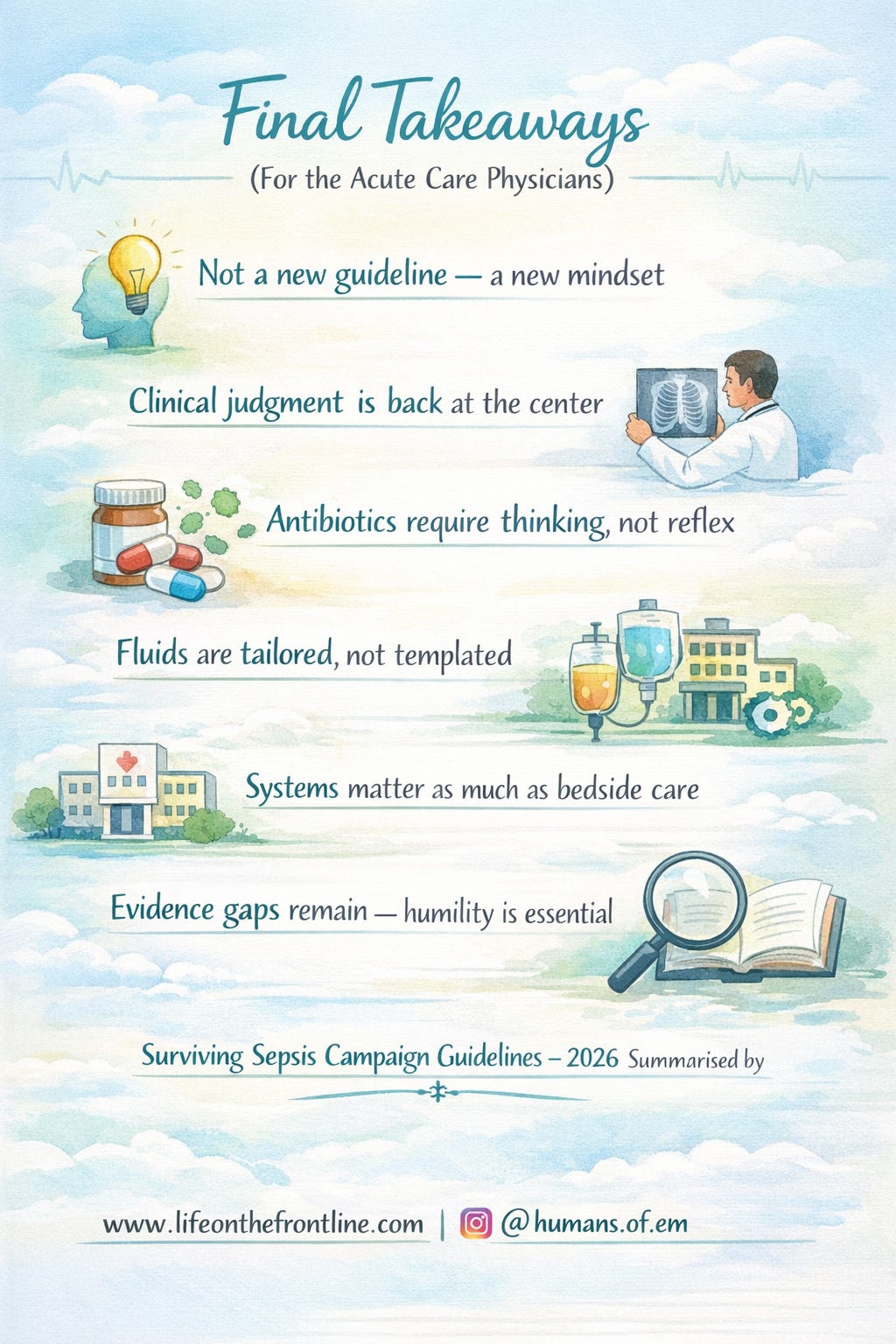
The 2026 Surviving Sepsis Guidelines don’t give you more answers.
They give you better questions.
And in the resuscitation bay at 3 AM —
that might be exactly what we needed.