

By-
Dr Arihant Jain, MD | lifeonthefrontline.com
Instagram: @humans.of.em
X | Linkedin | ORCID
—————————————————————
Alcohol withdrawal is one of those problems that looks deceptively simple.
A patient stops drinking → becomes tremulous and agitated → the CIWA score rises → benzodiazepines are given.
But severe alcohol withdrawal is not a scoring problem. It is a dynamic neuro-physiologic syndrome, and the most important decisions happen before the number on the chart tells you what to do.
I went through two useful approaches to alcohol withdrawal (Josh Farkas’ EMCrit/IBCC approach and the 2024 Annals of Emergency Medicine review by Gottlieb, Chien and Long) and tried to translate them into something that is practical at the ED bedside. The goal is not to create another “CIWA protocol.”
The goal is to answer:
Who is actually withdrawing, how sick are they, what should I give, and when should I stop giving it?
1. First question: Is this actually alcohol withdrawal?
Alcohol withdrawal syndrome occurs after cessation or reduction of heavy, prolonged alcohol use, with symptoms developing over hours to days. The underlying physiology is a shift toward CNS hyper-excitability: chronic alcohol exposure downregulates GABAergic activity and increases glutamatergic activity. When alcohol is removed, the inhibitory “brake” disappears while the excitatory system remains activated.
The bedside history matters more than the score
Ask:
How much alcohol does the patient usually drink?
Daily drinking or binge pattern?
When was the last drink?
What happens when they stop drinking?
Previous withdrawal seizures?
Previous delirium tremens?
Previous ICU admission/intubation for withdrawal?
Previous detoxification/rehabilitation?
Concomitant benzodiazepine or other sedative use?
EMCrit particularly emphasizes obtaining collateral history when the patient cannot provide a reliable history.
Don’t let a positive alcohol level reassure you
A patient can be actively withdrawing despite still having alcohol in the bloodstream.
In fact, the EMCrit review notes that an admission alcohol level >200 mg/dL may identify a patient at particularly high risk of withdrawal, especially when combined with a history suggesting dependence.
2. Know the clock
The timeline helps you anticipate what comes next.
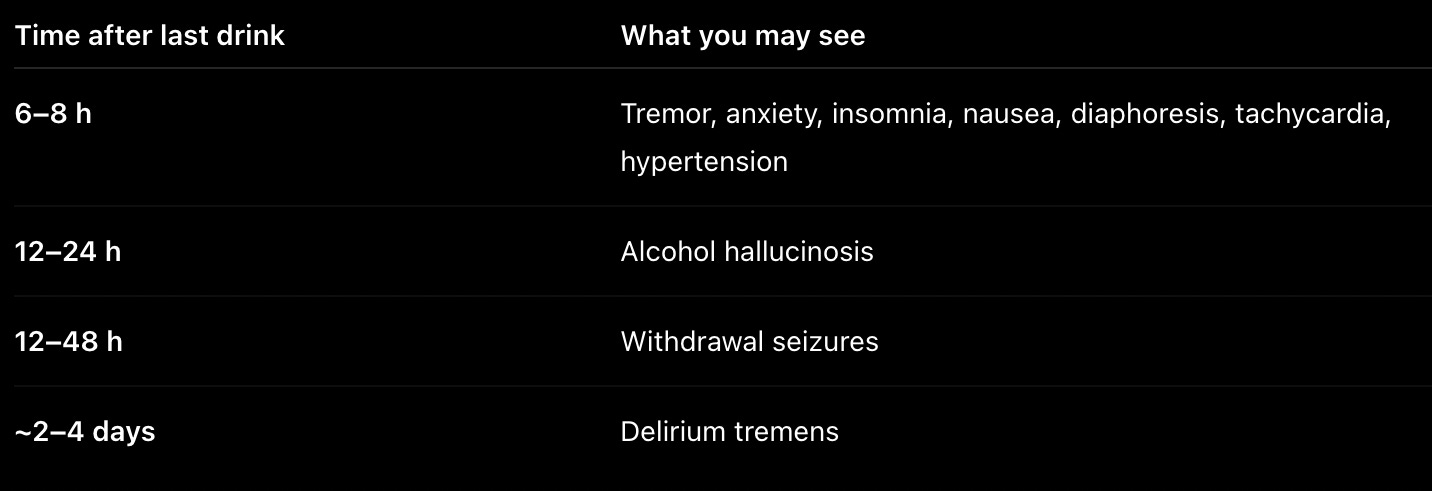
The 2024 Annals review describes initial symptoms beginning around 6–8 hours, with withdrawal generally peaking around 72 hours.
A practical implication
Time is not just documentation - it is a diagnostic tool.
A patient becoming delirious on day 5 should make you reconsider the assumption that “this is just alcohol withdrawal.”
Think:
Sepsis
Hypoglycemia
Head injury
Hepatic encephalopathy
Medication toxicity
Other withdrawal states
Metabolic abnormalities
Non-alcohol-related delirium
Both sources emphasize that alcohol withdrawal and particularly delirium tremens
is a clinical diagnosis of exclusion.
3. Before treating the agitation, ask: “What else could this be?”
This is probably the most important bedside step. A tachycardic, hypertensive, confused patient with a history of alcohol use does not automatically have delirium tremens.
Check:
Glucose → temperature → electrolytes → trauma → infection → liver disease → medications/toxins → neurologic pathology.
EMCrit review specifically recommends glucose and electrolyte assessment including Mg and phosphate, along with CBC, coagulation studies and liver tests; chest imaging and CT head should be considered when clinically indicated, particularly with trauma risk.
4. The cirrhotic patient is a diagnostic trap
One of the most dangerous mistakes is:
“Cirrhosis + agitation = alcohol withdrawal.”
Hepatic encephalopathy and alcohol withdrawal can look very different physiologically.
EMCrit emphasizes that patients with hepatic encephalopathy may be unusually sensitive to GABAergic drugs. Benzodiazepines and barbiturates can therefore produce prolonged sedation, and hepatic encephalopathy is considered a strong contraindication to phenobarbital in that framework.
So in a patient with advanced liver disease, ask:
Does the patient actually have the sympathetic/autonomic and motor findings of withdrawal?
Look for:
Tremor
Diaphoresis
Tachycardia
Hypertension
Hyperreflexia
Agitation
Hallucinations
Recent cessation/reduction
If those aren’t present, repeatedly escalating GABAergic sedation may be treating the wrong disease.
5. PAWSS answers a different question from CIWA
This distinction is extremely useful.
PAWSS = “Who is at risk of complicated withdrawal?”
CIWA/RASS = “How symptomatic/agitated is the patient right now?”
PAWSS is a validated screening tool intended to identify patients at risk for complicated withdrawal and is suggested early in the assessment of patients with chronic alcohol use. The Annals review notes that it may have value in the ED, although further ED validation is still needed.
So:
PAWSS → risk prediction
CIWA/RASS → treatment monitoring
Don’t use a high CIWA score to retrospectively establish the diagnosis.
6. CIWA is useful, but it has limitations
CIWA-Ar is probably the most familiar alcohol-withdrawal tool.
But it has a major limitation:
The patient has to participate in it.
It requires communication and can be confounded by other illnesses, anxiety, psychiatric disease and other physiologic abnormalities. It is also labor intensive.
That makes CIWA problematic in:
Delirious patients
Intubated patients
Patients unable to communicate
Severe agitation
Head injury
Critically ill patients
Patients with competing causes of tachycardia/agitation
Where does RASS fit?
RASS is objective, faster and does not require patient participation. The 2024 review describes a target of light sedation, approximately RASS +1 to −1.
EMCrit particularly favors RASS as the bedside target for phenobarbital titration.
My practical interpretation
Don’t treat the number. Treat the patient’s physiology, and use the score to help you track response.
7. Phenobarbital vs Benzodiazepines: Which One Should I Choose in the ED?
For decades, benzodiazepines have been the default treatment for alcohol withdrawal syndrome (AWS).
And for good reason.
They are effective, familiar, rapidly titratable, and have the strongest historical evidence for preventing withdrawal seizures and delirium. The ASAM guideline continues to describe benzodiazepines as first-line therapy for moderate and severe AWS.
But phenobarbital has made a significant comeback.
The question at the bedside is therefore not:
“Is phenobarbital better than benzodiazepines?”
A more useful question is:
“Which patient is better suited to phenobarbital, and which patient is better suited to benzodiazepines?”
The pharmacologic difference matters
Both drugs ultimately enhance inhibitory GABAergic neurotransmission, but they do it differently.
Benzodiazepines
Benzodiazepines increase the frequency of GABA-A chloride channel opening when GABA is present. This is important because chronic alcohol exposure produces neuroadaptation with reduced GABAergic responsiveness.
Phenobarbital
Phenobarbital increases the duration of GABA-A channel opening and also has effects on excitatory glutamatergic signaling. This broader pharmacologic activity is one reason it has theoretical and clinical appeal in severe or benzodiazepine-resistant withdrawal.
So the conceptual difference is:
Benzodiazepine → predominantly GABAergic amplification
Phenobarbital → GABAergic amplification + suppression of excitatory signaling
This may be particularly relevant in patients who become resistant to escalating benzodiazepine doses.
What does the comparative evidence actually show?
The evidence is encouraging—but not definitive.
The 2023 ED systematic review/meta-analysis included 8 studies, 1,507 patients and 2,012 treatment encounters. It found no significant difference between phenobarbital and benzodiazepines in ICU admission, hospital admission, ED readmission or adverse events. Importantly, the authors rated the overall evidence as low-to-moderate quality with moderate-to-high risk of bias and heterogeneity.
So:
Phenobarbital has not yet earned the label “universally superior.”
But newer observational data are increasingly interesting.
A 2026 propensity-matched cohort suggests lower rates of withdrawal seizures and delirium tremens with phenobarbital monotherapy without an apparent increase in mortality, mechanical ventilation or aspiration.
That fits with the broader direction of the literature: phenobarbital appears to be a reasonable alternative, and in some populations may have clinically important advantages.
But the important word is alternative, not replacement.
Where phenobarbital may have an advantage
a. Severe withdrawal
Phenobarbital becomes particularly attractive as withdrawal severity increases.
The 2024 Annals of Emergency Medicine review describes phenobarbital loading with 5–10 mg/kg IV, with additional dosing according to clinical response, as one option for severe AWS.
ASAM similarly recognizes phenobarbital as an appropriate alternative to benzodiazepines for severe withdrawal, particularly when used by clinicians experienced with the drug and with close monitoring.
b. Benzodiazepine-resistant withdrawal
This may be the most compelling indication. Some patients simply require progressively larger benzodiazepine doses without achieving adequate control.
At that point, continuing:
diazepam → diazepam → diazepam → lorazepam → more lorazepam
may not be the best strategy.
EMCrit specifically suggests transitioning toward phenobarbital in benzodiazepine-resistant delirium tremens. The pharmacology provides a plausible explanation: phenobarbital acts through mechanisms that are not identical to benzodiazepines.
c. A history of severe withdrawal
Consider phenobarbital early when the patient has a history of:
Previous withdrawal seizures
Previous delirium tremens
Previous ICU admission for withdrawal
Previous intubation
Recurrent severe withdrawal
High-risk withdrawal despite a currently modest CIWA score
These historical features are more useful than a single snapshot of the patient’s current score.
Some institutional phenobarbital protocols specifically identify previous withdrawal hospitalization, seizures/DTs, high admission alcohol levels and persistent symptoms despite benzodiazepines as triggers for a phenobarbital pathway.
d. When you want a long pharmacologic “tail”
This is one of phenobarbital’s practical advantages.
Phenobarbital has a very long half-life, allowing a loading strategy to provide sustained withdrawal suppression.
Instead of repeatedly chasing breakthrough symptoms with short-acting doses, an adequately loaded patient can effectively have a pharmacologic “self-taper.”
EMCrit uses this property as one of the major arguments for phenobarbital-based management. But this advantage becomes a disadvantage when you have chosen the wrong patient.
Because:
A long half-life is wonderful when you chose the right drug—and unforgiving when you chose the wrong diagnosis.
Where benzodiazepines may be the better choice
Phenobarbital should not become a reflex.There are several situations in which I would favor a benzodiazepine strategy.
a. Diagnostic uncertainty
This is an underappreciated reason. Phenobarbital is long acting.
If the patient’s agitation is actually due to:
Sepsis
Hepatic encephalopathy
Intracranial pathology
Toxicologic delirium
Hypoglycemia
Pain
Other withdrawal
Primary delirium
you have given a drug that may remain pharmacologically active for days.
EMCrit specifically warns against using phenobarbital when the diagnosis of AWS is uncertain because adverse effects are also prolonged. In such situations, titratable benzodiazepine therapy may be preferable.
b. Advanced liver disease / hepatic encephalopathy
This deserves special attention. Phenobarbital is hepatically metabolized, and the drug label lists marked hepatic impairment as a contraindication.
More importantly at the bedside:
Don’t confuse hepatic encephalopathy with alcohol withdrawal.
EMCrit considers hepatic encephalopathy a strong contraindication to phenobarbital because GABAergic drugs may produce prolonged sedation/coma in these patients.
ASAM recommends that when significant liver disease is present, a benzodiazepine with less hepatic metabolism should be used rather than relying on hepatically metabolized long-acting agents.
Practical distinction
Cirrhosis alone ≠ automatic contraindication to phenobarbital.
But:
Advanced hepatic dysfunction + suspected/known hepatic encephalopathy = strong reason to avoid phenobarbital.
And importantly, a patient can have both AWS and hepatic encephalopathy.
That is where the clinical examination matters most.
c. Respiratory compromise
Both drugs can cause respiratory depression. Phenobarbital’s narrow therapeutic window makes this particularly important. The ASAM guideline emphasizes that phenobarbital can cause respiratory depression and oversedation and is best used in settings with close monitoring by clinicians experienced with the drug.
The drug labeling lists severe respiratory distress with dyspnea or obstruction as a contraindication.
So a patient who is already:
Hypoventilating
Hypercapnic
Difficult to protect their airway
Receiving substantial opioids/sedatives
Experiencing significant respiratory compromise
requires extreme caution before additional long-acting CNS depressants are administered.
d. The patient has already received a large benzodiazepine load
This is one of the most important ED situations.
Phenobarbital + benzodiazepines are not pharmacologically independent drugs.
Their sedative effects can be synergistic. EMCrit explicitly warns that a phenobarbital dose that is safe by itself can become dangerous when combined with large benzodiazepine exposure.
So don’t look only at:
“Phenobarbital dose = 10 mg/kg.”
Also ask:
“How much benzodiazepine has this patient already received?”
This is why cumulative sedative exposure is more important than the individual medication order.
e. Important drug interactions
Phenobarbital is a potent hepatic enzyme inducer and can alter the metabolism of multiple medications.
This matters in patients taking:
Anticoagulants
Antiretrovirals
Immunosuppressants
Antiseizure medications
Other CYP-metabolized drugs
The interaction profile is substantially more complicated than many clinicians appreciate. Some institutional protocols specifically exclude patients receiving medications with important phenobarbital interactions.
So what are the “absolute” indications?
I would actually avoid the term “absolute indication.”
There is no universally accepted guideline that says:
“This patient must receive phenobarbital.”
Instead, think in terms of strong indications.
Strong reasons to consider phenobarbital
Severe AWS
Benzodiazepine-resistant AWS
Previous severe/complicated withdrawal
Withdrawal seizures where phenobarbital is an appropriate seizure/withdrawal agent
Need for a long-acting agent with sustained withdrawal suppression
A clinical environment where the treating team is experienced with phenobarbital and continuous monitoring is available
ASAM explicitly recognizes phenobarbital as an alternative to benzodiazepines in severe/complicated withdrawal and in patients with contraindications to benzodiazepines, provided the clinician is experienced and appropriate monitoring is available.
And what are the “absolute” contraindications?
Again, I would distinguish formal drug contraindications from clinical situations in which I would avoid it.
Formal phenobarbital contraindications include:
Known hypersensitivity to barbiturates
Manifest or latent porphyria
Marked hepatic impairment
Severe respiratory distress with dyspnea/obstruction
Strong clinical reasons to avoid or reconsider phenobarbital:
Known/suspected hepatic encephalopathy
Significant pre-existing respiratory depression
Major diagnostic uncertainty
Large recent benzodiazepine exposure
Significant concomitant CNS depressant exposure
Important drug interactions
Lack of appropriate monitoring or clinician experience
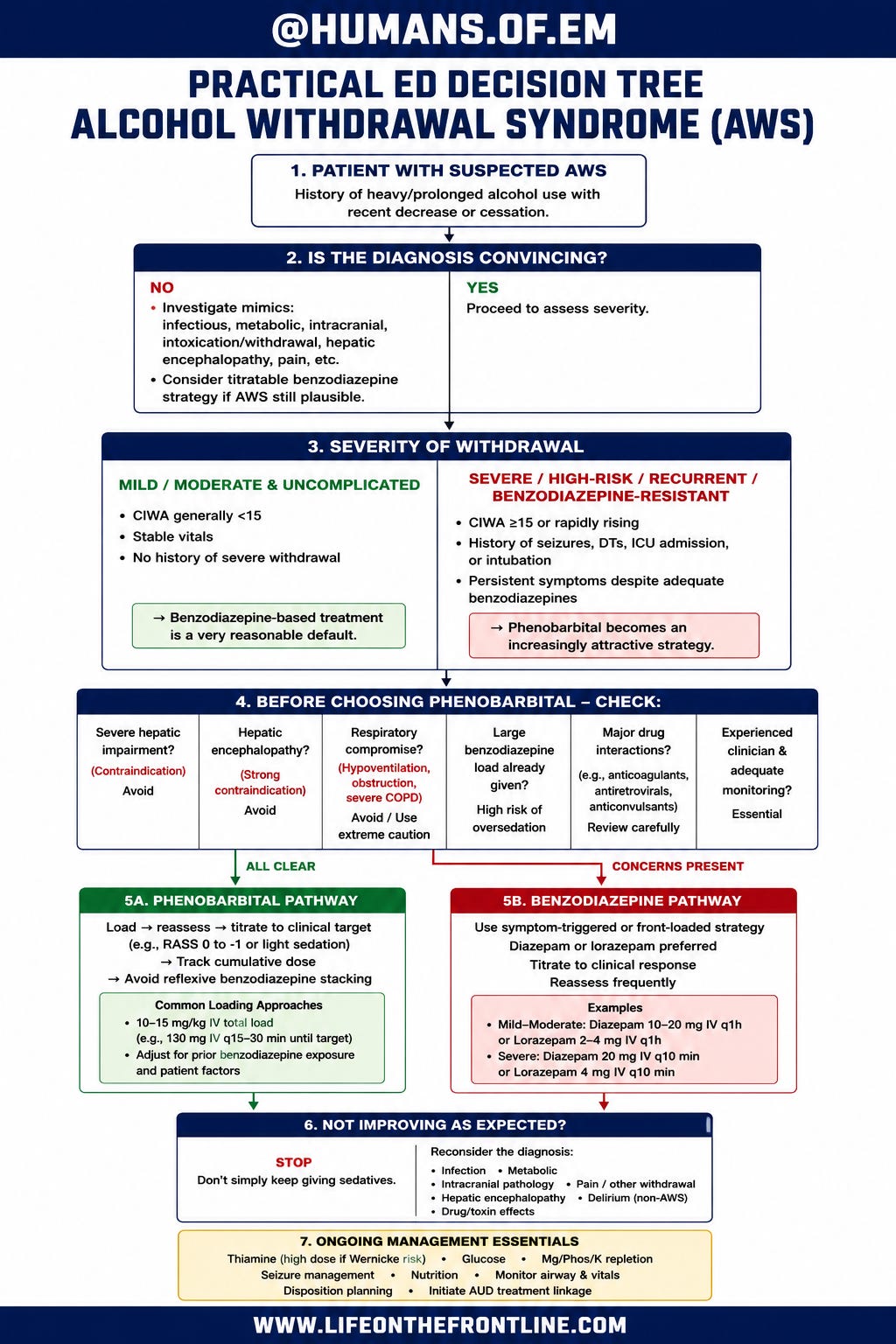
My practical ED decision tree
8. If using benzodiazepines: front-load, don’t drip-feed endlessly
The Annals review emphasizes early, adequate treatment.For mild–moderate withdrawal, its practical algorithm describes:
Diazepam 10–20 mg IV/PO every hour until stabilized
or
Lorazepam 2–4 mg IV/PO every hour
followed by symptom-triggered maintenance therapy.
For severe withdrawal, it describes more aggressive IV titration, including diazepam 20 mg IV every 10 minutes or lorazepam 4 mg IV every 10 minutes, with higher doses potentially required when symptoms do not rapidly improve.
EMCrit favors IV diazepam because of its rapid onset and longer duration, reducing the risk of repeated doses being given before the previous dose has taken effect.
The bedside lesson
If the patient is truly withdrawing: Under-treatment is a problem.
Repeated tiny doses that never adequately control the syndrome can result in escalating requirements and delayed control.
9. A practical phenobarbital approach
The 2024 Annals review describes:
Initial loading
Phenobarbital 5–10 mg/kg IV over ~30 min
Additional doses can be given, with a maximum of 15 mg/kg in its algorithm. If weight-based loading is delayed or the patient has already received benzodiazepines:
130–260 mg IV every 15–30 min is described as an incremental strategy.
EMCrit describes another titration strategy using 130 mg IV approximately every 30 minutes, targeting a RASS of 0 to +1.
Why the difference?
The exact dosing strategy is protocol-dependent.
The shared principle is:
Give enough drug to control the withdrawal, reassess frequently, and keep track of the cumulative dose.
10. Don’t blindly stack phenobarbital + benzodiazepines
This is one of the most important safety points.
Phenobarbital and benzodiazepines have synergistic sedative effects. EMCrit specifically cautions against simultaneously titrating both upward and recommends keeping track of the cumulative phenobarbital exposure.
So if you’ve decided:
“This patient is going down the phenobarbital pathway.”
then avoid reflexively continuing to pile on benzodiazepines.
And if a patient has already received substantial benzodiazepine doses, recognize that the phenobarbital loading strategy may need modification.
11. What if the patient remains agitated?
This is where clinicians can get into trouble.
Agitation ≠ automatically more withdrawal.
If the patient has received an adequate amount of GABAergic therapy but remains agitated, reassess the diagnosis.
Look again for:
Sepsis
Hypoglycemia
Head injury
Hepatic encephalopathy
Drug toxicity
Pain
Urinary retention
Hypoxia
Metabolic abnormalities
ICU/non-alcohol-related delirium
EMCrit specifically describes a transition to non-alcohol-related delirium, where continued escalation of benzodiazepines or phenobarbital can worsen the situation.
This is a powerful bedside rule:
If the treatment isn’t working, don’t just increase the treatment. Reconsider the diagnosis.
14. Withdrawal seizures are different from “seizure in an alcoholic”
Alcohol withdrawal seizures are usually generalized tonic-clonic, brief and self-limited, and typically occur within 12–48 hours of cessation. But don’t assume every seizure in a patient with alcohol use is a withdrawal seizure.
Think about:
Trauma/intracranial hemorrhage
Metabolic abnormalities
Epilepsy
Infection
Other toxicologic causes
SESA syndrome
EMCrit notes that withdrawal seizures tend to recur if untreated and recommends treatment directed at the withdrawal physiology rather than relying on traditional antiseizure medications such as phenytoin.
Phenobarbital is particularly attractive here because the same drug can address both withdrawal physiology and seizure activity.
13. Adjuncts are adjuncts
This is where many protocols go wrong.
Dexmedetomidine
Useful for controlling persistent sympathetic activation and providing titratable sedation, particularly when large doses of benzodiazepines/barbiturates are already being used. But it does not replace definitive withdrawal therapy.
The Annals review notes reduced benzodiazepine requirements with dexmedetomidine but also an increased risk of bradycardia and hypotension.
EMCrit similarly emphasizes that alpha-2 agonists and antipsychotics should not be used as the primary treatment for withdrawal because they do not address the underlying GABA/glutamate imbalance or provide adequate antiseizure therapy.
Ketamine
Ketamine is an NMDA antagonist and therefore has a mechanistically attractive role in benzodiazepine-refractory withdrawal. The 2024 review describes limited evidence suggesting reduced benzodiazepine requirements and potentially lower intubation rates/ICU length of stay.
For the patient who is already intubated with severe refractory withdrawal, either ketamine or propofol may be reasonable.
14. Don’t forget the “boring” part of the resuscitation
Alcohol withdrawal is rarely just a neurotransmitter problem. These patients are frequently malnourished and electrolyte depleted.
Think:
Glucose
Patients with alcoholism and cirrhosis may have impaired glycogen reserves and are vulnerable to hypoglycemia.
Magnesium
Total-body magnesium deficiency can be substantial and may require repeated replacement.
Phosphate
Consider phosphate depletion and refeeding syndrome, particularly in severely malnourished patients.
Thiamine
If Wernicke encephalopathy is possible, EMCrit recommends high-dose IV thiamine 500 mg every 8 hours; in patients without altered mental status, it describes 100 mg IV daily for prevention.
The practical message:
Treat the patient, not just the withdrawal score.
15. What should the ED disposition look like?
The decision isn’t simply:
CIWA high → admit
or
CIWA low → discharge.
Think about:
Severity and trajectory
History of seizures/DT
PAWSS/high-risk history
Comorbid illness
Electrolyte abnormalities
Ability to maintain oral intake
Social support
Reliability of follow-up
Risk of recurrent withdrawal
Need for repeated IV medication
Need for monitoring/airway support
Patients with severe or complicated withdrawal generally require monitored settings, while selected patients with mild disease and reliable follow-up may be candidates for outpatient management.
The 2024 review describes a short course of diazepam as possible bridging therapy in carefully selected patients only when an appropriately trained caregiver can monitor and administer it, reinforcing that discharge is a structured clinical decision rather than simply a low score.
16. And don’t discharge without addressing the underlying AUD
One of the missed opportunities in the ED is treating the withdrawal and forgetting the disease that caused it. Alcohol withdrawal is an acute complication of alcohol use disorder.
EMCrit describes naltrexone and acamprosate as the principal pharmacologic options, with medication ideally combined with psychosocial interventions. This doesn’t mean every ED patient needs medication started immediately. But every ED encounter should create an opportunity for:
Withdrawal treatment → brief intervention → treatment linkage → AUD pharmacotherapy when appropriate.
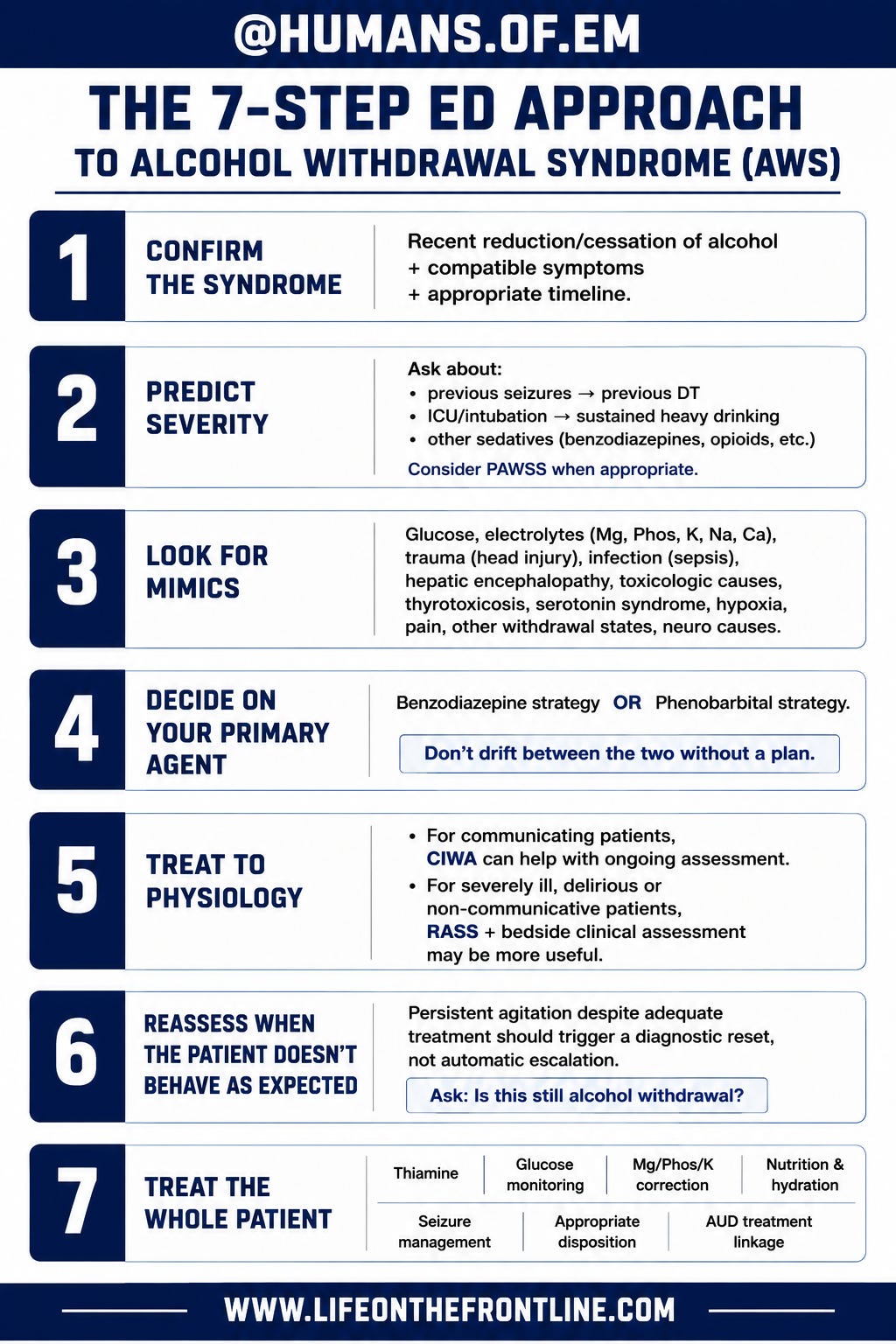
The bedside algorithm I would actually use
The take-home message
Alcohol withdrawal is often taught as:
“Calculate CIWA → give benzodiazepine → repeat.”
But the bedside reality is more nuanced.
Diagnose clinically.
Predict risk early.
Understand the timeline.
Choose your primary sedative strategy deliberately.
Treat the underlying neurophysiology rather than chasing agitation.
Use CIWA/RASS as tools—not as substitutes for clinical judgment.
And when treatment stops making sense, reconsider the diagnosis.
That last step may be the most important one.
‘For educational purposes only; local protocols, monitoring capability, comorbidities, and specialist input should guide actual patient care.’

References
Farkas J. Alcohol withdrawal & alcohol use disorder. EMCrit/Internet Book of Critical Care. 2023.
Gottlieb M, Chien N, Long B. Managing Alcohol Withdrawal Syndrome. Ann Emerg Med. 2024;84:29–39. doi:10.1016/j.annemergmed.2024.02.016.